Home Blog Page 5

What Is ONE Championship? A Simple Guide to ONE Championship

0
kobbydagan/depositphotos.com

If you are not familiar with ONE Championship (ONE FC) already, you may wonder how good this MMA promotion is. Does it put on the same quality shows as other promotions? Is it better than the UFC? Well, you are about to discover all the answers in this article.

Based in Singapore, ONE FC is the largest and most popular MMA promotion in Asia and is renowned for its distinct rules and event format, which sets it apart from the UFC. ONE FC events feature various combat sports besides MMA, such as Muay Thai, kickboxing, and submission grappling.

Let’s further explore the history of the ONE FC promotion and how it was put together. We will also go deep into the rules, explain how it differs from the UFC, and bring you closer to how this Asian promotion operates.

How ONE Championship Started

After the collapse of the legendary Japanese “PRIDE FC” in 2007, Asia was left without a major MMA organization. There were some attempts to get back to the glory days with the “DREAM” promotion, for instance. But overall, the MMA scene in Asia was in disarray. This situation presented a significant opportunity for an individual with a substantial investment to enter the market and swiftly gain dominance.

This is why Chatri Sityodtong, a former Thai boxer and entrepreneur, decided to launch a Pan-Asian promotion to unite the continent. His mission was to create an MMA promotion that would focus on all the Asian regions and promote the sport of MMA in their own way. His plan was to grow the biggest Asian promotion ever and later expand globally. He put the company headquarters in Singapore, and the first event was held in September 2011.

ONE FC Founder Chatri Sityodtong
Photo Credit: Sadoka74

ONE FC management instantly started investing a lot of resources into promoting their shows through different media channels. But they did it in a different way. ONE FC has chosen to approach event promotion differently from Western promotions, which tend to focus on sensational entertainment. ONE FC made a conscious decision to promote the sport by highlighting important values such as respect, honor, discipline, courage, and other qualities that define a true martial artist.

That’s why fans will never see fighters insulting each other in press conferences, other media events, or fighting during the weigh-ins. Not to mention, insulting each other’s religion, nation, or family is strictly forbidden.

The company quickly established itself in the Asian market thanks to its distinctive event format, regulations, and competitive pay. This drew in several skilled fighters from the U.S. and UFC, which bolstered its roster and credibility even further.

And once it got established as the leader in Asia, ONE FC began organizing more and more events in the U.S. with the mission to become a global brand.

What Makes ONE FC Events So Unique?

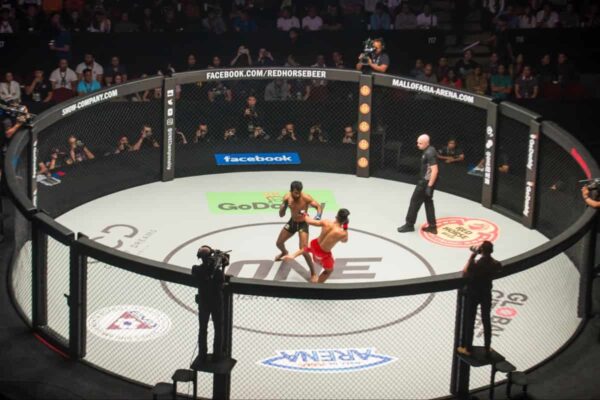
ONE FC is a unique organization because it promotes multiple combat sports. Apart from MMA matches, there are kickboxing, Muay Thai bouts, and submission grappling matches. And all of these combat sports take place inside the MMA steel cage. Muay Thai fighters actually compete wearing 4oz open-fingered gloves instead of full-padded boxing gloves.

The event format is also different than in most other promotions. A single ONE FC event often includes different sports on the same card. There can be 3 Muay Thai Fights, 3 Kickboxing fights, and 6 MMA fights on the same card. Despite being unconventional and possibly confusing, this approach of having multiple combat sports on the same card is actually highly effective and popular among fans.

For example, switching between different styles of combat sports adds a new dynamic to the event. Things rarely get boring, and fans always get to see something new and unique. ONE FC’s approach allows all fighters from different sports to receive equal media attention, thereby promoting all sports equally.

Muay Thai matches, in particular, are very exciting and are slowly becoming a core event of the promotion. Because fighters compete wearing 4oz MMA gloves, each match is packed with action, knockdowns, and highlight reel knockouts. It forces each Thai boxer to adapt to new circumstances as they can no longer use big gloves to block punches and kicks and must come up with different strategies.

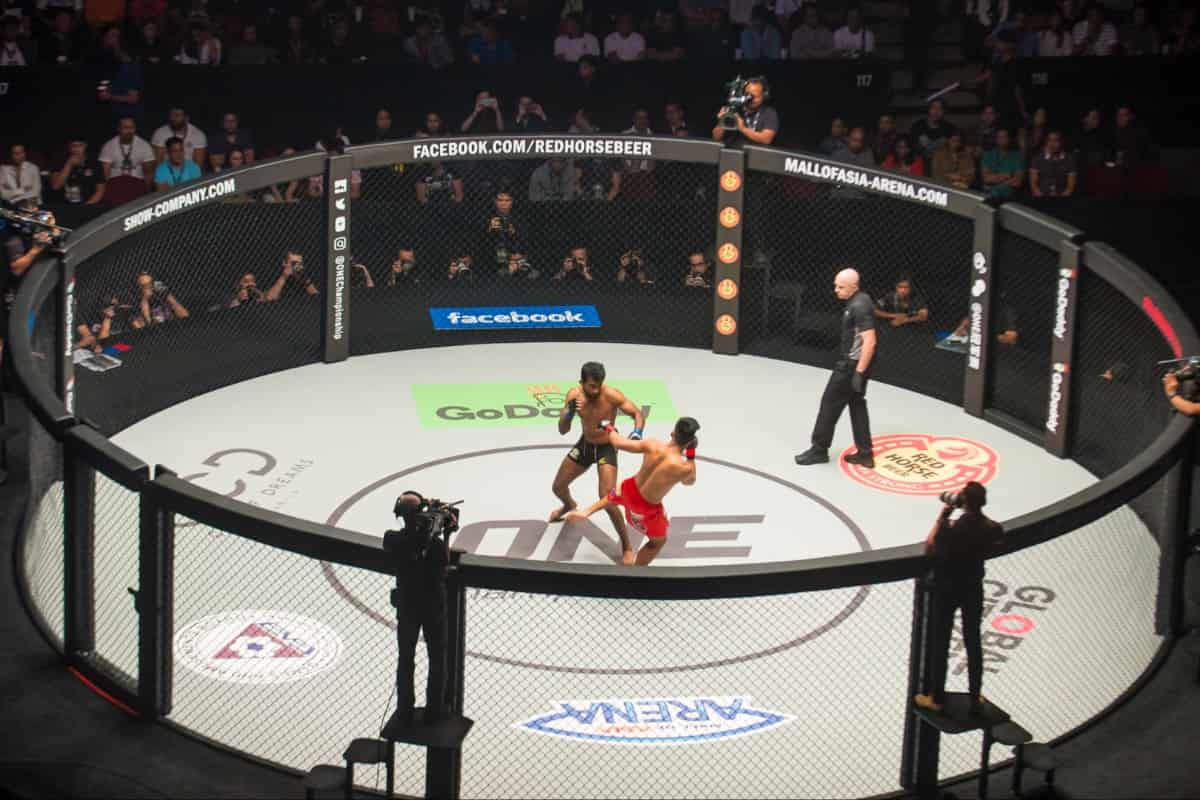
ONE FC event showcases different types of combat sports

ONE Championship Rules Explained

ONE uses the famous “Global Martial Arts Rule Set” which differs a lot in every way and makes the matches even more exciting for many people.

General rules

  • Gear — includes 4oz open-fingered gloves, hand wraps, mouthguard, groin cup, and shorts.
  • Match duration — most matches include 3–5 minute rounds, with a 1–minute break between each round. Championship fights are 5–5 minute rounds.
  • Fighting area — steel cage and a five-roped ring.

Scoring

Each ONE Championship event includes three judges sitting beside the cage and scoring the fight following strict criteria. Unlike other combat rule sets, ONE FC judges score the entire match instead of round by round. This means that a fighter who loses the first and second rounds can dominate in the third and take home the decision victory.

ONE FC judges evaluate the match using the following criteria, in this order:

  • Which fighter was closer to finishing the match with submission or knockout
  • Which fighter did more accumulated or immediate damage
  • Who landed a better striking combination and showcased cage generalship through cage control and ground positioning
  • Landed and defended takedowns
  • Which fighter was more aggressive

Legal/Illegal strikes

According to the Global Rule Set, fighters are allowed to strike with punches, kicks, knees, and elbows to the head and body. In contrast with other rules, fighters are also allowed to strike the grounded opponent with a knee to the head. Demetrius Johnson, a former UFC champion, famously lost the fight after Adriano Moraes knocked him out in this manner.

In terms of illegal strikes, fighters are not allowed to strike the groin area, throat, trachea, back of the head, back, or spine. In addition, fighters are not allowed to head butt, pull hair, or gouge eyes. Previously, a highly controversial leg strike to the downed opponent, also known as a “soccer kick” in MMA, was allowed. However, this technique was banned in 2016, when the promotion began expanding globally.

Weight classes

The promotion uses ten different weight classes, out of which 9 are for male fighters and 4 are for female fighters.

Weight ClassMinimum (lb)Maximum (lb)Gender
Heavyweight225265Male
Light Heavyweight205225Male
Middleweight185205Male
Welterweight170185Male
Lightweight155170Male
Featherweight145155Male
Bantamweight135145Male / Female
Flyweight125135Male / Female
Strawweight115125Male / Female
Atomweight105115Female
sourced from ONE FC

ONE Championship Weight Cutting Rule Explained

ONE FC has a unique weight-cutting policy that sets it apart from other MMA promotions. Unlike fighters in other organizations, ONE FC fighters are prohibited from dehydrating their bodies to cut massive weight in the week leading up to a fight. This rule ensures that they compete at a weight closer to their natural state and prevents any medical issues that may arise from cutting weight quickly.

So what prompted ONE FC to take a different approach to its weight-cutting policy? — In 2015, Chinese fighter Yang Jian Bing tragically passed away due to medical complications resulting from trying to lose weight rapidly by shedding water weight.

In order to avoid another tragedy, ONE FC has implemented a complete ban on weight-cutting through dehydration. They have also introduced a “hydration test” where officials measure the urine gravity of each fighter during fight week to ensure that dehydration is not being used as a weight loss method. Every fighter must pass the hydration test in order to be eligible to fight.

During event week, all athletes will participate in a combined weigh-in and hydration test. Hydration will be checked through a urine specific gravity test in which every athlete will submit a urine sample to a medical technician.

Under the guidance of ONE’s doctor, the technician and doctor will test the sample to ensure the athlete is hydrated with a urine specific gravity value of 1.025 or below. If the athlete passes this test, he or she can weigh-in. The athlete’s weight must be within the restrictions of the contracted weight class or catchweight limit.

ONE FC hydration test policy

As a result, this forces fighters to lose weight by following a strict diet program to reach the required weight, not by flushing water out of their system, which makes the entire weight-cutting process much safer. They would cut their intake of carbs, fats, and other nutrients but must continue to drink fluids.

After the fight, another weight check is carried out to ensure that fighters did not manipulate the hydration test in order to gain an unfair size advantage over their opponent. The post-fight weight cannot exceed 5% higher than the weight class or catchweight limit. If a fighter commits this offense, they will be held accountable under the following rules:

  • First offense — receives a warning.
  • Second offense — fighters will forfeit 25% of their fight purse.
  • Third offense — fighters will forfeit 50% of their fight purse and be immediately disqualified from competing in that specific weight class. They would need to move up in weight and compete in a higher weight class.
ONE FC Hydration Test & Weigh-In
RELATED:
How Do UFC Fighters Cut Weight So Rapidly?

Do ONE FC Fighters Get PED Tested?

Starting from August 2022, ONE FC has teamed up with the International Doping Tests & Management Agency to enhance the testing of Performance Enhancing Drugs (PEDs) and promote a cleaner sport. The deal gives the agency the freedom to handle all the testing independently and test the fighters whenever they want on all illegal substances.

RELATED:
Do UFC Fighters Get Drug Tested?

How Good Are ONE FC Fighters Compared to UFC?

The overall strength of ONE Championship roster is not quite there yet to match the strength of the UFC. However, this doesn’t mean that the athletes are less skilled by any means. In fact, ONE is considered a home to highly-talented fighters, not just from Asia but all around the world, and many of these fighters can successfully transition to the UFC and enjoy big success.

Of course, the “ONE vs. UFC: Champion versus Champion” type of event will most likely end with UFC champions winning most of the matches. No one denies that UFC fighters, especially champions and top 5 contenders, have better chances of winning. But, ONE fighters do not fall behind much in terms of skill, and this has been proven on multiple occasions.

For example, a couple of high-level UFC fighters and former champions like Demetrious Johnson, Eddie Alvarez, and Sage Northcut have moved to ONE. Interestingly, they all have suffered severe losses against relatively “unknown” fighters to most UFC fans.

Overall, the UFC champions are considered legitimate world MMA champions. Their road toward winning the title is much longer and more challenging than in other promotions. Each UFC division includes over 50 very skilled fighters, with the majority of them being the best the world has to offer, and beating the best ones makes you the best in the world.

RECOMMENDED READING:
Are UFC Fighters The Best In The World? FAQ

Key Difference Between ONE FC and UFC

The biggest difference is the rule set and scoring. ONE Championship uses the “Global Martial Arts Rule Set,” while the UFC uses the “Unified Rules of MMA.” These two rule sets are very similar regarding general rules, such as the number of rounds and gear. However, the key difference that stands out the most is in the legal/illegal strikes.

The following pinpoints the key differences between the two promotions:

Knees to the grounded opponent

ONE Championship allows its fighters to strike the grounded opponent with a knee to the head. It doesn’t matter if the opponent is touching the ground with both knees and hands; fighters can blast them with a knee.

In the UFC, however, you are not allowed to knee strike the grounded opponent’s head as long as one of the opponent’s knees or hands is touching the ground. This happened when Petr Yan was disqualified due to an illegal knee strike at UFC 259.

Scoring

The second big difference is the scoring. Both promotions have three judges sitting beside the cage, but how they score the match differs. In ONE, they score the match in its entirety.

In the UFC, matches are scored round by round. Following each round, the official collects scorecards from every judge, adds them up after 3 or 5 rounds, and announces the result.

Weight cutting

The third big difference is weight cutting. ONE Championship forbids weight cutting by dehydration. This means fighters can no longer lose excess weight, which makes the entire process safer and forces them to compete close to their natural weight.

UFC allows weight cutting by dehydration, and fighters can lose close to 15% of their body weight in the week leading up to a fight.

The way the fight is promoted

It is important to note that ONE and UFC have distinct approaches to promoting their respective sports. This can largely be attributed to the cultural differences between the Eastern and Western worlds, as what attracts audiences and drives pay-per-view sales differs between these areas.

ONE Championship upholds traditional and ethical martial arts values that require fighters to conduct themselves as true martial artists and display respect and honor towards their opponents. Instances of fighters crossing the line and engaging in insults or failing to shake hands after a fight are rare.

The UFC has a unique approach where their fighters can promote their fights however they choose. They can opt to engage in smack-talking via social media or show respect by refraining from it, and it’s entirely their decision.

Final Thoughts: How Popular Is ONE Championship?

ONE Championship has established itself as one of the best MMA organizations globally and emerged as a formidable competitor to the behemoth UFC. The numbers confirm this, as the 2022 Nielsen report showed ONE FC secured the top five spot in global TV viewerships with 406 million, while the UFC ranked at number nine with 259 million.

Next, ONE’s videos published on different platforms generated 7 billion organic views, much higher than UFC’s 4.3 billion views.

If you enjoy combat sports, specifically MMA, it’s worth exploring ONE Championship. Although it may not have the same level of global recognition as the UFC, ONE FC events provide high-quality production and feature many underdog MMA stars who are determined to become the best fighter in the world. You are guaranteed entertainment. Be sure to experience the excitement.
Are UFC Fighters Allowed to Bet on Themselves? FAQ

0
nikiteev/Depositphotos.com

Disclaimer: The following information is sourced from various credible media reports. We do our best to get the most accurate information.

Betting on combat sports, particularly the UFC, has become increasingly popular in recent years, both for fans as well as the fighters themselves. It’s not a surprise either – it captivates enthusiasts with the thrill of predicting fight outcomes and potentially reaping financial rewards.

However, betting on UFC fights also carries lots of questions and uncertainties. We’ll address the most frequently asked questions surrounding UFC betting, shedding light on topics such as the legality of betting on UFC fights, the new gambling policy implemented by the UFC as well as whether fighters can bet on fights today, potential consequences for fighters caught betting, and various other nuances.

Are UFC Fighters Allowed to Bet on UFC fights?

As of October 2022, UFC fighters are not allowed to bet on UFC fights, including their own. The policy change was implemented to maintain the integrity of the sport, prevent misuse of insider information, and comply with regulations set by sports betting industry regulators in the U.S.

Prior to this policy change, betting was actually allowed and was not only widespread, but openly promoted by the fighters themselves who used to tweet about their picks and winning bets for example.

What Is the New Gambling Policy in the UFC?

The most recent UFC conduct policy prohibits UFC fighters and their teams from betting on any UFC fights directly or through a third party.

Here is an excerpt of the memo from Hunter Campbell, the chief business officer of the UFC, that was sent out to the promotion’s roster and athlete managers:

“… In order to assist our athletes in understanding their obligations under the laws of the majority of states in which sports betting is permitted, and in further support of these integrity measures, UFC has incorporated a wagering prohibition into the UFC Athlete Conduct Policy expressly prohibiting athletes from wagering on any UFC match.”

Hunter Campbell, UFC Chief Business Officer

Hunter Campbell further explained and cautioned athletes that certain states not only prohibit them from participating in sports betting but also extend this rule to their training teams, family members, and individuals who possess inside information about the athletes and their events. Violation of these restrictions may lead to criminal charges, per Campbell.

Did the James Krause Incident Influence the UFC’s Gambling Policy?

UFC chief business officer Hunter Campbell’s memo indicates that no particular incident sparked the new policy change. He claimed the new gambling policy change was made “in light of clear direction that we have received from regulators responsible for the regulated sports betting industry in the United States.”

However, many people believe that a very controversial incident involving James Krause, a well-known MMA coach and former UFC fighter, triggered the UFC to rapidly overhaul its gambling policy in October 2022. Aside from coaching fighters, Krause regularly placed bets on UFC fights.

In the lead-up to UFC Fight Night 214 in November 2022, there was suspicious line movement among sportsbooks for the bout between Shayilan Nuerdanbieke and Krause’s fighter, Darrick Minner. In the final hours before the fight, the odds for a Nuerdanbieke win by knockout/TKO experienced a drastic shift from -220 to -420. This sudden change was primarily attributed to an influx of bets being placed on Nuerdanbieke to win by that method.

The fight ended in a first-round TKO victory for Nuerdanbieke after a leg kick hurt and injured Minner before some elbows finished the job. It was later revealed that Minner had been carrying an undisclosed knee injury into the fight, which likely played a significant role in his early defeat.

Krause’s presence in Minner’s corner raised suspicions about potential inside information and the impact it may have had on the fight’s outcome. In response, U.S. Integrity initiated an investigation, prompting the UFC to conduct a comprehensive review of the betting activity surrounding the fight.

Subsequently, Krause faced suspension and had his license revoked by the Nevada Athletic Commission. New Jersey also prohibited fights involving Krause, and the Canadian province of Ontario banned all UFC-related betting.

The UFC implemented measures to address the situation, including the announcement that fighters coached or training in Krause’s gym would not be permitted to compete in UFC events. As a result of this, many fighters had to cut ties with Krause, including UFC flyweight champion Brandon Moreno.

Minner was released from the organization, and reports suggested that the FBI became involved in the matter. UFC president Dana White warned his fighters not to get involved in such activities or risk going to prison.

The UFC would later announce U.S. Integrity as its official partner to monitor fight betting activity and all these changes resulted in Ontario later reinstating gambling on UFC fights in January 2023.

What Happens If UFC Fighters Get Caught Betting on UFC Fights?

The recent UFC betting scandal involving James Krause highlights the severe consequences that UFC fighters may face if caught betting on UFC fights. That is, UFC fighters could risk having their contract terminated, having their state license suspended, and even facing criminal charges as potential consequences.

RECOMMENDED READING:
What is Banned/Illegal in the UFC?

Can UFC Fighters Bet on Non-UFC MMA fights?

The new gambling policy of the UFC does not forbid its fighters from betting on other MMA promotions such as Bellator, ONE Championship, or the Professional Fighters League (PFL).

“The fighters aren’t prohibited from betting on any other sports or from wagering on other MMA promotions.”

UFC Athlete Conduct Policy updated to prohibit fighters from betting on UFC matches. (n.d.). Sports.yahoo.com.

As per the memo from Hunter Campbell, the policy only prohibits “athletes from wagering on any UFC match.” Campbell also wrote that fighters are still allowed to have sports betting companies as their sponsors and will help fighters determine the restrictions in their home states.

Can I Legally Bet on UFC fights?

Yes, it is completely legal to bet on UFC fights in many jurisdictions and states, provided you do so through a licensed bookmaker or betting platform. The exact laws and regulations vary by country and even by state or province within countries, so it’s best to check the specific laws and regulations where you are located.

What Happens If You Bet on a UFC Fight and It Is a Draw?

In most cases, if a UFC fight ends in a draw, bets on either fighter to win are usually refunded as the bet is void. However, the specific rules depend on the betting platform and the type of bet placed.

For example, if a draw option is offered as a potential bet, any bet you place on an opponent is effectively settled as a loss as you can choose to bet on the fight ending as a draw.

What Is the Difference Between Minus and Plus Spread?

In betting terms, an easy way to remember what the “minus” symbol indicates is that it’s the favorite and shows how much you need to wager to win a certain amount. The “plus” symbol indicates the underdog and shows how much you could win if you wager a certain amount.

For example, a -200 favorite means you would need to bet $200 to win $100, while a +200 underdog means you would win $200 if you bet $100.

When it comes to the point spread, this is a figure set by oddsmakers to provide a numerical advantage or disadvantage based on the margin of victory or defeat for a given team.

The team that is the favorite — or most likely to win — will be given a negative point spread, meaning they would need to win by more than that number of points. The “underdog” — or least likely to win — is given a positive point spread, meaning they could lose by up to that many points, or win the game, and still cover the spread.

Speaking of covering the spread, this is a betting term which means a team or player has achieved the desired result of the bettor. Another term you may have heard is betting the spread — this simply means placing a bet on whether a team or player will perform better or worse than the point spread.

Why Is Kickboxing Popular in the Netherlands? A Closer Look

0
Photo by Combathistory

Kickboxing has been around since the 1950s and is spread worldwide. However, one particular country that most people least expect is widely recognized as the Mecca of kickboxing, and that is the Netherlands. But how? Why is kickboxing so popular in the Netherlands, where it’s not known to be culturally rooted in martial arts?

Netherlands was the first country to adopt modern kickboxing from Japan. It quickly established global dominance and became home to the best training facilities, coaches, and world champions, all of whom played very influential roles in making it a very popular sport in the Netherlands.

That was a quick overview of why kickboxing is very popular in the Netherlands. But don’t stop here – keep reading to discover more about the Dutch kickboxing style, its rich history, and the legendary fighters who played significant roles in making it popular.

What Is the History of Dutch Kickboxing?

To understand how kickboxing became a major sport and popular in the Netherlands, it’s crucial to first understand the birth of kickboxing in Japan. I’ll explain this in two parts so it’s easier for you to understand.

Part 1: How kickboxing first started

The story of Dutch kickboxing actually began in Japan. Although similar styles like Muay Thai have been around for centuries, the term kickboxing and the sport itself emerged in the 1950s in Japan. This combat sport was developed as a mix of karate, boxing, and Thai boxing techniques. Kicks and knees came from Kyokushin and Muay Thai, while footwork and punches are from Western boxing.

During the 1950s, there was a big rivalry between Kyokushin karate and Muay Thai fighters. Fighters from both arts have fought each other for years under customized rules. So naturally, kickboxing emerged as a neutral ground where fighters from both arts could fight each other under mixed rules that do not favor either style. These events became really popular in the 1960s and were primarily held in the city of Osaka.

The man who deserves a lot of credit for establishing modern kickboxing is Tatsuo Yamada. He was a skilled karateka and the founder of “Nihon Kempo Karate-do.” Crucially, Yamada was the first karateka to start training in Muay Thai. And he later started mixing techniques and rules from both styles to develop what he called “karate-boxing.”

Later on, the boxing promoter Osamu Noguchi would further upgrade this style. He named it “kickboxing,” founded the first Kickboxing Association, and organized many events.

Part 2: How kickboxing spread in the Netherlands

During the 1960s, there was a kickboxing boom across Japan, with gyms opening up in every town. One of the most famous is the original “Mejiro Gym” in Mejiro, Tokyo, and this is the place where the Dutch martial artist Jan Plas came to learn this new style.

Jan Plas (pioneer of Dutch kickboxing)
Photo by Nanorsuaq

After a few years, Plas returned to his native Netherlands to open the European Mejiro School. And this school is considered the birthplace of the Dutch kickboxing style. Together with his friend Thom Harinck, Plas founded the Dutch Kickboxing Association in 1976. The two would produce many kickboxing world champions that would dominate the competition in the following decades.

Rare footage of Jan Plas teaching kickboxing at Mejiro Gym
RECOMMENDED READING:
What Is ISKA Kickboxing?

Why Is Kickboxing So Popular In the Netherlands?

Back in the 1970s, the Netherlands was the first European country to adopt kickboxing, thanks to Jan Plas, who brought it from Japan. As a result, the Dutch were the ones who developed and popularized the sport from scratch.

As kickboxing gained popularity in other nations, it led to a surge in global competition, such as in K-1 kickboxing. Dutch gyms and coaches emerged as dominant winning forces in these competitions, consistently staying at the top and proving their superiority.

With Dutch kickboxers dominating the world kickboxing stage, Dutch society began recognizing their athletes as cultural heroes and embracing them as role models, which made kickboxing extremely popular in the Netherlands, to the point where it became an unofficial national sport.

As a result, almost every town in the Netherlands has at least one kickboxing school, which is full of talented up-and-coming young fighters and established fighters. And there are also large gyms where people from other countries can come and train under the best coaches.

Aspiring kickboxers from around the world often visit the Netherlands to train with skilled coaches and fighters and improve their skills. This is because the Dutch have a reputation for being excellent at kickboxing. Kickboxing in the Netherlands is similar to the popularity of wrestling in Dagestan. In other words, kickboxing is a big part of the Netherlands’ sports history, culture, and lifestyle, just like how Taekwondo is a popular sport deeply rooted in Korean culture.

On a side note, kickboxing is not the most popular sport in the Netherlands. This title belongs to soccer, which is generally the most popular sport in Europe by a large margin.

What Is the Dutch Style of Kickboxing?

The Dutch style of kickboxing emerged at the famous Meijiro Gym in Amsterdam. It is rooted in three different styles mixed into one: Kyokushin karate, boxing, and Muay Thai. The emphasis is on boxing combos mixed with fast footwork, kicks, forward pressure, and aggressiveness. Dutch-style fighters compete at a high pace, have a high output of strikes, and never throw one shot at a time.

You can easily spot a fighter trained in the Dutch style by watching kickboxing fights. They rely on their hands and hitting their opponents with advanced boxing combos. They also utilize footwork and head movement to angle out to evade the attack and out-position the opponent to create an opening for a counterattack. As soon as they see an opening, they blast their opponent with hard low/high kicks from all angles and ranges.

When you see a fighter throwing 5–6 fast punches and finishing the combo with a kick, that’s Dutch style.

They are masters at using advanced boxing combos to set up the kicks and knock their opponent out or overwhelm them with a high level of technique. They sometimes use Thai boxing techniques such as front kicks to keep their range and land body shots or jumping knees when the opponent is backed against the ropes. Some of the masters of this specific type of attack were K-1 legends Remy Bonjasky and Andy Souwer.

Training is also different than in other kickboxing styles, as Dutch gyms put a lot of emphasis on hard sparring and drills. Some Dutch kickboxing schools have quite a bad reputation when it comes to injuries and gym fights.

But according to their philosophy, intense sparring is the best way to mentally and physically prepare for combat. Strength and conditioning workouts are also brutal, as you need top cardio to maintain such a high output of strikes and pace.

Dutch kickboxing rules

Dutch kickboxing style is primarily designed to be in line with K-1 and Japanese kickboxing rule sets. Following is a detailed explanation of the key rules.

Legal strikes/Illegal — fighters can strike with kicks, punches, and knees above and below the waist. They can use leg kicks, body kicks, and head kicks, as well as punches to the head and body and knees. The use of elbows is not allowed, and there is limited clinch work.

Sweeps are allowed but won’t bring you any points or give you an advantage on the scorecards, so fighters rarely use them. Takedowns or striking the grounded opponent are strictly forbidden.

Match duration — matches can have between 3 and 5 rounds, depending on the importance of the match. Each round is 3 minutes long, and there is one minute of rest between each round. If a match ends in a draw, there is one extra round to determine the winner.

Gear — Dutch kickboxers compete wearing full-padded boxing gloves, hand wraps, mouthguards, and groin guards. They wear kickboxing shorts or leggings, as Andy Souwer did throughout his career.

Is K-1 kickboxing the same as Dutch kickboxing?

No, K-1 is not the same as Dutch Kickboxing, and here is a detailed explanation.

K-1 is a kickboxing promotion developed in Japan in 1993. The founder of this organization was Kazuyoshi Ishii, a master of Seidokaikan karate.

K-1 combines elements of various striking martial arts such as Muay Thai, boxing, karate, and kung fu. It emerged as a platform where strikers from different arts could fight against each other. And, of course, determine which striking style is the best.

On the other hand, Dutch Kickboxing is a specific style that emerged in the Netherlands. It is known for its emphasis on boxing techniques, high output and pace, pressure, and kicks and knees. Right from the opening bell, Dutch fighters would step on the gas and put pressure on their opponent without taking a step back.

Dutch kickboxers all have great cardio, which enables them to maintain a high output of strikes throughout the fight consistently, and it is really hard to keep up with them. It is a very technical style widely regarded as one of the best styles of kickboxing.

In summary, while K-1 is a sports organization, Dutch kickboxing is a specific fighting style.

RECOMMENDED READING:
What Is American Kickboxing?

Who Are the Best Dutch Kickboxers of All Time?

Dozens of kickboxing world champions have come out of the Netherlands, with each one leaving a significant mark on the sport. Following is a list of the five most popular ones.

Rob Kaman — is one of the pioneers of Dutch kickboxing and a fighter who deserves a lot of credit for popularizing the sport. He is a 9-time kickboxing world champion known for exceptional technique and vicious low-kicks. The fans called him “Mr. Low-Kick” because he used this specific move to finish many of his matches. He would destroy the movement of his opponents with perfectly placed leg kicks before putting them out with punches or more kicks.

Peter Aerts — is a Dutch kickboxing legend who became famous while fighting under the K-1 banner. In the 90s, he won the K-1 World Grand Prix title three times during the promotion’s glory days, earning him the nickname “Mr. K-1”. In his career, he won 108 kickboxing matches, 81 by knockout, which gives you an insight into his brutal style.

Semmy Schilt — is among the most accomplished Dutch martial artists and physically the most intimidating one. But despite being a tall and big fighter, Schilt was very agile and an exceptional technician. Between 2005 and 2010, he managed to win four K-1 World Grand Prix titles and was simply unstoppable. He also fought a lot in MMA, where he was a Pancrase open-weight champion.

Ramon Dekkers — is a Dutch kickboxing legend who became famous for fighting in Thailand. He is known as one of the few European kickboxers who beat Thai boxers in Muay Thai. Most of his opponents in Thailand had a hard time dealing with his unconventional Dutch style of Thai boxing and his prominent violent instincts, making him one of the most feared fighters of his era.

Ernesto Hoost — is widely regarded as the best Dutch kickboxer of all time. In his long career, Hoost won the prestigious K-1 World Grand Prix title four times and fought at the top of the game for 13 years. He is also known as “Mr. Perfect” simply because he was the best in every aspect of the game—an ideal mix of high fighting IQ, superior genetics, and great skills.

RELATED:
Greatest Ever: Top 11 Dutch Kickboxers of All Time – Ranked

Have There Been Any Dutch Kickboxers in MMA/UFC?

Gegard Mousasi — is one of the best strikers in MMA history. He started his career in MMA in 2003. He then switched over to kickboxing in 2004 to compete in Muay Thai and K-1, where he beat the legendary Musashi. In his MMA career, he became Bellator and Dream Middleweight champion and Strikeforce light heavyweight champion. He was also a top UFC contender for many years.

Alistair Overeem — is probably the most famous Dutch kickboxer in MMA/UFC. He became famous for fighting in MMA during the 2000s but would later switch to K-1, where he won the World GP. Later, he signed with the UFC, where he competed for many years at the top of the game. In his MMA career, he won the DREAM and StrikeForce heavyweight titles.

Gokhan Saki — is a K-1 legend and a great representation of Dutch kickboxing. For years, Saki successfully competed at the highest level of K-1 and beat many great fighters, but he never won the title. He fought under the UFC banner twice and scored a performance-of-the-night finish over Henrique da Silva in 2017.

Semmy Schilt — actually started his legendary career in MMA. He fought for the Japanese “Pancrase” promotion, where he was an open-weight champion. Later, he would also compete in PRIDE FC and the UFC but failed to win any titles. After retiring from MMA, he switched to K-1, where he won 4 World GP titles.

Bas Rutten — is a Dutch MMA legend who also started his journey in kickboxing before switching to MMA. He also fought in the “Pancrase” promotion, where he was an open-weight champion. He arrived in the UFC on a 19-fight unbeaten streak and won two more fights in the UFC, winning the UFC heavyweight title, before retiring from competition.

What Are The Most Popular Kickboxing Promotions?

Kickboxing as a combat sport is not as popular as in the 1990s or 2000s; however, it is still more than relevant in combat sports. In modern times, there are a couple of promotions where Dutch style and other kickboxers compete, with GLORY and ONE FC being the most popular.

GLORY kickboxing has been around since 2012, and it is home to the best kickboxers in the world. Their roster is packed with talented Dutch kickboxers, and most of the events are hosted in the Netherlands and other parts of Europe and the US. GLORY competitions attract the very best kickboxers from around the world, but it’s the Dutch-style kickboxers who primarily dominate the competition.

ONE FC is known as the best MMA promotion in Asia. However, this organization also organizes Muay Thai, and Kickboxing matches inside the MMA cage, and these matches are incredibly exciting. Each event mixes MMA, Kickboxing, and Muay Thai fights, making the show dynamic and fun to watch. Many great kickboxers, such as Georgio Petrosyan, Nicky Holzken, Andy Souwer, and many others, have already fought for ONE.

Greatest Ever: Top 11 Dutch Kickboxers of All Time – Ranked

Dutch-style kickboxer Peter Aerts
Credit: via IG @peteraertsofficial

Kickboxing is one of the most popular combat sports that has been around since the 1950s. Though kickboxing is often associated with countries with strong martial arts cultures, such as Japan or Thailand, the nation that actually dominates the sport is the Netherlands.

Along with soccer, kickboxing is a national sport in the Netherlands, and this country alone has produced dozens of kickboxing world champions. For example, during the glory days of the K-1 organization, 15 out of 20 World GP champions were Dutch, and fighters from this nation continued to dominate the sport.

So let’s take a closer look at the best Dutch kickboxers in history, their stories, and their careers.

11. Alistair Overeem

Overeem is primarily known for his accomplishments in mixed martial arts (MMA), where he fought for all the major promotions such as PRIDE, UFC, and StrikeForce. However, he also had a successful kickboxing career where he was able to reach the pinnacle of the sport. In 2010, he transitioned from MMA to kickboxing to win the prestigious K-1 tournament. During this run, he beat some of the legends of the sport, like Badr Hari, Peter Aerts, Gokhan Saki, and Tyron Spong.

Like most Dutch martial artists, Overeem started his journey in kickboxing, where he trained with other famous Dutch fighters. During the late 90s and early 2000s, he would simultaneously fight in both MMA and kickboxing. But after losing a couple of kickboxing fights, he would put all of his focus on MMA for the next decade.

When he switched back to kickboxing, Overeem arrived looking like a monster. Despite weighing over 260 pounds, he was packed with muscles and was very agile for a man that size. Inside the ring, he primarily relied on overwhelming his opponents with size in the clinch and using this position to destroy them with vicious knees. This was a tactic he would later use a lot in the UFC as well.

RECOMMENDED READING:
Is Kickboxing a Sport or a Martial Art?

10. Tyron Spong

Tyrone Spong is one of the most underrated kickboxers in history. He competed in 116 pro matches, out of which he won 107, 73 by knockout, and lost only 7. Though he never won the K-1 title, Spong was able to win the “It’s Showtime” world title and the Glory Slam Tournament.

At the age of 29, he decided to test his skills in professional boxing, where he holds an undefeated record of 13-0. He also fought in MMA, twice for the WSOF promotion, where he scored two wins, and once for Eagle FC, where he lost to Sergei Kharitonov.

9. Badr Hari

Badr Hari is the kickboxing equivalent of Conor McGregor. That is, Badr is a global kickboxing superstar who deserves much credit for popularizing the sport in the 2000s. Even though he never won the K-1 title, mainly thanks to his wild personality, Hari is far more popular than most other kickboxers on this list. In some way, Hari was a total promotional package. He was a troublemaker, outspoken, charming, and a very aggressive fighter.

Inside the ring, Hari would always throw each shot with full power and the goal of knocking his opponent out cold. He never bothered much about being tactical and navigating his way to a decision victory. From the opening bell, he would start swinging power shot after power shot until he or his opponent went down.

Though this style certainly cost him a better career, it’s also the reason why he is so popular.
In his long career, Hari won the K-1 and “It’s ShowTime” heavyweight titles, but he never won the prestigious K-1 World Grand Prix despite reaching the finals two times.

8. Rob Kaman

Kaman is one of the biggest names in Dutch kickboxing, and he learned how to fight directly under the tutelage of Jan Plas at Mejiro Gym in Holland. Plas is one of the sport’s pioneers and is considered the father of the famous Dutch kickboxing style.

During the 80s and 90s, Kaman emerged as one of the first kickboxing superstars. Inside the ring, Kaman shined with incredible footwork and crisp boxing. But his primary weapons were laser-perfect leg kicks, which he utilized to perfection. In fact, Kaman was so good with this specific technique that he finished many of his matches with vicious kicks. He would chop the opponent’s legs until they couldn’t stand anymore.

This earned him the nickname “Mr. Low-kick,” and he is widely regarded as the father of this technique. Or at least, he is a fighter who popularized low kicks in combat sports. In his career, Kaman managed to win world Muay Thai and kickboxing titles 9 times in two weight classes, which makes him one of the most accomplished kickboxers on this list.

7. Andy Sauwer

Andy Sauwer is perhaps technically the most proficient fighter on this list. His fighting style is a great example of the Dutch school of kickboxing and how it all looks in practical application. He became a global sensation while fighting in the K-1 organization, winning two K-1 World Max titles. Later, Sauwer would go to Japan and become a four-time ShootBoxing champ, and he also fought for “It’s Showtime.”

Watching him perform during the mid-2000s was breathtaking, as he would step on the gas right from the opening second and wouldn’t stop until the final bell. He would put pressure on his opponents and often overwhelm them with his relentless pace, high output of strikes, and accuracy.

Like a pure Dutch fighter, he relied heavily on his hands to throw a barrage of punches before unleashing his kicks. One of his signature moves was to back his opponent against the ropes with hard punches before blasting them with a flying knee to knock them out.

Sauwer fought as a professional for 22 years, during which he scored an amazing 161 wins, out of which 98 were knockouts and only 22 losses—a truly fantastic fighter.

6. Rico Verhoeven

Rico Verhoeven represents the modern school of Dutch kickboxing in the heavyweight division. He is, by far, the most successful GLORY kickboxing champion in history, with ten title defenses on his record. He basically cleaned out an entire generation of contenders and holds many records. In modern times, Verhoeven is considered the Anderson Silva of kickboxing, and yes, he is that dominant.

Although he weighs close to 265 pounds (120 kg), Verhoeven is not a typical heavyweight fighter. He is very athletic, strong, flexible, fast, and moves and strikes like a light heavyweight. It’s always amazing to watch him perform, as you don’t get to see a man his size moving that well and being so fast and agile.

On top of that, he is an intelligent fighter, extremely focused on making reads, gathering data, adapting, and implementing tactics. He has a tight defense and very powerful low kicks. Like most Dutch fighters, his boxing is also very good, especially the jab, which he uses to keep his range or set up attacks. What’s more, he used to train a lot with the legendary heavyweight boxer Tyson Fury.

5. Remy Bonjaski

Stylistically, Bonjaski might be the most exciting kickboxer of all time. Unlike most other Dutch fighters, Bonjaski’s style is rooted in Muay Thai, and he used a lot of Thai boxing moves in K-1. His signature move is the “flying knee,” which is why people gave him the nickname “The Flying Gentleman.”

Apart from knees, Bonjaski also had quite unusual kicking techniques. He would often throw jumping roundhouse kicks, for example, and knock people out cold. Like Thai fighters, he also never relied too much on his hands and punching combos. He would use his hands to close the range and set up powerful kicks and knees.

In some ways, Bonjaski was the total package and a nightmare matchup for anyone. He was very athletic, fast, durable, skilled, and, on top of that, very unpredictable with these unorthodox moves. The majority of his opponents had a tough time reading his style and predicting what he was going to do next.

In his career, he won the K-1 World Grand Prix tournament three times and beat just about every big name from his generation.

4. Peter Aerts

Peter Aerts is a true K-1 legend and a fan-favorite fighter who left nothing but carnage in every fight. He won the prestigious World GP title three times in the 90s and was so dominant that people called him “Mr. K-1”. But what’s even more impressive is that he was K-1 World Grand Prix runner-up in 2006, 2007, and 2010, when he was already out of his prime—this on its own shows you how good Aerts was.

His fighting style was simply brutal. Though most kickboxers on this list have good kicking techniques, Aerts probably has the best. Right from the opening seconds, he would rely on his long reach to blast his opponents with hard and precise kicks, often knocking them out in spectacular fashion. Sometimes, Aerts’s opponents would fly through the ropes or lose consciousness mid-air.

This is not a big surprise considering that Aerts came into kickboxing from Kyokushin karate, where kicks are the main weapon. Kyokushin also taught him how to throw kicks from all angles and ranges, making his game more versatile. He scored 108 wins in his career, out of which 81 came via knockout.

3. Ramon Dekkers

Ramon Dekkers is a legendary Dutch kickboxer and, inside the ring, probably the most violent one too. He is one of the few foreign fighters who managed to travel to Thailand, home to Muay Thai, and beat Thai boxers in their own game. Despite having a hard time adapting to new rules and strategies, Dekkers was able to conquer Thai boxing and beat the best fighters at the legendary Lumpinee Stadium. People often refer to him as the Mike Tyson of kickboxing, and this is not far from the truth.

Though he won many titles, Dekkers was widely known for his aggressive fighting style. His nickname, “Turbine From Hell,” perfectly illustrates his identity in the ring. Back in the day, you rarely saw him step back, as he was always marching forward. He was throwing each strike with full force, and it’s amazing how he was able to maintain such a high output of strikes over the entire match.

Thai boxers, who primarily rely on kicks and clinches, had a tough time dealing with his advanced boxing combos. This approach earned him a lot of love and respect from the fans and the “royal award” from the Thai Royal Family. Sadly, Dekkers passed away on February 27, 2013, at the age of 43.

2. Semmy Schilt

Semmy Schilt is among the most accomplished kickboxers in history and physically the most intimidating one. Standing 6 feet 11 inches tall, Schilt was one of the tallest fighters in history. Weighing 255 pounds, he moved with the agility of a man half his size. Schilt was a force to be reckoned with.

And apart from superior genetics, he is a highly skilled fighter, proficient in multiple martial arts like Kyokushin karate, where he was a world champion.

Schilt actually started his career in MMA in the late 1990s. He fought primarily in Pancrase, where he was the open-weight champion. Later, he switched to PRIDE FC, but he lost to Fedor Emelianenko and Antonio Nogueira. He even fought under the UFC banner twice, where he beat Pete Williams at UFC 31 and lost to Josh Barnett at UFC 32.

He would also enter the K-1 competition during this time, where he enjoyed huge success. Between 2005 and 2010, he won four World Grand Prix titles and became the K-1 Super Heavyweight Champion. After the collapse of K-1, Schilt signed with GLORY Kickboxing, where he also won both the Grand Slam tournament and heavyweight championships—a truly remarkable martial art career.

RELATED:
Top 15 Greatest Kickboxers In UFC History 

1. Ernesto Hoost

Ernesto Hoost is a kickboxing legend and, by many, the best K-1 kickboxer of all time, and it is hard to argue against that. He fought the best of the best K-1 fighters for 13 years, from 1993 all the way to 2006. During this time, he managed to win the prestigious World GP tournament four times.

Though his finest performances were during the glory days of the 1990s, his ability to beat younger champions when he was already out of his prime was incredible. The main reason why he was able to dominate the sport for so long was his incredible technical proficiency. The mix of high fighting IQ and perfect fighting skills is why people see him as the GOAT of kickboxing.

Watching him perform was like watching a ballet. He almost effortlessly destroyed his opponents with perfectly placed kicks, knees, and punches.

Hoost wasn’t physically strong or big, nor did he possess big power in his hands. Hoost was simply good everywhere, which is why people call him “Mr. Perfect.” One of his favorite combos was to throw a cross, follow with a body shot, and finish the combo with a powerful leg kick. Apart from K-1, Hoost is also a multiple I.S.K.A and W.K.A world champion.

Top 10 Best Taekwondo Fighters in UFC History, Ranked

0
Photo by BagoGames
Image Credit: BagoGames

A lot of MMA fans believe that Taekwondo (TKD) doesn’t have any relevance in cage fighting. But the reality is TKD is more than present in modern MMA. Although the application of this Korean art is quite limited, there have been a number of successful UFC fighters who came from a strong foundation in TKD.

In this article, we bring you the 10 greatest Taekwondo UFC fighters in history. The fighters listed below not only have a strong background in taekwondo, but they have also effectively used taekwondo moves in the cage.

10. Chris Barnett

Rank: 3rd-degree black belt

If you have seen Barnett, he clearly looks out of shape, but don’t let his appearance deceive you because Barnett is actually quite athletic, flexible, and agile. Chris Barnett is an exciting UFC heavyweight fighter who has scored one of the most spectacular spinning kick finishes in recent history.

At UFC 268, he caught Gian Villante with a perfectly placed wheel kick to the head, instantly sending the Canadian down to the canvas. The crowd was shocked as no one expected 5’9″ out of shape looking Barnett to blast 6’2″, very athletic-looking Villante with a wild head kick. But he did it mainly thanks to his strong Taekwondo background.

Barnett grew up in a martial art family, with both of his parents being black belts in TKD. Naturally, he decided to follow in their footsteps and began training at the age of 5. He later switched to wrestling during his high-school days and trained in Judo before finally going into MMA.

Thanks to his hilarious personality and fearless fighting style, he quickly amassed a huge fan base in the UFC. Fans love him mainly because he does not hesitate to execute all types of flashy moves that are very entertaining. In fact, it’s incredible to see how a man of his size and weight can pull off some of the moves he is regularly doing inside the octagon.

RELATED:
Why Is There A Weight Limit For UFC Heavyweight Fighters?

9. Paul Felder

Rank: 2nd-degree black belt

Paul Felder is a former UFC contender in the lightweight division who took on the color commentator role upon retiring from the sport. Although mainly known for his great Muay Thai skills, Felder actually has a strong TKD background, which he showcased on multiple occasions during his career.

Felder started his martial art journey by signing up for TKD classes when he was 12. For years, he would simultaneously train in TKD and karate, where he also holds a 2nd-degree black belt. In his career, he won many medals and competed in the AAU Junior Olympic Games for TKD along with his cousin Niko Portillo. Later in college, he switched to Muay Thai and MMA in his mid-20s.

He fought under the UFC banner on 15 occasions and scored 9 wins against top opponents such as Edson Barboza and Charles Oliveira. Though he suffered 6 losses, bear in mind that four were close split decisions that could have gone either way. He was very talented, tough, durable, and spectacular to watch.

Paul Felder showcasing his fancy TKD spinning heel kick

8. Edson Barboza

Rank: Black belt

Edson Barboza is a fan-favorite UFC fighter who has been fighting at the top of the game for many years. What he brings into each bout are exceptional striking skills deeply rooted in Taekwondo and Muay Thai.

He started training in Taekwondo as a kid, where he managed to reach a black-belt rank in a short period of time. Later on, he would switch to Muay Thai and then MMA, where he didn’t need much time to succeed.

With exceptional striking skills and brutal knockouts, he quickly climbed the UFC rankings all the way to the top. Over the years, he added a strong grappling defense, enabling him to keep the fight standing and demolish his opponents with laser-perfect striking.

What stands out in his game are his spinning kicks from TKD. The way he knocked out Terry Etim at UFC 142 with a wheel kick is an ideal example of how practical TKD is in MMA. The other great example of his kicking game was the beatdown he put on Dan Hooker. It was painful to watch Barboza land kick after kick until Hooker couldn’t take it anymore. Though he has faced and beaten many great fighters, Barboza has never won the UFC title.

Edson Barboza talks about his TKD background

7. Bas Rutten

Rank: 2nd-degree black belt

Rutten is one of the pioneers of modern MMA who dominated the scene back in the 1990s. He is the former UFC and Pancrase heavyweight champion and one of the very first all-around fighters. The secret behind his success lies in the fact that he was a master of multiple martial arts at a time when the rest were primarily one-dimensional fighters. Although these were the early MMA beginnings, Rutten’s style was advanced even by modern standards.

He started his martial art career in Taekwondo at the age of 14, and he reached a 2nd-degree black belt. But after getting into a couple of street fights, his parents put his martial arts journey on hold for the next few years. Rutten would eventually get back to training in his early 20s, but this time in Kyokushin karate, where he also earned a black belt. His last stop before going into MMA was kickboxing, where he accumulated a record of 14 wins and 2 losses.

What’s impressive about him is that he retired while on a 22-fight winning streak and on top of the game. Shortly after winning the UFC title at UFC 20 against Kevin Randleman, he left the sport to pursue other challenges. He came back 7 years later for one last fight, which he won against Rubel Villareal.

Bas Rutten’s vintage bout footage
RECOMMENDED FOR YOU:
What Are Liver Shots In Combat Sports/MMA?

6. Yair Rodriguez

Rank: black belt

Yair Rodriguez is among the most exciting UFC fighters and a great TKD representative in modern MMA. While most other fighters on this list have all changed and adapted their styles for cage fighting, Rodriguez didn’t. He remained “loyal” to TKD by using TKD techniques as his main weapon in a fight.

And he mastered the art of timing and delivering powerful kicks to absolute perfection. He has, by far, the best kicking skills in the game. What’s amazing about his kicks is the fact that he can throw them from all ranges and angles. Whether it’s a wild wheel kick, jump kick, or spinning kick to the body, Yair can do it all, and he rarely ever misses.

His fighting IQ, speed, flexibility, and spatial awareness are off the charts, and the world has never seen such a dynamic and fluid fighter. In his career, Rodriguez scored many memorable highlight-reel knockouts. But the one that stands out is undoubtedly the beatdown he put on veteran BJ Penn in 2017. This fight showcased the effectiveness of Yair’s TKD kicks in a UFC fight at the expense of BJ suffering a brutal defeat.

5. Rose Namajunas

Rank: black belt

Rose Namajunas is one of, if not THE greatest, UFC female strawweight champions who comes from a strong Taekwondo background.

Growing up in a tough Milwaukee, WI, neighborhood, she witnessed violence from a young age while dealing with her father’s schizophrenia. During this time, Namajunas often got into fights, earning her the nickname “Thug Rose.”

To sublimate all the anger issues, her mother enrolled her in Taekwondo, where she earned a junior black belt rank at the age of 9. She would then switch to karate, where she holds a black belt rank, and BJJ, where she is a brown belt. Considering her background, it’s not surprising that she is probably the most complete female athlete on the UFC roster.

As far as TKD is concerned, Namajunas shines with fast and precise kicks, with her front kick technique being a thing of beauty. In her UFC career, she won the strawweight title twice, and she was the first woman in UFC history to regain the championship after losing it.

4. Valentina Shevchenko

Rank: 2nd-degree black belt and Master of Sports

Shevchenko spent her childhood training in many martial arts, including TKD, in which she enrolled at the age of 5. Her talent, dedication, and skills led her to win multiple World and European championships. But to say that her TKD skills transitioned well into MMA would be an understatement. Inside the cage, she shines with incredible kicking technique, timing, stance switch, power, and prominent finishing instincts. Though she has other skills as well, her TKD defines her style.

Shevchenko made her UFC debut in 2015, and she reached the top in a short period of time. Just three years later, in 2018, she would win the vacant flyweight title and successfully defend it seven times in the next five years. On top of that, she holds multiple records for consecutive wins, knockouts, and takedowns, and she showed dominance in many other aspects of the game.

Over the years, she established herself as one of the most dominant and well-rounded fighters in women’s MMA. She is among the best female MMA fighters in history, according to many fans.

3. Anthony Pettis

Rank: 3rd-degree black belt

Anthony Pettis is a former UFC lightweight champion with a strong TKD background. Apart from being a champion, Pettis is among MMA’s most exciting fighters and best strikers. Most fans primarily know him for his incredible kicking skills, which come from TKD.

Pettis got enrolled in TKD at age five, and by the age of 18, he was already a 3rd degree black belt. At 19, he began his MMA training at Roufusport MMA Academy, eventually becoming a MMA/UFC fighter. He quickly became famous while fighting in the WEC promotion with the famous “showtime kick” he landed against Benson Henderson at WEC 53, which remains one of the most iconic moments in MMA history.

Pettis arrived in the UFC in 2011 as a big prospect. He needed less than two years to win the lightweight title, again by beating Henderson at UFC 164. Throughout his UFC career, he faced and beat numerous top-ranked opponents and was engaged in many memorable battles. Fans loved him because he was always ready to put on a show and was never in a boring match. Whenever Pettis was on a card, you knew you were about to see something spectacular.

2. Benson Henderson

Rank: Black Belt

MMA fans know Benson Henderson as the former UFC and WEC lightweight champion and one of history’s best 155-pound fighters. His mother, who is of Korean descent, decided to enroll him and his brother in TKD so that they could learn more about Korean culture. Benson achieved a TKD black belt after a few years and began wrestling in high school. He went on to become a collegiate wrestler and was twice recognized as an NAIA All-American.

Benson became a pro-MMA fighter in 2006, mainly utilizing his strong TKD background for standup fights and wrestling skills to handle any adversity on the ground. His TKD training gave him flexibility, speed, and accuracy, especially in executing kicks, which he was really good at.

During his prime days, Henderson rarely made any mistakes, miscalculated, or went out of his zone, which is why his nickname is “smooth.” Whether it was grappling or striking, he was good everywhere and comfortable fighting against any style.

1. Anderson Silva

Rank: 5th-degree black belt

Anderson Silva is widely regarded as the greatest UFC fighter of all time. He embarked on his combat sports journey in TKD at a young age. During this time, he also trained in Muay Thai, Capoeira, and Wing Chun. The combination of these striking styles is the reason why Silva was such an unorthodox fighter and so hard to beat. He had too many tricks up his sleeves.

In MMA, he was known as the most dynamic striker. In his prime, this man was untouchable. His unorthodox movement, footwork, timing, accuracy, speed, and combos were laser perfect. It was clear that his fighting style was too advanced for his era, and it took a while for his challengers to catch on.

Silva went on to win 16 fights in a row between 2006 and 2013, winning the UFC title in the process. During this time, he scored 11 finishes and defended his throne 10 times before losing it to Chris Weidman. Despite some setbacks in later years, his impact on the sport remains undeniable.

What Is PFL MMA? A Quick and Easy Guide to PFL MMA

0
Photo by PFL MMA

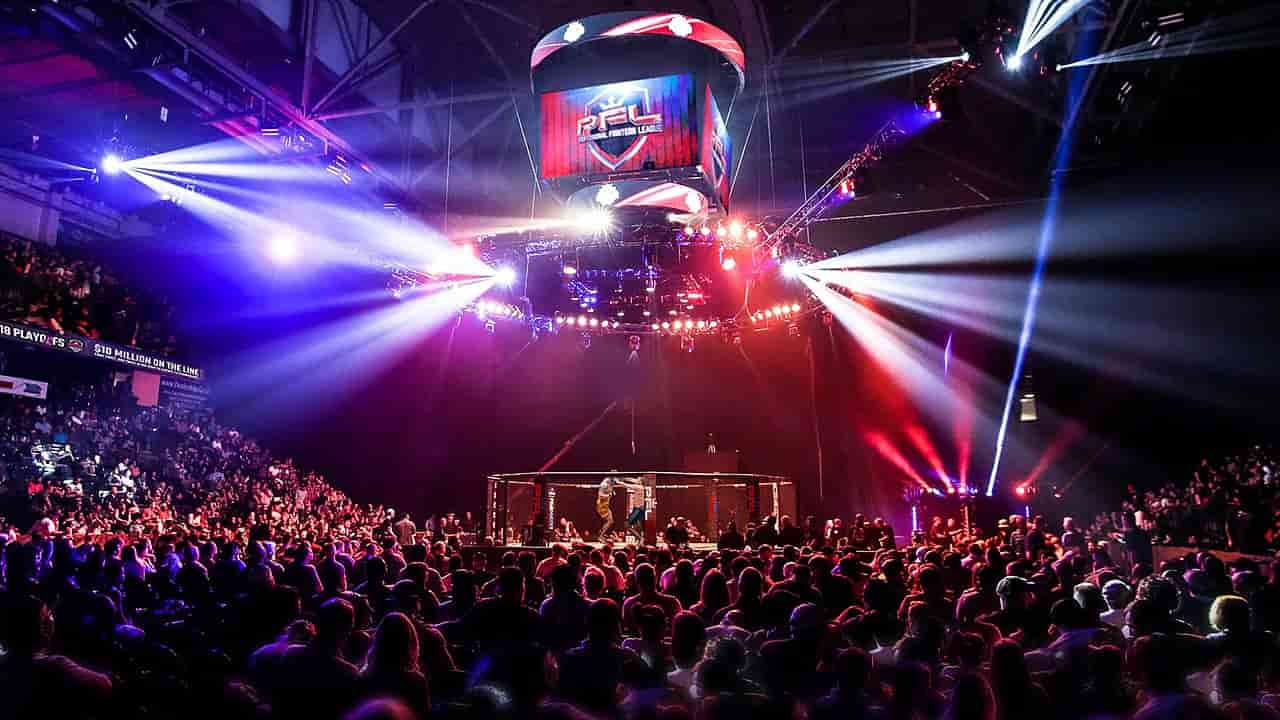
Professional Fighters League (PFL) has been in the spotlight lately, notably since Francis Ngannou, a former UFC heavyweight champion, joined their heavyweight roster. This rise in media attention has increased MMA fans’ curiosity about their unique league format and how it works. Here’s a PFL in a nutshell.

PFL, launched in 2018, is the first major MMA promotion to use a sport-season format where fighters compete in regular-season events to earn points. After the regular season, fighters with the most points compete in the playoffs, where the final two winners face off in the championship.

There you have a quick summary of how PFL MMA promotions work, but keep reading on for a complete guide to understanding PFL MMA.

History of PFL

PFL actually arose from the World Series of Fighting (WSOF) promotion. It all started when McLean, Virginia investors, acquired the WSOF promotion in 2017. WSOF had a TV deal with NBC Sports Network, and its events were broadcasted worldwide.

They hosted events in Canada, Japan, China, and of course, the US. Shortly after the acquisition, they re-branded the business to the “Professional Fighters League (PFL).” And the inaugural event took place in 2018, and they introduced the league model the same year.

Throughout the next few years, PFL primarily focused on finding new investors, putting the system together, getting through COVID restrictions, and boosting their funding. Apart from investment groups such as Ares Capital, celebrities like Marshawn Lynch and Wiz Khalifa also joined PFL as partners, with Lynch getting into the ownership group while Khalifa became an advisor.

The promotion also invested a lot in marketing. They did a good job of following the trends and using strategies to penetrate the market. But above all, they wanted to differentiate their product from other similar ones.

In 2020, PFL became the first sports league to launch a non-fungible token (NFT). Next, it partnered with DraftKings, that, apart from being an official sportsbook partner, also sponsors the pre-fight shows. Next, the “SmartCage” concept relies on real-time data technology, and it is the first of its kind in MMA.

Viewers can enjoy real-time data such as the speed of the strikes, heart rate, and other information. PFL also partnered with the game publisher “Rival Games” to create a gaming community before landing a deal with “millions.co” to promote group streaming of the events.

The “Super Fight” division was created in 2023 and will be aired on pay-per-view. The biggest news, however, is that fighters competing in the “Super Fight” division will receive 50% of the pay-per-view (PPV) revenue, significantly more than what other MMA organizations offer.

RECOMMENDED READING:
When Did UFC Start? UFC Ultimate History Explained

PFL Fighting Rules

Each PFL season includes 72 fighters who compete in 5 weight classes for men and one for women. First, they compete in the regular season, then the post-season, and final championship, where a weight class winner wins a $1 million prize.

  • Ruleset: Unified Rules of MMA. The only major difference is the prohibition of elbow strikes. 
  • Fighting area: the matches take place in a 10-sided cage called the “SmartCage” because of its technological features.
  • Match duration: Each match in the regular and playoffs has 3–3 minute rounds, while the championship is 5–5 minute rounds. 
  • Weight classes: heavyweight (limit up to 265 lb), light heavyweight (limit up to 205 lb), welterweight (limit up to 170 lb), lightweight (limit up to 155 lb), featherweight (limit up to 145 lb). Women compete only in the lightweight (limit up to 155 lb) division.

What Is the Season Format of the PFL?

Regular season—includes between six and seven events where 72 fighters compete two times each. The regular season follows a point-based scoring system in which fighters receive points for every win, knockout, and submission.

The winner of the match is awarded 3 points, whether it’s a decision or a finish. On top of that, fighters receive 3 bonus points if they finish the match in round 1, 2 points in round 2, or 1 point in round 3. If the match ends in a draw, both fighters receive 1 point. At the end of the regular season, 4 fighters with the most points in their weight class advance to the playoffs.

Post-season (playoffs)—is where the four best fighters in each weight class compete in an elimination format. The playoffs usually consist of three events. A fighter with the most points is ranked #1, and they fight against the #4-ranked fighter in their division. This means that a #2-ranked fighter will fight a #3-ranked fighter in a three-round match. The winners of these two matchups advance to the championship.

Championship — is the season final where the two best fighters in each weight class compete against each other in a five-round fight. The season winner receives a $1 million prize.

The Key Difference between PFL and UFC

The key difference is the event format. PFL is a league where fighters compete multiple times in a sport-season format, while UFC organizes conventional single events. These two promotions might also visually look the same at first glance. However, there are also many differences; the following is a detailed explanation.

Event format

PFL season is very structured. First, fighters compete in a regular season against opponents in their weight class. PFL employs a point system rather than a ranking system for fighters to advance to the playoff events. For example, after two regular season fights, the athletes with the most points advance to the semi-finals and later the finals. Each event is organized separately, meaning that fighters only compete once in each event.

UFC is different because it includes a ranking system. To climb the rankings, fighters who join the UFC roster must win one fight at a time. Their goal is to enter the official top 15 rankings, earn a title shot, and win the world title. How quickly a fighter is going to rise is based on many factors. The most important ones are the record, finishing rate, and popularity. Back in the 90s, the UFC used to be a tournament, but this is no longer the case.

Legal/Illegal strikes

Both the UFC and PFL have adopted the Unified Rules of MMA. This means that the majority of the rules are the same across both promotions. However, PFL slightly differs as it prohibits elbow strikes to the head and body. This is not new, as other promotions in the past, such as the Japanese PRIDE FC, also didn’t allow elbows.

Elbow strikes are no more dangerous than punches and kicks. However, elbows can easily tear the skin off and cause deep cuts and severe bleeding. These bad cuts often result in premature doctor stoppages. Even if a fighter was winning before the doctor stoppage, bad cuts can force doctors to end a fight early, which can have an impact on the outcome and future careers of the fighters.

Strength of the roster

The UFC roster is much stronger and deeper, as there are more than 700 fighters under contract. Plus, the UFC is regarded as the absolute leader in the industry and is home to the best fighters in the world. Every MMA athlete begins their journey with the dream of winning the UFC title because that means you are a legitimate world champion.

At some point, the majority of talented fighters end up signing with the UFC because they want to test themselves against the toughest opponent. Each of the 12 weight classes has around 50 fighters, much more than PFL.

In contrast, each PFL weight class has 12 fighters. So in total, there are 72 fighters across six divisions and another 12 in the female weight class. PFL fighters are also very talented. However, their roster primarily involves:

  • Up-and-coming potentials.
  • MMA veterans.
  • Former UFC fighters that have passed their prime.

The only major exception is Francis Ngannou, who end up signing with PFL at the peak of his fame.

Cage

UFC fighters compete in an 8-sided steel cage called an “Octagon.” In modern days, the promotion uses two different variations. The original octagon is 30ft (9.1 m) in diameter, has 746 square feet of fighting space, 6 feet-high fence, and is primarily used for big PPV events. The smaller version is 25ft (7.62 m) in diameter with 518 ft of fighting area. It is used for low-profile shows such as “Fight Nights,” hosted in the UFC apex center.

UFC octagon
Image credit: Lee Brimelow

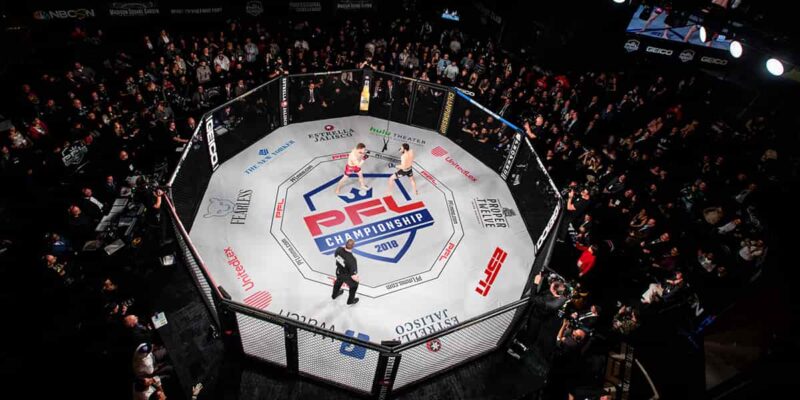
PFL fighters compete in a 10-sided cage. In 2019, a partnership was formed with an SMT company to provide real-time data to viewers. Biometric sensors were installed around the cage to measure various data such as the speed of kicks and punches, heart rate tracking, energy exerted, and more.

PFL 10-sided cage
Image credit: pflmma.com

Former UFC Fighters Who Joined the PFL

Following is a list of notable UFC fighters who left the UFC to sign with PFL.

Anthony Pettis

Pettis is among the most exciting fighters in MMA history. He is the former UFC lightweight champion and global superstar. After fighting under the UFC banner for nine years and completing his last contract, he decided to move to PFL and try to win a $1 million prize. Although he failed to mimic the same success, Pettis is still a big draw. PFL gained many new fans thanks to his presence.

Marlon Moraes

After losing a bantamweight title fight to Henry Cejudo in 2019, Moraes’s UFC career took a steep dive, and he never recovered from it. He suffered four hard losses in a row and decided to leave the UFC for good. Just as everyone thought he would retire, the news came out that he was signing with PFL. But unfortunately, Moraes would suffer another two back-to-back losses in his first two appearances.

Shane Burgos

Burgos joined the PFL at the peak of his prime. After fighting for the UFC for 6 years, where he put together a record of 8-3, Burgos completed his contract and decided to test free agency. At the time, he was on a two-fight winning streak, and everyone was surprised to see that the UFC let him go, especially considering that he was among the most exciting featherweights. Even Dana White himself stated that letting Burgos go was a big mistake on their part.

Francis Ngannou

Despite nearly two years of negotiations, the UFC and their heavyweight champion, Francis Ngannou, could not agree on a new contract. The champion became a free agent, and after months of silence, the news finally broke that Ngannou was joining the PFL roster. It was the first case in MMA history that an active UFC champion was moving over to rival organizations. After Burgos, Ngannou was the second high-profile UFC fighter to sign with PFL.

How Many Times Do PFL Fighters Compete In a Season?

PFL fighters compete a minimum of 2 times in a season, or 4 times if they reach the finals. So the correct answer is based on their performance. During the regular season, all fighters from all weight classes compete two times. If they do well and advance to the semi-finals, or “playoffs,” they fight one more time before the finals.

Bear in mind that each part of the season includes multiple events. The regular season has between six and seven events, and the playoffs have three and the final (championships). Unlike in the early days of MMA, fighters are no longer competing multiple times in a single night.

RELATED:
How Many Times A Year Do UFC Fighters Fight?

Do PFL Athletes Get Tested for PEDs?

On May 9, 2023, PFL MMA announced that it had taken action and partnered with USADA to implement strict drug testing procedures for its fighters, mirroring the UFC’s drug testing procedures.

This comes in light of a PED scandal that has implicated some of its fighters. The PFL has made necessary changes to its PED testing procedures to ensure the safety and integrity of its athletes.