Home Blog Page 8

What Is ISKA Kickboxing? A Simple Guide to ISKA Kickboxing

0
Image via iskaworldhq.com

Credit: IKTA European Kickboxing Champion James “The Dragon” Turner provided information about ISKA and IKTA.

If you are a fan of kickboxing or striking martial arts in general, you have likely heard about the term “ISKA Kickboxing.” However, you might not be sure what this ISKA stands for or what role it plays in the world of kickboxing.

ISKA stands for “International Sport Kickboxing Association.” It is a major sanctioning and regulatory body for kickboxing events worldwide and also hosts its own ISKA kickboxing events.

ISKA has sanctioned many well-known events like K-1 and K1 MAX, GLORY Kickboxing, and mixed martial arts (MMA) events like the now-defunct “Strikeforce.” Let’s further explore the history of the ISKA organization, the style it promotes, and how it differs from other governing bodies.

History of ISKA Kickboxing

During the 70s and early 80s, sports karate was very popular in the west and sanctioned by the “Professional Karate Association (PKA).” But the PKA’s influence was declining because of legal and financial problems, while kickboxing’s popularity was growing. Eventually, the PKA sanctioning body was dissolved.

In response to the PKA’s dissolution, resigning PKA executives decided to establish a new governing body, the ISKA (International Sport Karate/Kickboxing Association), on July 16, 1986. The organization was instantly recognized as the major governing body for all sports karate and kickboxing events.

The ISKA continued to sanction full-contact karate/American kickboxing in conjunction with the then-established PKC (Professional Karate Commission). The shows were televised in a seamless continuation from the PKA era, which was later revived as a “promotional” banner but not a “sanctioning body.” I.e., PKA revival shows in the 1990s still had their title fights sanctioned by the ISKA, the IKF (International Kickboxing Federation), and/or the WKA (World Kickboxing Association).

In the meantime, the WAKO organization primarily sanctioned the European market, and the WKA was the main governing body in Asia. However, this didn’t stop ISKA from attempting to spread worldwide. The ISKA strategically split into united organizations such as ISKA Asia, ISKA Australia, and Europe.

In the late 1980s and early 1990s, when Full Contact Kickboxing (wearing long pants and no low kicks allowed) became less prominent, the ISKA became a leading international governing body for both amateur and professional kickboxing events of all rule designations, such as:

  • Full-contact
  • International Rules (with low kicks)
  • Oriental rules (K-1 rules)
  • Muay Thai

ISKA has been the world’s leading sanctioning/regulatory body for combat sports and competitive martial arts since 1986. In modern days, though, ISKA is best known worldwide as the International Sport Kickboxing Association, which hosts kickboxing matches and produces some of the greatest kickboxers ever.

RECOMMENDED READING:
What Is The History of Kickboxing? – What You Need To Know

ISKA Kickboxing Styles

ISKA has different rule sets and sanctions for different types of kickboxing styles. Following is a list of major styles sanctioned by ISKA in over 50 states worldwide.

K-1 (Oriental Rules)

K-1 is a promotion that emerged from Seidokaikan karate back in 1993. It quickly became one of the world’s most popular combat sports events, even bigger than boxing at some point. ISKA started sanctioning K-1 events in 2000, during the glory days of the promotion, and it has been overseeing the events ever since.

In terms of rules, K-1 is quite simple. Each match lasts 3 rounds, with each round being 3 minutes long. K-1 fighters are allowed to utilize kicks (high and low), punches, and knees in the clinch for a limited amount of time.

K-1 is widely recognized as the most popular and exciting style of kickboxing. Due to the short duration of the matches, the emphasis is on power, high output, damage, and the majority of matches end in vicious knockouts.

Muay Thai

Muay Thai is a national sport in Thailand and one of the most versatile striking systems. Thai boxing events are also sanctioned by ISKA, primarily in Europe and the US. In contrast with other kickboxing styles, Muay Thai includes more techniques and is far more brutal.

Muay Thai kickboxing

Athletes can also fight in the clinch and do damage with vicious elbow and knee strikes, as well as punches and kicks. They can also execute throws and sweeps to take the opponent down, but ground fighting is forbidden.

Most matches include five rounds of action, with each round lasting three minutes. And unlike in other styles, there are 2 minutes of rest between each round, which adds to the excitement of the matches because fighters can exert more energy in the fight and then recover better due to the extended rest between rounds.

American Kickboxing (Full-Contact)

American kickboxing emerged in the 1970s in the US, and it was the first kickboxing style sanctioned by ISKA. This specific variation of kickboxing is unique because it doesn’t include kicks below the waist, also known as low kicks. The focus is on mixing techniques from western boxing with high kicks from karate.

American Kickboxing (Full-Contact kickboxing)
Photo by Don Wilson

In contrast with other styles, American kickboxers wear trousers and shoes. Elbows, knees, clinch fighting, and grappling are strictly forbidden. The matches can last anywhere between 3 and 10 rounds, depending on the importance of the fight, with each round lasting 2 minutes. There is a 1-minute rest period between each round.

Kickboxing Semi-Contact

Semi-Contact is a variation of American kickboxing similar to karate matches. Instead of utilizing full power, the emphasis is on speed and precision. In terms of techniques, the rules are the same as in American kickboxing. Fighters can utilize punches and kicks above the waist only.

They compete wearing a shirt and kickboxing trousers, shin pads, kick boots, and headgear. Matches typically last three rounds, each lasting 2-3 minutes, with a 1-minute break in between rounds. Punches, kicks, and sweeps are awarded 1 point, while kicks to the head bring you 2 points, and jumping kicks to the head bring you 3 points.

Freestyle Rules

This variation is basically American Kickboxing with low kicks. Athletes are enabled to throw punches, high/low kicks, and knees. They compete wearing kickboxing trousers, boxing gloves, mouthguards, shin guards, and groin guards.

The rules allow fighting in the clinch but only for 5 seconds, while throws and sweeps are forbidden. The matches usually include between 3 and 5 rounds for amateurs or up to 10 rounds for professionals. Each round is 3 minutes long, with 1 minute of rest between each round.

Light Contact Kickboxing

Light contact variation is very similar to the full-contact style. It includes the same techniques as full contact, but strikes are thrown with less power, as its name suggests. The focus is on overwhelming the opponent with speed, technique, and precision rather than sheer force.

People also describe it as a competitive sparring session. The rounds are shorter, lasting between 1.5 and 2 minutes, and you can’t win by knockout.

ISKA Kickboxing Rules

ISKA Kickboxing has two codified sets of rules for both amateur and professional competitions. The first is “Unified ISKA/ABC Kickboxing,” while the other is “ISKA Europe Rules.” For the purpose of this article, we will explain the Unified ISKA kickboxing rules.

Match duration — pro kickboxing matches are split into rounds and may have up to 10 rounds. Each round is 3 minutes long, and there is a 1-minute rest period between each round.

Scoring system — each match includes three judges sitting at different sides of the ring. They utilize a 10-point must system to score the match round by round. The winner of the round receives 10 points, while the loser gets 9, 8, or 7, depending on how dominant the winner was. If the round is even, both kickboxers will get 10 points.

Scoring criteria — to determine the winner of the round, judges rely on the following criteria:

  • Number of knockdowns 
  • Cumulative effective impact on the opponent
  • Number of clean scoring strikes
  • Ring generalship and aggressiveness

Ways to win — kickboxers can win a fight by knockout, decision, or technical knockout by scoring three knockdowns in the same round.

Protective gear — mouthpiece, full-padded boxing gloves, shorts, a groin cup, trousers (American style), and shoes.

Illegal techniques — head butts, groin strikes, strikes to the back of the head or spine, striking on the break or after the bell, holding the opponent, striking the downed opponent.

Legal techniques — punches, low kicks (not in all styles), high kicks, knees (not in all styles), elbows (not in all styles).

ISKA Weight Classes

Following is a detailed explanation of ISKA kickboxing weight classes:

Men’s kickboxing divisions:

DivisionWeight
Flyweight117lbs; 53.5 kg 
Bantamweight121lbs; 55 kg
Featherweight125lbs; 57 kg
Super-featherweight129lbs; 59 kg
Lightweight134lbs; 61 kg
Super-lightweight139lbs; 63.5 kg
Light-welterweight143lbs; 65 kg
Welterweight147lbs; 67 kg
Super-welterweight154lbs; 70 kg
Light-middleweight159lbs; 72.5 kg
Middleweight165lbs; 75 kg
Super-middleweight171lbs; 78 kg
Light-heavyweight179lbs; 81.5 kg
Light-cruiserweight 187lbs; 85 kg
Cruiserweight 194lbs; 88.5 kg
Super-cruiserweight209lbs; 95 kg
Heavyweight220lbs; 100 kg
Super-heavyweight+220lbs; + 100 kg

Women’s kickboxing divisions

DivisionWeight
Atomweight105lbs; 48 kg
Strawweight111lbs; 50.5 kg
Flyweight114lbs; 52 kg
Super-flyweight117lbs; 53.5 kg
Bantamweight121lbs; 55 kg
Featherweight 125lbs; 57 kg
Super-featherweight 129lbs; 59 kg
Lightweight134lbs; 61 kg
Super-lightweight139lbs; 63.5 kg
Light-welterweight143lbs; 65 kg
Welterweight147lbs; 67 kg
Super-welterweight154lbs; 70 kg

Are There Any Former ISKA Kickboxers in the UFC/MMA?

Donald Cerrone

Donald Cerrone is a former UFC fighter and one of the greatest who never won the UFC world title. He was primarily known for his advanced kickboxing skills, which he perfectly utilized to win many matches.

Before getting into MMA, Cerrone spent many years competing as a kickboxer, winning many championships across the US. Under the ISKA banner, he won the amateur Colorado State Middleweight Championship.

Stephen Thompson

Stephen “Wonderboy” Thompson is the former UFC welterweight title challenger and one of the most dynamic strikers the world has ever seen. He has a strong background in karate and kickboxing and is one of the few fighters who primarily rely on these two martial arts inside the cage. In his kickboxing career, he became the:

  • Southeast Middleweight Amateur champion in 2000
  • ISKA Georgia State Middleweight amateur champion in 1999.

Michael “Venom” Page

Although he has never competed in the UFC promotion, Page is among the most popular Bellator MMA fighters. He holds the record for most knockout victories in Bellator history and is a spectacular fighter to watch. Before switching to MMA, Page spent over a decade successfully competing in kickboxing. Among many titles, he also won the ISKA World Martial Arts Championships in 1998.

Who Are the Greatest ISKA Champions?

Throughout history, there have been many great ISKA champions. Following is a list of some of the most accomplished ones.

Jerome Le Banner

Jerome Le Banner is one of the best French kickboxers of all time and the former ISKA World Champion. Known for his massive body frame, big muscles, and aggressive fighting style, Le Banner was among the most feared fighters during the late 90s and the glory days of K-1 promotion.

Although he never won the prestigious K-1 title, he never was in a boring fight, and that’s why so many people still remember him.

Andy Souwer

Andy Souwer is a pure representation of the Dutch style. Inside the ring, Souwer was very aggressive, always pushing forward, attacking with a barrage of high-precision boxing combos, and finishing his attacks with hard low/high kicks.

In his career, he won the K-1 World MAX titles twice (in 2005 & 2007) and became the ISKA World Super Welterweight Champion.

Georgio Petrosyan

Georgio Petrosyan is a kickboxing legend, often considered the most technical kickboxer of all time, which earned him the nickname “The Doctor.” Just the fact that he remained undefeated in K-1 for five straight years, during which he beat the best kickboxers of that era, speaks for itself.

In his career, he won the K-1 World MAX title twice (in 2009 & 2010) and the ISKA World Championship.

Rob Kaman

Rob Kaman is one of the pioneers of modern kickboxing and the Dutch style. Back in the 70s and 80s, Kaman was unstoppable and known for his perfect leg-kicking techniques, which he utilized to perfection.

He finished nine of his opponents with this specific technique. Kaman retired in 1999 with 97 wins on his record (77 knockouts) and just 12 losses. In his career, Kaman won multiple world titles, including the:

  • ISKA Oriental Rules Light Heavyweight Champion
  • ISKA Full Contact Super Middleweight Champion

Ernesto Hoost

Ernesto Hoost is an absolute kickboxing legend, and many people consider him to be the best K-1 fighter ever. In his career, he won the prestigious K-1 World GP four times and competed at the sport’s highest level for more than two decades.

Inside the ring, he was fast, powerful, and had laser precision, and his fighting IQ was off the charts. This is the main reason why people also describe him as “Mr. Perfect.

Apart from K-1, Hoost also won the:

  • ISKA European Championship
  • ISKA Muay Thai Championship

Related Questions

What is IKTA?

The IKTA (Intercontinental Kick Thai Boxing Association) was previously known as the IKA (International Kick Boxing Association) but was renamed and newly established as the IKTA in 2012: World President Marco Ghibaudo (Mexico) and Vice World President Massimo Brizi (Italy).

The IKTA fills the void left in the wake of the dissolution/lack of activity of several (Full Contact) Kickboxing sanctioning bodies over the years and revitalizes the sport with a vision of the future. Additionally, the IKTA sanctions all major combat sports: kickboxing, muay thai, K-1 rules, and MMA.

Speaking personally, I can say from experience that the IKTA is like a big family. The athletes who compete regularly in the IKTA are true sportspeople and martial artists.

IKTA European Champion, James “the Dragon” Turner
James “The Dragon” Turner

While it’s lesser known than the ISKA kickboxing association, the IKTA is a platform for highly talented and well-respected martial artists who like to compete in primarily full-contact style against other like-minded martial artists.

RECOMMENDED READING:
James "The Dragon" Turner's IKTA endorsed book, "Full Contact Kickboxing: A Complete Guide To Training And Strategies", easily explains kickboxing, combat sports, and the IKTA in greater detail.

Disclaimer: This is not a paid endorsement or an affiliate link.

What’s the main difference between ISKA and IKTA?

As can be observed from the organization’s previous name IKA (International Kickboxing Association), the IKTA emphasizes Full Contact Kickboxing as a highly technical and prestigious sport.

The organization’s heritage denotes that this sport (Full Contact) is the “first love” of the association’s leaders. While all combat sports (except Professional Boxing) are featured in IKTA events, Full Contact Kickboxing is prominently featured. Full Contct is often the rule set for ‘main event’ fights on IKTA shows. The ISKA is, of course, one of the original sanctioning bodies for Full Contact rules Kickboxing.

However, a major difference between the ISKA and the IKTA is that while the ISKA still sanction some Full Contact rules fights, their attention has assuredly shifted towards other rule styles, even prominently ‘re-naming’ their Oriental Rules division (with some modifications) to “Unified Rules,” implying that these rules are the “main” Kickboxing rules.

This is so they are in line with organizations such as “GLORY Kickboxing” and “Bellator Kickboxing (sister promotion of Bellator MMA)” and can sanction their title fights, even though this rule system was predominantly known as K-1 rules and was pioneered by the actual K-1 association in many ways.

Conversely, the IKTA more actively promotes Full Contact as its major kickboxing discipline, as that is what the IKTA believes is the most prestigious and spectacular sport/rules style of all. The IKTA also sanctions bouts under what the ISKA calls “Unified Rules,” but the IKTA refers to these as K-1 rules instead.
What Are Low Kicks In Kickboxing/MMA? A Beginner’s Guide

0

In modern times, low kicks have become one of the most effective techniques in freestyle combat, such as mixed martial arts (MMA) or GLORY kickboxing matches. But what is the secret behind the rise of low kicks, and why is this specific martial art technique so effective?

Low kicks are considered any leg kicks that strike below the waist of the opponent, primarily aimed at the thigh or calf. The goal is to kick the opponent with the shinbone (in Muay Thai) or foot (in karate) to damage their quadriceps or the sciatic nerve and impair their mobility.

Kicks with enough power and precision can easily finish the fight, as you can often see in MMA. We’ll help you understand the overall effectiveness of this kicking technique and what makes it so special.

What are Low Kicks?

Low-kicks are specific martial arts techniques designed to cause damage to the opponent’s legs. When executed with proper technique, low kicks can generate massive force, and if you manage to hit the right spot, you can easily finish the fight. Repeated kicks often result in damage to ligaments, muscle tissue, the sciatic nerve, joints, and bones.

The roots of low-kicking techniques are impossible to determine, as people have been kicking each other since the dawn of humankind. But in modern times, this technique has been popularized by martial arts such as Muay Thai, Kickboxing, and different forms of Karate. Each of these martial arts has its own variation of each kick, but the concept of low kicking remains the same.

For example, Muay Thai fighters tend to load up on each kick, throw them with their leg fully extended, and land with the shinbone. On the other hand, kickboxers bend their knees while throwing a kick and land with their foot. Further, Taekwondo and Karate have their own variations.

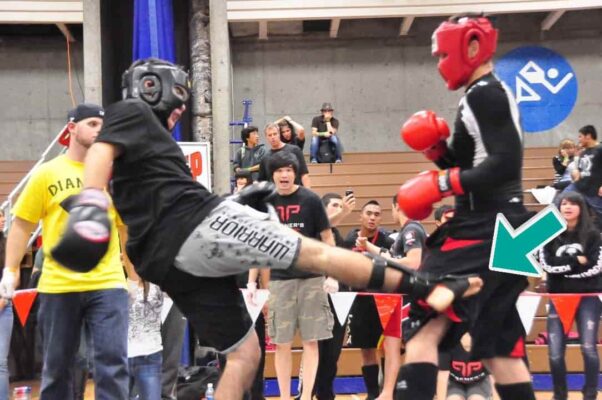
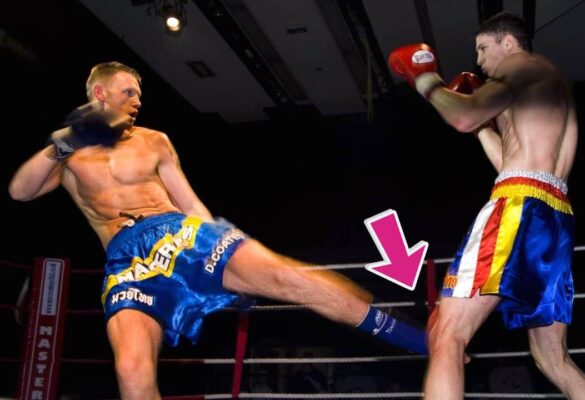
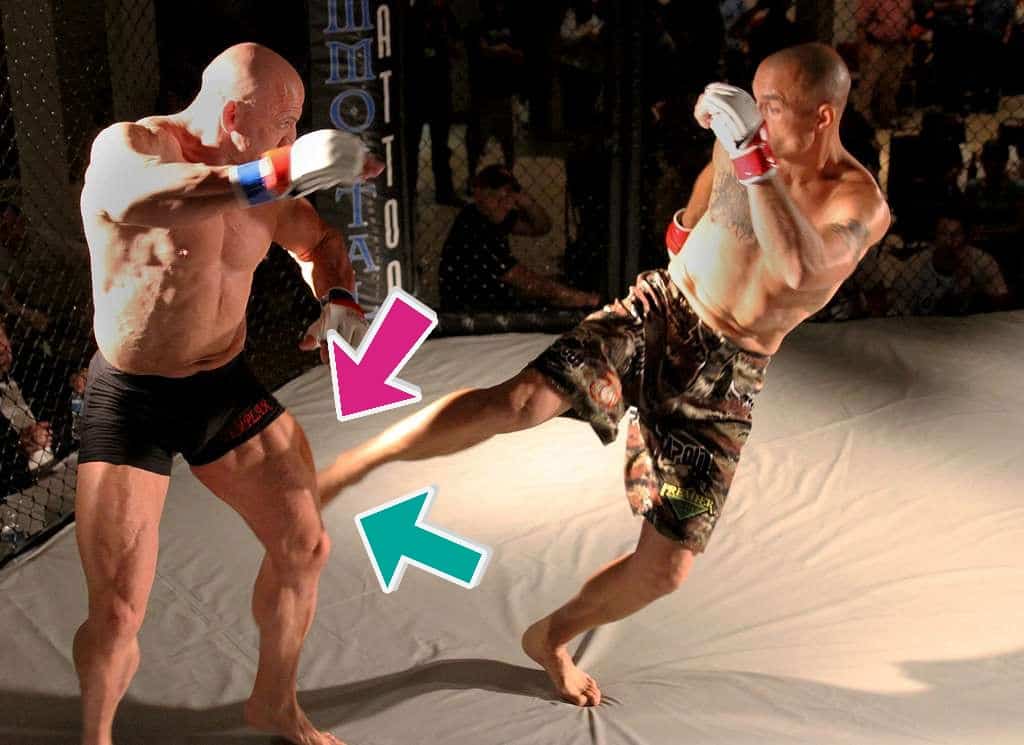
Low kicks are usually aimed at the opponent’s thigh or calf. Depending on the position and stances, there are two variations. First, you can throw them to the outside of the opponent’s leg or to the inside of the leg. See the images below for examples of both outside and inside low kicks.

Outside low kick
Photo by superwebdeveloper

Inside low kick
Photo by Loura Conerney

In martial arts, a low kick is considered any kick that is thrown below the waist of the opponent. It is a low kick, whether it lands on the opponent’s thigh or ankle.

What Are the Different Types of Low Kicks?

Low-kicks play a big role in just about every martial art style. Whether it’s MMA, Muay Thai, or a Japanese martial art such as karate, low kicks are a crucial element of striking.

These fighting styles share many low-kicking techniques that look similar but also have their own variations. Here are some of the most popular:

Oblique kick

UFC champion Jon Jones is well known for using this kick. The motion of the kick is very similar to a stomp. However, the oblique kick is usually aimed at the opponent’s knee and thrown diagonally. Jon Jones explains the oblique kick more in detail in the following clip.

Roundhouse kick to the calf 

The most popular low kick across all striking martial arts. Fighters would usually throw a hard roundhouse kick to hit the opponent’s calf right below the knee. Or they might target the other leg and hit the inside part of the calf.

Roundhouse kick to the thigh 

A very effective and powerful kick. Fighters usually target the inside part of the thigh to cause damage and disrupt the opponent’s balance.

Sidekick 

A common low-kicking technique. Since a sidekick generates a lot of force, fighters would use it to target the opponent’s knee.

Muay Thai vs. Kickboxing: How low kicks are landed differently

It’s worth pointing out that there is a difference in the way fighters throw low kicks and how they land them. Muay Thai fighters prefer fully extending their legs to generate massive force and land their kicks with their shins. Although these kicks are not like the ones in karate, for instance, each one carries enormous force.

Kickboxers prefer to throw their low kicks by lifting their leg, bending the knee at the half-point of the kick, and then hitting the opponent’s leg with their foot. The athletes trained in Taekwondo and different styles of karate also use a similar style.

RELATED:
Muay Thai vs Kickboxing  –  Key Differences Explained and FAQ

How Effective Are Low Kicks In a Fight?

Low-kicks are very practical techniques for any type of freestyle combat. However, bear in mind that the overall effectiveness also depends on the type of situation you are in. Some self-defense scenarios, for example, won’t give you enough space to throw kicks.

The following examples illustrate why low kicks are very effective.

Keep the opponent at a distance and set up attacks

Low kicks are very effective at maintaining your range during the fight. Unlike high and spinning kicks, low kicks do not require as much time and energy to execute. Skilled fighters can throw them in the blink of an eye without much risk.

Opponents walking you down usually lean heavily on the lead leg, which you can target to disrupt their forward momentum and cause damage.

Low kicks are also a great way to create openings for other types of attacks, such as punches. Targeting the leg will likely force the opponent to drop their guard (hands) and expose their chin, which you can also attack.

Low kicks slow down the opponent’s movement

It’s unlikely that a single-leg kick will finish the fight for many fighters. However, repeated leg strikes can significantly slow the opponent’s movement. This is notably effective if your opponent’s style relies heavily on footwork. After absorbing a couple of hard kicks at the same spot, their leg will start to swell and feel numb at some point.

They will no longer have the same feeling, impacting how they move and throw strikes. When your leg is damaged, it throws off your balance, timing, reactions, and the way you punch or kick.

The best example of this was when Dustin Poirier damaged Conor McGregor’s lead leg with hard calf kicks in their second fight (UFC 257). McGregor, whose primary skillset is boxing along with a heavy dependence on his lead leg movement, couldn’t move well or strike well after getting kicked in the calf over and over again. He became a sitting duck, which led to his demise in the fight. See the fight clip below.

Can easily immobilize legs during the fight

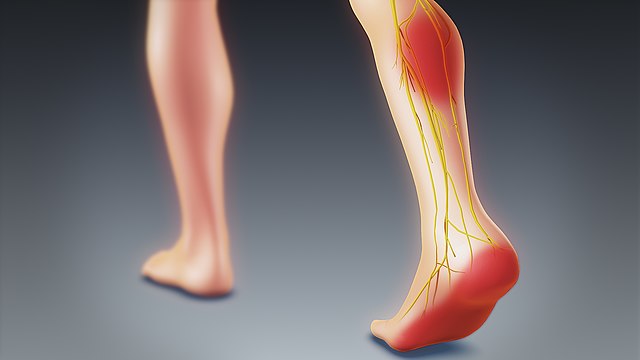
A well-placed leg kick can also cause nerve damage; when this happens, it’s usually game over. First, a leg kick can damage the famous sciatic nerve, the longest nerve in the human body, which goes from your spine all the way down to your foot.

A low kick can be very effective at disturbing this nerve during the fight because the sciatic nerve has little to no muscle protection in the lower part of the leg. You can immobilize your opponent’s leg by repeatedly kicking the correct spot.

Sciatica nerve
Credit: scientificanimations.com

The next is the peroneal nerve, located just above the knee. This nerve can get damaged if a person absorbs a couple of hard low kicks to the exterior part of the knee toward the back of the leg. The damage usually results in a temporary loss of motor control of the leg, pain, and numbness.

RELATED:
What Are Liver Shots In Combat Sports/MMA?

What Are the Risks of Throwing Low Kicks?

Although low kicks are a very effective strategy, this technique also comes with some potential risks. Here are some of the risks associated with throwing low kicks in a fight:

Knee injuries

Throwing repeated leg kicks puts a lot of stress on the knee joint. This can lead to chronic pain, inflammation, or more severe injuries such as a torn ligament or meniscus. To prevent this, fighters who rely heavily on leg kicks must spend a lot of time enhancing their knees’ strength with different exercises.

Shin injuries

Shin injuries are common in Muay Thai, where fighters land kicks with their shin bones (tibia). If the shin bone is not strong enough, a well-placed low kick could cause it to break. This happened to Anderson Silva at UFC 168 against Chris Weidman. At one moment, Weidman perfectly timed the low kick, which resulted in Silva breaking his shin bone in half.

Foot injuries

Foot injuries are common in martial arts such as kickboxing, which involves landing low kicks with the foot. In most cases, fighters sustain minor or severe injuries when they hit the opponent’s knee instead of the calf or thigh. This can result in sprains, torn ligaments, or foot fractures.

Leaves you open for counterattacks

In order to throw a leg kick, you have to put yourself off balance or out of position for a brief moment. If you telegraph the attack and the opponent sees it coming, they can easily catch you with the counterattack. They might catch you with the punches or, as in MMA, change their levels and take you down to the ground.

How Do Fighters Defend Against Low Kicks?

The most common way is by checking the kick or moving away. Here is a detailed explanation of all the methods.

  • Checking the kick—includes lifting your leg, slightly turning it towards the upcoming kick, and blocking the kick with your knee or shinbone. The opponent is targeting the soft parts of the calf and thigh. So checking your opponent’s low kick with the hard surface of your knee or shinbone causes huge pain to your opponent and may result in a bone fracture upon impact.
Check leg kicks
  •  Catching the kick — is also a common way to defend against low kicks. This method requires solid timing and skill but is very effective as catching the leg enables you to take the opponent down or counterattack with kicks and punches.
  •  Moving away  involves you stepping back or angling out to the side to avoid the low kick. As with catching the kick, this method requires timing and high spatial awareness.

Are Leg Kicks Effective in Street Fights?

Leg kicks can be an effective technique in self-defense situations. When timed and placed correctly, these strikes can cause damage to the opponent’s legs and limit their mobility. However, the overall effectiveness is based on many factors, such as the place of the fight. There are scenarios where you won’t have enough space to throw a kick, such as in a crowded bar, for instance.

This technique is notably effective against people not trained in martial arts. These people have never felt the power of a kick, nor do they know how to check low kicks correctly. No matter how strong they are, just a single, well-placed kick can drop an average person down to the ground. For instance, some Thai boxers can generate great power in a kick, similar to hitting someone with a baseball bat. Leg kicks can be an effective technique in a self-defense situation. Now imagine an average person receiving such a strike from a well-trained kickboxer.

Overall, leg kicks are very effective in street fighting scenarios where you have enough space to move around. But you can’t rely solely on this technique in a self-defense scenario. Low kicks aren’t some magical technique that works in all self-defense situations. Low kicks can be a very effective arsenal when you mix them with punches, head movement, and footwork to defend yourself.

How Fighters Train to Throw Low Kicks

Fighters improve their leg-kicking skills by focusing on developing proper technique and increasing flexibility and strength. Following is a detailed explanation:

  • Stretching exercises — enable you to increase flexibility and range of motion. You can’t expect to throw hard leg kicks the right way without having flexible hips for example. As a result, students perform different dynamic and static stretches before and after each workout.
  • Strength training — involves doing specific workouts that increase the leg muscles such as leg presses, squats, and lunges. These exercises increase the strength and power of the leg muscles, which enables you to throw harder kicks as well as to absorb the punishment.
  • Heavy bag workouts — are crucial when it comes to drilling specific low-kicking techniques. Throwing hundreds of kicks enables them to develop proper technique, stamp the motion of the kick deep into their muscle memory, and condition their legs to withstand the impact of the strike.
  • Sparring — is one of the most effective methods to learn how to apply low kicks in a fight. Knowing the correct motion of the kick is great. But you need to practice this technique against the fully resisting opponent in sparring on a regular basis to learn how to use it in a fight.
  • Shin bone conditioning—the objective is to harden the shin bone like stone, making a low kick more damaging when you kick your opponent’s leg. In order to strengthen their shin bones, some Muay Thai fighters kick banana trees with their shins. But most fighters kick a punching bag or a padded wooden dummy instead.

Are Low Kicks Used in All Kickboxing Styles?

Different styles of kickboxing, including Muay Thai, Japanese Karate, and Taekwondo, utilize both high and low kicks.

However, competitions in American kickboxing (full-contact kickboxing) do not allow kicks below the waist. This variation emerged in the 1970s, putting more emphasis on punches (western boxing) and high kicks above the waist.

Who Has Popularized Low Kicks in Combat Sports?

As different martial arts transitioned into mainstream sports, many great fighters used low kicks as their signature move to win fights, popularizing this specific technique.

Maurice Smith— is a former kickboxer who put kickboxing on the map in UFC fights. In his career, he utilized low kicks to finish many of his opponents, such as Bill Morrison, Raymond Horsey, and Travis Everett.

Marco Ruas — is one of the best leg kickers in the history of MMA. The best display of his leg-kicking technique was in his match against Paul Varelans at UFC 7. Ruas repeatedly landed devastating Muay Thai leg kicks onto Varelans’ huge thighs until he couldn’t handle it anymore.

Rob Kaman— is also known as “Mr. Low Kick”. This Dutchman is a true pioneer of modern kickboxing, and the man is synonymous with leg kicks in combat sports.

Rob Kaman “Mr. Low Kick”

Some other well-known athletes who used low kicks to a great extent in combat sports are:

  • Jose Aldo
  • Antoni Hardonk
  • Pat Barry
  • Mauricio “Shogun” Rua

The Final Say: Why Low Kicks are One of the Best Kicks

Learning how to throw a low kick is very simple. And the simplicity mixed with speed is what makes this technique so practical in every form of fighting. On top of that, low kicks do not require as much energy or a high level of athleticism to execute as other kicks do, as you often see in fancy Taekwondo kicks.

What is Okinawan Karate? An Introductory Guide for Beginners

0
Photo by LucaPknight

Karate has many styles and forms and is usually traced back to two main lineages: Japanese and Okinawan. You may wonder what Okinawan karate is and how it differs from modern variations.

Okinawan karate refers to the earliest karate forms created in Okinawa. When Japan took over the Okinawa islands, Okinawans developed karate to protect themselves from cruel rulers. Karate eventually spread to Japan, and these Okinawan forms became the basis for various styles of karate.

This is just a brief explanation of what Okinawa Karate is. Be sure to continue reading to learn more about its history and how it influenced the birth of other modern karate styles and forms.

The History of Okinawan Karate

The earliest records of the Okinawan style of karate date all the way back to the beginning of the 15th century. Because of its central location, Okinawa has always been the place of trade and cultural exchanges, especially with neighboring countries. When it comes to martial arts, different hand-to-hand and weapon-based martial arts practices usually come from China.

However, in 1429, the three main kingdoms in Okinawa decided to unite and form the Ryukyu Kingdom. A couple of decades after the Ryukyu Kingdom came into power, all martial arts practices would be forbidden due to the fear of widespread teaching negatively affecting the kingdom.

But when Japan’s Satsuma Domain conquered Okinawa Island, Okinawans were not allowed to have any weapons, and martial arts training was also banned. This was when historians believed people in Okinawa started developing Karate, which literally means “empty hands,” as a fighting system to protect themselves from ruthless rulers.

Despite all the restrictions, the people of Okinawa secretly developed various combat systems. They combined the “empty hand” techniques from Chinese martial arts with household and farming tools used as weapons to create combat systems they called “Okinawa-Te” or “Uchinaa-dii.”

Over the years, they have developed different variations of “Te.” The major ones came from the three different villages: Shuri, Naga, and Tomari. To distinguish one variation from the other, they named each one by the village it originates from:

  • Shuri-te
  • Naha-te
  • Tomari-te

Later on, these three original Okinawan styles would influence the birth of dozens of others. Masters from shuri, naha, and tomari-te would form the following four main Okinawan karate styles:

  • Shito-Ryu (originates from Shuri-te and Naha-te)
  • Shorin-ryu (originates from Shuri-te and Naha-te)
  • Uechi-Ryu
  • Goju-Ryu (originates from Naha-te)
RECOMMENDED:
What Is The History of Kickboxing? – What You Need To Know

What Are the Major Okinawan Karate Styles?

The following is an explanation of the original karate styles developed in Okinawa. These styles later influenced the birth of dozens of modern ones on the main island of Japan.

Shito-Ryu

Shito-Ryu originated from the Shuri-te and Naha-te schools of Okinawan martial art teaching. It was founded by Kewa Mabuni, a Shuri-te master who adopted the concept of “hard-soft” fighting methods similar to those in Goju-Ryu.

However, in contrast with other styles, Shito-Ryu focuses even more on katas and direct attacks. In total, students need to master over 90 katas, and most of them revolve around different blocks, punches, and kicks. The other key difference is the fighting stance, as the system adopts a low and short stance instead of a wide one.

Next, the techniques are supposed to be executed with full force. But unlike in other styles, Shito-Ryu puts slightly more emphasis on speed and precision.

Goju-Ryu

Goju-Ryu, which was created by Kanryo Higaonna, is thought to be one of the oldest Okinawan styles.As its name suggests, Goju is a mix of hard techniques (go) and moves aimed to be executed in a soft manner (ju). The founder, Higaonna, was a master of the Naha-te fighting style, which he used as a base to develop his own variation. In total, there are 12 core katas in the standard curriculum.

Goju-Ryu is also a very effective form, especially when it comes to close range. This style emphasizes hard striking with direct punches, open-hand strikes, and various types of kicks.

It also includes the basics of grappling attacks, such as throws, wrist locks, and joint locks. The soft part of systems actually refers to circular and linear movements, which are very important in Goju when it comes to maintaining distance.

Uechi-ryu

Uechu-Ryu is also known as “Pangai-noon” which translates to “half-hard, half-soft.” Like most other original Okinawan styles, Uechi-Ryu also adopts the concept of hard direct striking with circular and linear movements.

Chinese martial arts influenced the system, as its founder, Uechi Kanbun, a student of southern styles of Kung Fu, incorporated many elements from Kung Fu. The Kung Fu style from Fujian Province had notably great influences on Uechi-Ryu. In contrast with other styles, Uechi-Ryu has only eight empty-hand katas.

Shoring-ryu

Shorin-Ryu is considered the oldest karate style. Chosin Chibana officially founded it in 1933, but it is believed the system is much older. Shorin-Ryu is heavily influenced by the Shuri-te methods and principles, and there are 18 different katas.

The system emphasizes fast and precise striking and is based on the strategy of evasion. Students are taught how to attack sensitive body points with fast kicks, punches, and hand attacks.

RELATED:
What Are The Different Styles of Karate? Simply Explained

Okinawan Karate vs. Japanese Karate: What Are the Differences?

Okinawan karate is the original or traditional style of karate, while Japanese karate is a more modern variation that came about much later.

The art of karate started to rise in Japan after the country annexed the Okinawan Islands in 1879. This triggered the migration of people from Okinawa to the main islands, including skilled karatekas who started opening up schools and developing Japanese karate styles. However, these new forms were much different.

Following is a list of some of the key differences between Okinawan and Japanese styles of karate.

Self-Defense vs. Competition

All karate styles developed in the Okinawan Islands are designed solely for self-defense. There is no competition or rule of any kind. These styles teach you all about the physical and mental aspects of real combat and scenarios you may encounter in real life.

Modern Japanese karate is also rooted in self-defense. But the entire concept and learning syllabus have shifted from self-defense to competition over time. This is because karate became an integral part of the educational system in Japan. Karate would also become a very popular sport. In other words, traditional karate needed to be changed, made safer, and simplified.

As a result, the classes and methods of teaching in most Japanese karate styles are designed to align with the rules of competition, the famous “point fighting” rules. This shift to a competition-based style negatively impacted the system’s overall effectiveness and made it much different from the Okinawan styles.

Fighting range

Okinawan styles primarily focus on close-range combat. That’s why all of these systems emphasize short stances, direct striking techniques, and techniques like grabbing, twisting, attacking joint locks, and takedowns and throws. It also involves some brutal techniques, such as hitting the pressure points and nerve bundles, choking the opponent to sleep, etc.

Japanese karate is way different. It emphasizes wide and longer stances, originating from Japanese sword fencing called “kendo.” Students are primarily thought to strike and counterattack from a safe distance and avoid close-range exchanges. That’s why Japanese karate doesn’t involve much grappling or advanced self-defense tactics at close range.

Kobudo weapon-based training

Okinawan styles adopt the concept of “empty hand” fighting techniques. However, most of the masters are also trained in “Kobudo,” which is the art of using different combat tools such as nunchaku, kama, tonfa, sai, and bo.

According to their philosophy, Kobudo is not integral to Okinawan karate or the learning curriculum. However, Okinawa practitioners train in kobudo from time to time to learn how to defend against weapons. Again, the main idea behind this is to increase your self-defense abilities.

Kobudo is left out of most Japanese karate styles. You will have difficulty finding weapon training in Japanese karate dojos in modern times. Even if you do see weapons on display, it’s mostly for aesthetic reasons, as Japanese styles no longer practice kobudo.

Stances

The karate styles developed in Okinawa adopt the concept of short and high stances. According to their philosophy, a high stance is a natural one and puts less stress on your joints, such as your knees, feet, and back.

And they believe this type of stance is more practical in self-defense scenarios and close-range combat, while wide stances work well in competition. In some cases, Okinawan stances might be half the length of the ones developed later in Japan.

Okinawans never say Osu

“Osu” is a term developed in Japanese karate that translates to “push.” It means pushing yourself to the limits of endurance, pain, pressure, and other obstacles on your martial arts journey. The term is deeply stamped into the martial arts vernacular in modern times and utilized by other combat systems, such as jiu-jitsu.

In the present day, “Osu” also has many different meanings, such as “hello, goodbye, train harder,” etc.
However, karatekas from Okinawan styles never used or heard about Osu. Instead, they usually use the term “hai.”

Is Okinawan Karate Effective?

Okinawan karate styles are very effective in real combat. Each of the styles is designed to be practical in different combat scenarios. Styles like Goju-Ryu, Shito-Ryu, and Uechi-Ryu all teach effective techniques. You will develop good self-defense skills and solid instincts and reactions.

Unlike modern karate styles, the ones developed in Okinawa do not include any competition. The entire focus of training is on preparing a person for real combat. And these styles also teach a broader range of techniques as a result.

While modern styles emphasize kicks and punches, Okinawan styles are more versatile. These also involve the basics of grappling, ground fighting, and other self-defense tactics. While modern styles prepare you to win matches, the ones in the Okinawan style teach you how to fight.

The entire concept of Okinawan karate is centered on escaping trouble in the most efficient way possible. That’s why the emphasis is on short and high stances, direct and fast striking with full force, using all limbs, including elbows and knees, and grappling techniques.

Does Okinawan karate have grappling?

Okinawan karate teaches a broad range of techniques, including the principles of grappling and ground fighting. Although not as advanced as the ones in wrestling or jiu-Jitsu, these techniques are practical enough to help you handle the attacker if the fight hits the ground at some point.

In the standup, students learn techniques that mostly originate from Judo and Jujutsu. They are taught how to manipulate the opponent’s weight, re-direct energy, secure strong grips and use leverage to either defend or execute a grappling attack. They learn all types of throws, trips, takedowns, and once on the ground, practical joint locks and chokeholds. It basically covers all the elements.

However, you must separate Okinawan teaching methods from the modern Japanese styles. Grappling and ground fighting is not a part of modern Japanese karate.

Which Okinawan karate style is the most effective?

All Okinawan karate styles are designed to be effective and include reality-based techniques. Thus, picking just one is a challenging task. For many people, though, Goju-Ryu is often seen as the most effective style of Okinawan karate, being the most versatile and well-balanced.

And unlike other styles, Goju Ryu focuses on strength training, which improves the system’s overall effectiveness. Students utilize various traditional training tools to enhance both upper and lower body strength. They put a lot of emphasis on improving the strength in their arms (grip strength) and core to prepare for intense grappling exchanges.

Overall, the Goju-Ryu style is considered the most versatile self-defense system among all Okinawan styles because it covers all aspects of fighting. It includes both long and short-range kicking and punching techniques on the feet. But it also involves many takedown, throwing, and joint-locking techniques that other styles don’t use as much.

Students also participate in full-contact sparring, which adds to the system’s realism and teaches you how to apply techniques in real combat.

Related Questions

Which style of karate is most effective for MMA?

Shotokan karate is often seen as the best style if your goal is to transition from karate to MMA at some point on your martial arts journey.

However, remember that relying solely on Shotokan karate skills in MMA won’t help you much. You still need to develop all-around skills to cover other aspects of the game. This includes wrestling, BJJ, boxing, and many other techniques.

Most elements from Shotokan transition well to MMA. But this works best in combination with techniques from other martial arts.

Shotokan styles emphasize:

  • Advanced footwork and movement
  • Fast and direct striking
  • Very effective counter-striking skills
  • Unpredictable attacks

Karatekas who switch over to MMA also have superior:

  • Striking speed
  • Coordination
  • Balance
  • Spatial awareness

UFC fighters like Lyoto Machida and Stephen Thompson are masters at using karate techniques like movement, angles, all kinds of spinning, side and roundhouse kicks, and punches down the middle to win fights.

Shotokan karatekas are very unpredictable, and preparing against this style is challenging. They usually do not use conventional striking combinations and movements, which gives them a big advantage in MMA fights.

What is the most effective karate style for self-defense?

If you want to learn karate solely for self-defense, you should search for Goju-Ryu, Uechi-Ryu, or Shotokan school that embraces traditional teaching methods. Most modern Japanese styles emphasize competition over self-defense, so be sure to do proper research before signing up.

When it comes to self-defense, traditional styles developed in the Okinawan islands are known to be the most practical. These styles focus only on self-defense by concentrating on practical techniques, and they usually teach everything there is to know about fighting.

This includes striking with kicks, punches, open hands, knees, and elbows. And there is the grappling aspect, which involves sweeps, throws, takedowns, and the basic principles of ground fighting defense and offense. On top of that, there are other reality-based fighting moves, such as attacking pressure points like the throat, groin area, kidneys, etc.

Bruce Lee vs. Wong Jack Man – What Really Happened?

0
Credit: Clouse, R. (Director). (1973). Enter the Dragon [Film]. Warner Brothers Pictures.

Editor’s note: The views and opinions expressed below are those of the author.

The Lee-Wong fight is one of the most controversial in martial arts history. With few witnesses, the details are not very clear of which man was the victor. While many accounts claim that Lee was victorious over Wong Jack, some claim that Bruce Lee’s undefeated streak was broken with the result of a tie in his fight with Wong Jack Man in 1964. 

While Bruce Lee was an exceptionally skilled fighter, interviews with Wong Jack Man challenge the idea that Bruce Lee was undefeated. With varying accounts of the outcome, it leads us to the ultimate question: What really happened?

Who is Wong Jack Man?

Wong Jack Man is best known for his fight with Bruce Lee. Wong Jack was a Shaolin martial arts master teaching out of San Francisco when Lee was teaching martial arts in the same city. Wong did not believe in teaching Chinese martial arts to non-Chinese citizens. As a result, when Wong Jack found out Bruce Lee was teaching non-Chinese citizens, the feud between Wong Jack and Lee began.

Wong Jack Man
Credit: Wikimedia

Why Did Wong Jack Man and Bruce Lee Fight Each Other?

The confrontation between Bruce Lee and Wong Jack Man resulted from a combination of factors simmering in the San Francisco martial arts community. 

Professionally, Lee’s arrival on the scene and rapid success in attracting students created resentment from established teachers like Wong Jack Man, who saw him as an arrogant upstart. 

Racially, Lee’s decision to teach kung fu to non-Chinese students challenged tradition and offended masters like Wong Jack Man, who had recently immigrated from Hong Kong. 

Personally, Lee’s insults and aggression provoked Wong Jack Man in front of others, demanding a response.

While the details surrounding the fight remain ambiguous, it was clearly the culmination of these racial, professional, and personal conflicts. The fight was an opportunity for Lee to prove his superiority and legitimize his unconventional approach. 

Who Really Won the Fight? 

The fight between Bruce Lee and Wong Jack Man has become legendary, but the details of the match are varied and mythologized. It can also be very confusing to try to find out what really happened.

The debate around the outcome, and variations in the details, are likely due in part to the fight’s legendary status and the prevalence of mythmaking that comes with that. 

While Lee is often described as the clear victor who decisively defeated Wong, there have been some questions about who the real winner was. Since the fight was not recorded on film, the only source of information about what happened at the fight is the eyewitness account at the scene.

Of all the eyewitness accounts who were present at the fight scene, two of the most convincing eyewitness accounts are those of David Chin and Linda Lee, both on opposing sides. That is, they both corroborate each other’s testimony that Bruce Lee won the fight.

This fight was a pivotal learning experience for Lee because it made him question how useful traditional martial arts were in real-life combat situations. This prompted him to develop a new fighting system called “Jeet Kune Do,” which is based on adaptability by incorporating effective and useful techniques from various fighting styles rather than fighting according to a prescribed set of rules.

RELATED:
Is Jeet Kune Do Same As Kung Fu? – A Simple Comparison

What Did Wong Jack Man Say About the Fight?

According to Wong Jack Man, the fight took place in Oakland, California in 1964 at Lee’s studio. The fight was quick and aggressive. The following illustrates Wong Jack Man’s account.

Wong Jack Man began with him bowing and offering a handshake to Bruce Lee. But Lee responded by suddenly poking at Wong’s eyes with his fingers, an aggressive opening move that set the tone for the match.

Lee relied primarily on Wing Chun Kung Fu techniques, including quick jabs at Wong’s eyes, throat strikes, and kicks to the groin. He aggressively attacked Wong with these techniques while yelling and screaming.

Wong was forced to defend himself by stepping back and using arm and leg blocks to avoid Lee’s attacks.

When there were openings, Wong would counterattack by delivering blows to Lee’s head and body. But he did not press the advantage when he had the chance to harm Lee seriously. 

At several points, Wong could lock Lee’s head under his arm, immobilizing him. But again, he chose not to take advantage of these opportunities.

In contrast, Wong Jack Man relied more on Northern Shaolin Kung Fu defensive techniques. He blocked Lee’s strikes and only occasionally counterattacked as he tried to avoid Lee’s aggressive and violent attacks. He believed that Lee intended to kill him, so his focus was largely on defending himself.

The fight ended after Wong Jack struck Lee three times in the head, causing him to stop attacking. But even then, Lee remained furious and enraged. The fight duration of the fight was intense and violent.

RELATED:
Do Most Traditional Martial Arts Actually Work?

What Did Linda Lee Say About the Fight?

Accounts of the highly anticipated match between martial arts legends Bruce Lee and Wong Jack Man vary widely. However, after analyzing and reviewing historical accounts from multiple sources, a clearer picture of the brief but intense fight emerges.

On September 26, 1964, Bruce Lee’s wife, Linda Lee Caldwell, recalls that around 13 people, including herself and Wong Jack Man, gathered at Lee’s Oakland martial arts studio at 6 pm. 

James Lee, Bruce’s associate, who died shortly before him, is the only other she identified. 

Wong Jack Man remembers around seven attendees, including the Lees and himself. The only other witness for this story, tai chi teacher William Chen, recalls around 15 attendees but could not identify any others. 

According to Wong Jack Man, he arrived at the studio with five others, though he said they “were only there to see the hubbub.”

Wong Jack Man states he rode with Chan “Bald Head” Keung, David Chin, two martial artists associated with Chinatown’s Ghee Yau Seah social club. Ronald “Ya Ya” Wu, Raymond Fong and Martin Wong, were also in the car.

In the studio were Bruce Lee, his 8-months-pregnant wife Linda, and his colleague James Lee, who had a loaded handgun “in case things spiraled out of control,” according to Linda Lee. This brought the total number of attendees to nine. 

Linda Lee and David Chin, who were on opposing sides, both agreed that the fight was fast and violent. David Chin said, “The whole thing lasted…not more than seven minutes,” while Linda Lee claims it was no more than three minutes and recalled that Bruce Lee clearly won the fight as she quoted in the following:

“For an instant, indeed, the scrap threatened to degenerate into a farce as Wong actually turned and ran. But Bruce pounced on him like a springing leopard and brought him to the floor where he began pounding him into a state of demoralization. “Is that enough?” shouted Bruce, “That’s enough!” pleaded his adversary. Bruce demanded a second reply to his question to make sure that he understood this was the end of the fight.”

Lee, Linda. (1978). Bruce Lee: The Man Only I Knew. Warner Books Inc.
Linda Lee tells her side of the story of Bruce Lee vs. Wong Jack Man.

Wong Jack Man’s Response to Linda Lee’s Story

In Wong Jack’s interview, he contrasts sharply with the stories of Linda Lee. 

Wong Jack Man characterized the fight as a long, 25-minute, vicious encounter where Lee aggressively tried to harm him.

He states that he felt Lee actually wanted to kill him, and remembers thinking, ‘If he injures me, if he really hurts me, I’ll have to kill him.’

But according to Wong, “before that need arose, the fight ended due to Lee’s “unusually winded” condition than to a decisive blow by either opponent”. The outcome was a tie with no clear winner. 

This is consistent with the witness of William Chen’s account, which is a bit vaguer than any other witness’s account. 

Wong states that Lee asked him to refrain from discussing the match with the public, and Wong Jack agreed with Lee and kept his word. But, according to Wong Jack, when Lee later told the public in an interview that he had won a quick, unofficial match against Wong Jack Man, Wong Jack issued an open challenge.

Wong then published his own side of the story in a Chinese newspaper, contradicting Lee’s account and claiming the match lasted around 20 minutes and ended in a tie.

Before we left, Bruce Lee asked me not to discuss the fight with anyone and I agreed. But later he bragged to people that he had won, which is why I then I issued a public challenge on the front page of a local Chinese newspaper, inviting him to fight me in an open arena filled with witnesses. He did not respond.

“Shaolin Master Wong Jack Man’s Last Interview.” Hunyuan Martial Arts Academy of San Jose

However, David Chin, who was on Bruce Lee’s opponent’s side at the fight scene, recounts a story that contradicts Wong Jack Man and yet closely aligns with Linda Lee’s:

Eventually Bruce’s relentless advance caused Wong to stumble over a small step, into an untenable position on the floor where Bruce hollered “Do you yield?” in Cantonese over and over while pummeling him repeatedly. Having lost his footing, Wong had no choice but to concede. “From there, he said he gives up and we stopped the fight,” recalls David Chin. “The whole thing lasted…not more than seven minutes.”

Bruce Lee vs. Wong Jack Man: Fact, fiction and the birth of the dragon. VICE. (2016, October 4).

Final Thoughts

The match between Lee and Wong Jack Man was a pivotal moment in the development of martial arts. Among the many stories told of this fight, that is the truth that resonates—one that is ultimately a tale of evolution, change, and progress. Lee was its herald. Not victory or defeat, but innovation, marked this fight as history that moves, marches forth, and leaps ahead, much as Lee himself did in revolutionizing martial arts for generations to come.

What is Hapkido? Guide to an Effective, Forgotten Martial Art

0

Hapkido is a relatively young martial art compared to other more ancient combat styles with centuries of history. What is Hapkido? How did it come about, and is it an effective self-defense martial art?

Hapkido is a Korean martial art focused on self-defense techniques. It is known for its dynamic and fluid movements that allow practitioners to defend themselves effectively against multiple attackers, regardless of their size or strength. It includes strikes, blocks, throws, and locks.

If you have not heard of Hapkido, we have some interesting information on the foundation of the fighting style, its roots, and its philosophy. This will help you learn more about Hapkido and if it is the right martial art for you to learn for self-defense or discipline and focus.

History Of Hapkido

Hapkido is practiced worldwide and has gained popularity for its practical and effective self-defense techniques. It is also commonly used as a form of physical exercise and to develop mental and emotional discipline.

But let’s learn a little more about the origins of this new martial art, including how it was developed and the roots of the techniques in this fighting style.

What does Hapkido mean?

The name “Hapkido” can be translated to mean “the way of coordinating energy” or “the way of harmony and power.” This name reflects the core principles of Hapkido, which are focused on using an opponent’s energy against them harmoniously and powerfully.

  • The meaning of “Hap.” The first part of the word Hapkido, “hap,” can be translated to mean harmony or coordination. This reflects the emphasis on using an opponent’s energy against them rather than trying to overpower them with brute force.
  • The meaning of “Ki.” The second part of the word Hapkido, “ki,” can be translated to mean energy or power. This reflects the emphasis on using an opponent’s energy against them in a powerful way. Hapkido practitioners learn to harness their own ki, or life force energy, to execute techniques with maximum efficiency and effectiveness.
  • The meaning of “Do.” The final part of the word Hapkido, “do,” can be translated to mean “the way” or “the path.” This reflects the idea that Hapkido is not just a martial art but a way of life. Practitioners are encouraged to apply the principles of Hapkido to all aspects of their lives, striving for harmony and balance in everything they do.

Who created Hapkido?

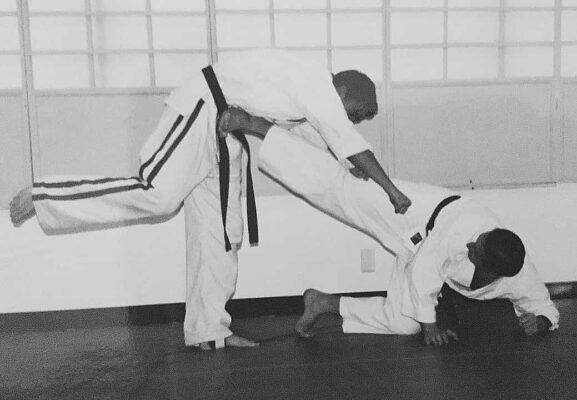
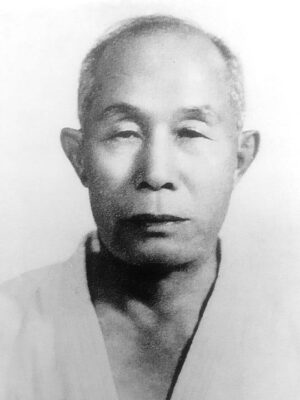
Hapkido was founded by a Korean martial artist, Choi Yong-Sul (1904-1986). Choi was born in what is now North Korea and was adopted by a Japanese family at a young age. As a young man, he studied martial arts in Japan, including Daito-ryu Aiki jujutsu.

Grand Master Yong Sul Choi
Photo by Tokaria

After World War II, Choi returned to Korea and began teaching martial arts. He combined his knowledge of Daito-ryu Aiki jujutsu with traditional Korean martial arts and his own innovations to create Hapkido

Choi’s unique approach to martial arts emphasized fluid, circular movements and using an opponent’s energy against them.

Choi’s teachings attracted many students, and Hapkido quickly spread throughout Korea and eventually worldwide. Choi continued to teach and develop Hapkido until he died in 1986.

Although Choi is widely credited as the founder of Hapkido, the martial art has continued to evolve and develop over time, with different schools and practitioners adding their own techniques and approaches to the art.

What does Hapkido focus on?

Hapkido is a martial art that focuses primarily on practical self-defense techniques, emphasizing circular and fluid movements to control an opponent’s energy. 

Hapkido is built upon a set of principles that guide the techniques and movements used in the martial art. These principles are essential to understanding the effectiveness and uniqueness of Hapkido.

  • The Unity of Opposites. The first principle of Hapkido is the unity of opposites. This principle is based on the concept that everything has an opposite and that these opposites constantly interact. In Hapkido, this principle is applied to the idea of softness and hardness. Practitioners learn to use soft and hard techniques and switch between them seamlessly, depending on the situation. 
  • The Circle Principle. The circle principle is another important principle in Hapkido. It is based on the idea that circular movements are more efficient and effective than linear movements. In Hapkido, circular movements are used to redirect an attacker’s force, making it easier to control them and defend yourself. This principle is also applied to the concept of flow, as Hapkido practitioners are taught to move in a fluid and continuous manner without stopping or hesitating.
  • The Water Principle. The water principle is the final principle of Hapkido. It is based on the idea that water is the most powerful force in nature because it can adapt and flow around obstacles. In Hapkido, practitioners are taught to be like water and adapt to any situation. This principle is closely related to the circle principle, as circular movements are also a key aspect of the water principle.

Together, these principles make Hapkido a highly adaptable and effective martial art. By learning to use both soft and hard techniques, circular movements, and the ability to adapt to any situation, practitioners can defend themselves against any attacker, regardless of their size or strength.

What Are the Main Hapkido Techniques?

Hapkido is a martial art that emphasizes practical self-defense techniques, including joint locks, throws, strikes, and pressure points.

Hapkido does not promote the use of grappling as the belief is that you need to keep distance between you and your attacker to have space to counter their attacks and redirect their energy to your advantage.

  • Joint Locks. Joint locks are a central part of Hapkido’s technique. They involve applying pressure to an opponent’s joint in order to cause pain or immobilize them. Joint locks are often used to subdue an attacker without causing them serious injury. 
  • Throws. Throws are another key technique in Hapkido. They involve using an opponent’s momentum to throw them to the ground. Throws are often used to neutralize an opponent’s attack and create distance between the practitioner and the attacker. 
  • Strikes. Strikes are also an important part of Hapkido’s technique. They involve using kicks, punches, or other strikes to inflict damage on an attacker. Strikes are often combined with joint locks and throws to subdue an attacker quickly. Hapkido strikes are designed to be powerful and efficient, emphasizing accuracy and precision.
  • Pressure Points. Pressure points are specific points located on the body where pressure can be applied to cause pain or discomfort. In Hapkido, pressure points are often combined with joint locks and strikes to subdue an attacker. Some common pressure points used in Hapkido include the temple, the collarbone, and the base of the neck.

Hapkido’s techniques are designed to be practical and effective, allowing practitioners to defend themselves against any type of attack. 

Is Hapkido Good for self-defense?

Hapkido is a martial art that is specifically designed for self-defense. Its techniques are practical and effective, and its emphasis on circular and fluid movements allows practitioners to control an opponent’s energy and gain the upper hand in a self-defense situation

However, every martial art has its weaknesses, so there is no perfect martial art. The main weakness of Hapkido is that no grappling techniques or ground fighting moves are taught

If your opponent manages to get you on the ground, no techniques in the Hapkido arsenal teach you how to fight from this position.

Another criticism of Hapkido is that the techniques must be executed flawlessly to be effective. Unless you are proficient in Hapkido to a high level, you may not have the time or space to execute the techniques perfectly, rendering them ineffective against a determined attacker.

Does Hapkido Use Weapons?

While Hapkido is primarily known for its unarmed self-defense techniques, it also includes the use of various traditional Korean weapons. Hapkido practitioners learn how to use weapons such as the cane, short stick, long staff, and sword.

Using weapons in Hapkido complements and enhances the practitioner’s unarmed self-defense skills

It’s worth noting that while weapons are an important part of Hapkido, they are not typically taught to beginners. Students usually begin by learning the basics of unarmed self-defense techniques before progressing to weapon training.

Is Hapkido Hard To Learn?

Learning Hapkido requires time, dedication, and practice, like any martial art. However, whether or not Hapkido is hard to learn depends on several factors, including the individual’s physical abilities, prior experience with martial arts or sports, and learning style.

Some aspects of Hapkido, such as learning the basic movements and techniques, can be relatively easy. These skills can be taught to beginners in a structured way, with a clear progression of skills and techniques.

Advanced techniques require a higher level of physical skill, flexibility, and mental focus. Additionally, Hapkido emphasizes fluid and dynamic movements, which can take time to master.

Hapkido can be a dangerous martial art to study, as you can sustain injuries from forceful contact or damage to joints if locks and holds are not applied correctly. However, this can be said for many other martial arts, such as Aikido, where similar injuries can occur.

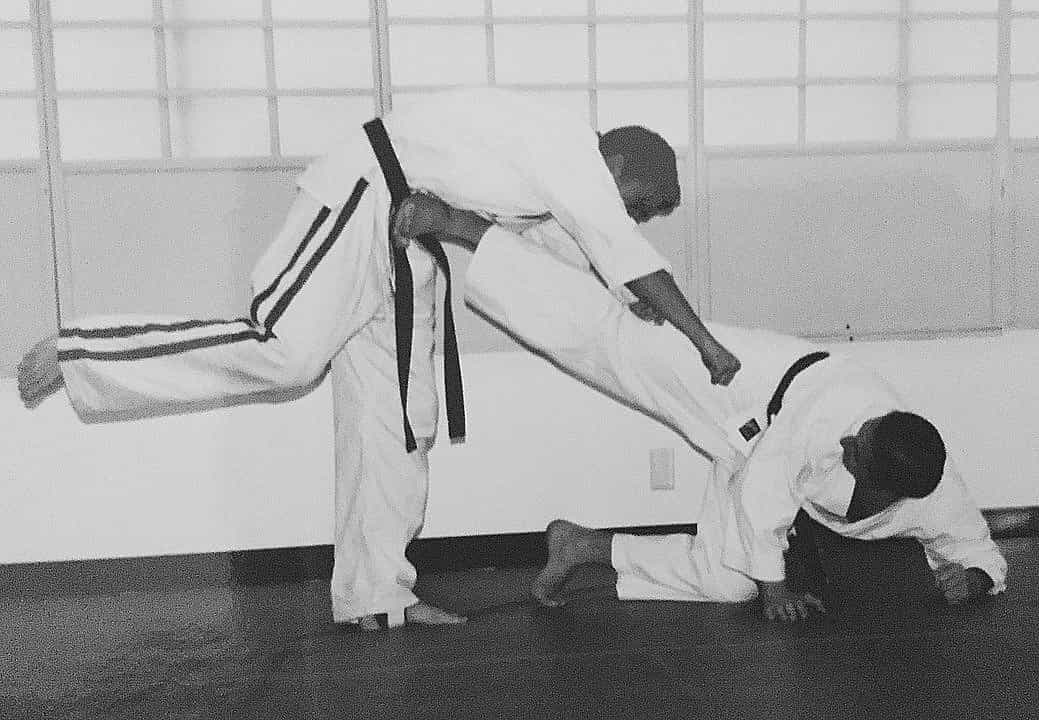
Hapkido throw
Credit: Wikimedia

Hapkido requires dedication and practice, but it’s not necessarily more difficult than other martial arts. The key is finding a qualified instructor and committing to consistent training over time. With dedication and practice, anyone can learn and master the techniques of Hapkido.

How Long Does It Take To Learn Hapkido?

The time it takes to learn Hapkido can vary widely depending on several criteria, including the individual’s natural ability, level of commitment, frequency of training, and the quality of instruction they receive.

Most Hapkido schools divide their curriculum into levels or belts, each indicating a certain degree of proficiency and mastery of Hapkido techniques. The time it takes to progress through these levels can vary from school to school, but generally, it takes several years of consistent training to reach advanced levels.

On average, reaching the black belt level in Hapkido may take around 3-5 years. However, this can vary significantly depending on the individual’s training schedule, natural ability, and level of dedication.

Hapkido is not a martial art that can be learned quickly or easily. It requires consistent practice and dedication over a period of years to truly master the techniques and principles of Hapkido.

Why Is Hapkido Not Popular?

Hapkido is a highly effective martial art with a rich history and a wide range of techniques and skills. However, compared to other martial arts like Brazilian Jiu-jitsu (BJJ) or Taekwondo, Hapkido is relatively less well-known and popular, especially outside of Korea.

  • Hapkido is often overshadowed by more well-known martial arts, especially those popularized through media and pop culture. 
  • Hapkido can be challenging to learn and requires a high level of commitment and practice, which can be a barrier to entry for some people. 
  • A lack of awareness and understanding about what Hapkido is and what it has to offer.
  • Hapkido has many techniques, many of which are complex and take a long time to master. 

However, despite its relative lack of popularity, Hapkido remains a highly respected and effective martial art.

RELATED:
Do Most Traditional Martial Arts Actually Work?

Is Hapkido the Same as Aikido?

Hapkido and Aikido share similarities in their focus on joint locks, throws, and fluid movements. However, they are distinct martial arts with different origins, techniques, and philosophies.

The similarities between Hapkido and Aikido stem from the fact that both martial arts forms have their roots in Daito-ryu Aiki jujutsu.

Hapkido has a strong influence based on Korean martial arts techniques, while Aikido’s influence is mostly from Japanese martial arts.

Hapkido incorporates some kicks into its techniques, while Aikido does not include any kicks in its array of techniques.

While there are some similarities between Hapkido and Aikido, they are different martial arts with distinct techniques and philosophies. However, practitioners of both arts may find value in studying the other, as they can complement and enrich each other’s training.

Hapkido vs. Taekwondo: Which is Better?

Hapkido and Taekwondo both originated in Korea. While the two have some basic similarities, they are distinct martial arts with different techniques, focuses, and philosophies.

Taekwondo is a martial art primarily focusing on striking techniques, including high and mid kicks, punches, and strikes. It places a strong emphasis on discipline, respect, and self-control.

On the other hand, Hapkido is a martial art that emphasizes practical self-defense techniques, including joint locks, throws, and strikes. It also incorporates aspects of meditation and breathing techniques to develop mental focus and awareness.

Both martial arts have their strengths and weaknesses, and the better option will depend on the individual’s goals and preferences. 

For example, Taekwondo may be a better choice for individuals looking for a more rigorous physical workout or those interested in competitive sparring. 

Hapkido may be better for those looking to develop practical self-defense skills and a greater emphasis on joint locks and throws. 

Ultimately, the decision between Hapkido and Taekwondo will depend on the individual’s goals, preferences, and needs. It may be beneficial to try out both martial arts and see which one resonates with you the most.

Who Should Learn Hapkido?

Hapkido is a martial art that anyone can learn and practice, regardless of age, gender, or physical ability. The techniques and skills taught in Hapkido are adaptable and can be modified to suit the individual’s needs and abilities.

Hapkido is useful for those facing opponents larger and stronger than themselves, which is why it is a popular self-defense style for women. The self-defense focus of the martial art makes it useful for anyone interested in learning self-defense techniques.

People looking to challenge themselves physically and mentally may also find Hapkido a rewarding martial art to study. The techniques and skills taught in Hapkido require practice, dedication, and discipline to master, which can be both challenging and fulfilling.

RELATED:
What is Gracie Jiu-Jitsu? Fully Explained

Summary

Hapkido is a dynamic and practical martial art that emphasizes joint locks, throws, strikes, and self-defense techniques. Its lack of popularity outside of Korea is largely due to a lack of general awareness and few dojo’s with proficient instructors to train students in the art.

While Hapkido is not as well-known as other martial arts, such as Karate or Taekwondo, it is still a valuable and effective martial art to study for those interested in practical self-defense, mental and emotional control, and physical conditioning. 

How Does Taekwondo Belt Promotion Work? Easy Guide

0

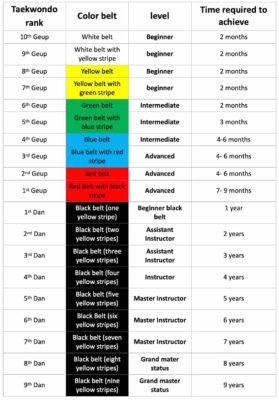
Each belt in the Taekwondo (TKD) ranking system defines the level of experience and has a certain meaning. The goal is always improving your skills and moving from one rank to the higher one. But what are the exact requirements? How does belt promotion work in Taekwondo?

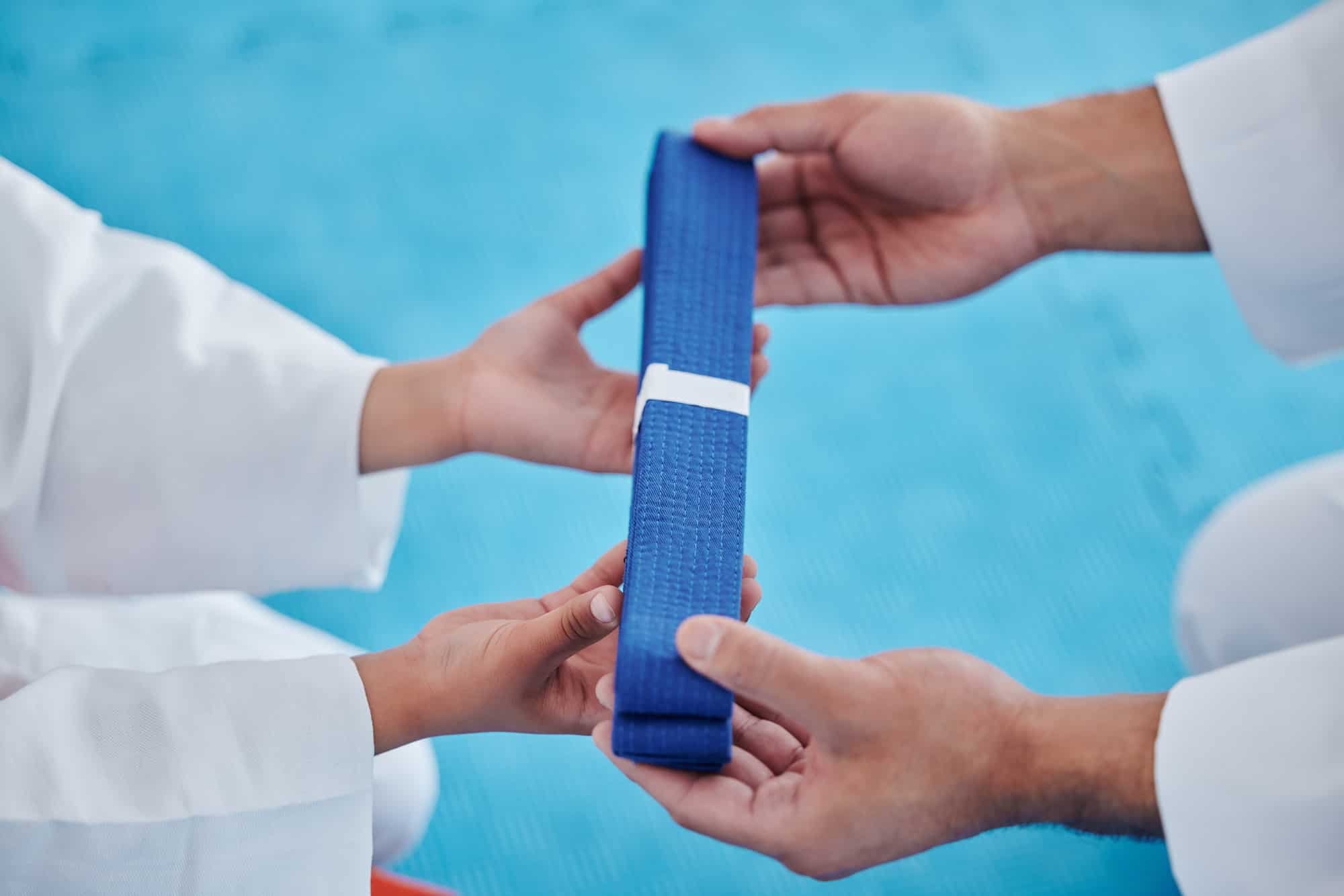
Eligible taekwondo students will get an invitation to take a belt promotion test before the examiners. There are physical exercises, forms, sparring, breaking boards, and a written test as part of the promotion test. Examiners will promote you to a higher belt if you meet all the requirements.

This is just a brief explanation of how testing work in Taekwondo. Thus, be sure to read this article to learn more about it.

How does TKD belt promotion work?

Official belt promotions for geup (junior ranks) are hosted quarterly. Mostly in February, May, August, and November, though this varies depending on the governing bodies.

In general, a student will receive an invitation to participate in promotion testing from their main instructor. The invitation is usually sent well in advance of the test, giving you enough time to focus on specific tasks and prepare. Each belt rank requires different sets of techniques and skills, and you will spend most of the time enhancing these areas of your game to pass the test. Of course, the progression gets harder as a student reaches higher or more advanced ranks.

The main goal of promotion testing is to showcase progress such as improved technique, conditioning, reflexes, and an overall understanding of TKD principles. From the instructor’s point of view, the purpose of belt promotion is to signify and approve your progress and give you extra motivation to work even harder and stay on the right path.

It should be noted that the way promotion works differs between the styles of Taekwondo, countries, and even schools. Though standardized, there are certain differences when it comes to requirements for each level as well as the overall promotional criteria.

What does TKD belt testing consist of?

Physical exercises — are a part of every promotion testing, regardless of the belt. Students must showcase a high level of conditioning by performing different bodyweight exercises. This includes push-ups, squats, and sit-ups. The number of reps varies between the ranks and gets harder as you move to the higher ranks.

Forms — are also known as “poomsae” and are sets of a pre-arranged set of techniques and combos. Students perform these moves alone without a training partner. The key is to carry out specific techniques in a focused, confident manner and with perfect technique. This includes a demonstration of kicks, punches, and breaking boards. And each move is closely evaluated to the slightest detail during the process.

Sparring — is a part of testing where a student needs to demonstrate a high level of proficiency in applying techniques against a fully resisting opponent. For example, black belt testing includes three rounds of sparring against another black belt, with each round lasting 1.5–2 minutes on average. The main goal is not to win the exchange at all costs but to show a high level of skill in executing techniques against a legitimate black belt.

Written test — is usually required at the senior ranks. Students need to showcase an understanding of Taekwondo terminology, history, and philosophy.

Breaking boards — is usually the final part of testing. Depending on their age and skill level, students will break boards with their hands and kicks. Kids below nine usually break five thin boards, while advanced students above 18 years old must break a 2-inch thick board.

RECOMMENDED:
Is Taekwondo Good for Kids? Parents’ Guide to Taekwondo FAQ

What are the requirements for each Taekwondo belt?

Here is a list of the technical skills that students need to learn and show to examiners in order to advance from one belt rank to the next. Remember that the exact techniques significantly differ between organizations, countries, and schools. This is a general guideline for the level of technique you can expect at each belt rank.

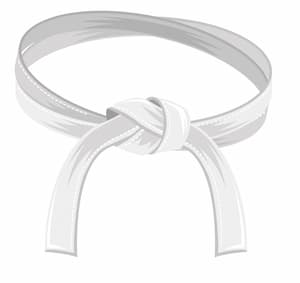
White belt requirements

StancesBlocksFist strikesKicking techniquesStrength and conditioning
Attention stanceLower blocksFront-hand middle punchRoundhouse kick10 jumps
Ready stanceOuter blockDouble punchFront snap10 push-ups
Fighting stanceMiddle blockReverse PunchSide kick10 sit-ups
Front stanceHigh blockPalm strikeJumping front and side kicks10 squats

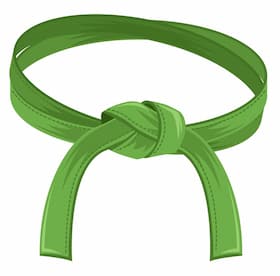
Green belt requirements

StancesBlocksHand strikesKicksStrength and conditioning
Back stanceLower blockBack knuckle forward strikeJumping front leg25 push-ups

Inner blockLift punchHook kick25 jumps 

Outer blockDownward punchOutward/Inward Crescent kick50 sit-ups

Palm blockHammerfistRear/Front foot counter kick

Pressing block
Instep turn kick


Back kick

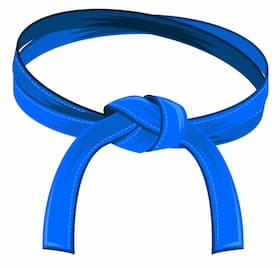
Blue belt requirements

StancesBlocksStrikesKicksStrength and conditioning
Rear cross stanceTrunk Push Low blockVertical punchPushing front and side kick25 jumps
Cross stanceHigh outside blockTurning punchPushing kick25 push-ups

Outside wrist pressing blockElbow rear strikeJumping back kick50 sit-ups

Palm Heel pressing blockTurning elbowJumping turn kick

Palm heel inward blockDownward elbowSpin hook kick


Outward back fist

Red belt requirements

StancesBlocksStrikesKickingStrength and conditioning
Tiger stanceOne hand wide open blockTurn over punchTwisting kick60 jumps
Forward cross stanceInside wrist double blockSide PunchScissors kick60 push-ups

Hand blade double blockDownward and inward chopFront foot whip kick100 sit-ups

Palm heel blockForward chopBack whip kick

Scissor block
Front kick with the heel

Black belt requirements

StancesBlocksStrikesKickingStrength and conditioning
Crane stanceInward/outward kicking blockExtended knuckle fist360 degree back whip kick80 push-ups
Assisting StanceFront/side kicking blockFork punch540 degree back whip kick100 squats
Inner knee stanceDiamond blockKeumgang punchRepeating turn/side/flip kicks130 doubles
Log Pushing PostureBull horn blockPalm heel forward strikeJumping back whip kick10 pull-ups


Scissors fingertip thrustJumping flip kick

How long does It take to advance through each TKD belt?

In some schools with weak criteria that promote their dojo as a place where a “black belt is secured in a short time,” you can reach a 1st-degree black belt in a year or two. However, traditional schools with good reputations stick to strict criteria; it usually takes between 3 and 5 years for a student to reach the same rank.

Following is a simple chart of how long it takes to obtain each belt in Taekwondo’s junior and senior ranks. However, keep in mind that the progression is based on individual talent, dedication, promotional criteria, and the school you train at.

RELATED:
Taekwondo Belt Ranking System – EASILY Explained For Beginners

What happens when you fail the Taekwondo promotion test?

Failing a Taekwondo test is not the end of the world and is considered a part of the learning process. If you fail, your main instructor and examiners will explain to you the reason you failed. Then, they would say what you could have done better and advise which areas you need to work on to improve, come back, and pass the test.

Also, you don’t need to wait long before you can attend the testing again. When it comes to the junior ranks (geups), testing is organized quarterly. This gives you enough time to improve, come back, and pass the test.

Remember that seeing a student fail a promotion test is uncommon. By the time they step on the mats to perform, most students have already mastered the required techniques and skills. If they didn’t, they wouldn’t receive an invite from their main instructor after all. The instructor would extend the time before you can be graded and give you more time to improve your form before you are deemed ready for a higher belt.

The main reason TKD students fail a test is not a lack of skill. Some students actually get overwhelmed by the pressure of the moment and get too anxious. This may lead to some mistakes during the demonstration.

Can you get double-promoted in TKD if you are really good?

Taekwondo students can “skip” a level and get double promoted if they show the required skill level, but this rarely happens. In most cases, students who get double promoted already have previous experience in a conceptually similar martial art, such as karate.

Those who get double promoted because of their athleticism and ability to adopt knowledge and progress are way ahead of other students in their group. Once the main instructor spots you progressing faster, they will consider inviting you to a double promotion test.

However, most schools prefer to stick to the standardized learning curriculum without making these types of exceptions. This is notably true for schools that embrace traditional methods of teaching and ranking. According to their philosophy, developing skills and adopting the philosophy of Taekwondo must be done steadily, and you have to enjoy the process.

Is there a fee for TKD promotion?

Students are required to pay a fee whenever they are attending promotional testing. Of course, the exact price varies between the organizations, and the economic standard is not the same in all countries. For the purpose of this article, let’s focus on the Taekwondo testing fees in the US.

If you are applying for a color belt test (geups), the fee ranges between $30 and  $100 in some states and schools. In some cases, the main instructor takes the entire fee for their time. But in other cases, a large portion of it is actually sent to the association that organizes the testing. However, the instructor provides the certificate and color belt you receive, not the association.

The price of Taekwondo black belt exams (dan ranks) is significantly higher. For example, a student has to pay between $150 and $500 for the 1st-degree black belt test in all three major TKD styles, ATA, ITF, and WT. The price includes a color belt, a certificate, and, in some rare cases, a brand new uniform. The testing price progressively goes up as you move through the other nine black belt ranks.

The prices in other countries and the way the fee system works differ greatly, and it is almost impossible to come up with close numbers. For example, the fees are much lower in some economically undeveloped countries. Also, schools with a long history and good reputations tend to charge more than the new ones, and many other variables determine the price.

Do you have to compete in a tournament to get promoted?

Most Taekwondo schools, notably traditional ones, rely solely on the skill you demonstrated in testing when it comes to belt promotion. Being a solid competitor and continuously winning matches in competition further confirms your skill level. But the results themselves do not make your life easier in testing for a higher belt.

However, some other styles, like World Taekwondo (WT), for example, rely heavily on the competition. The entire learning curriculum is designed to align with the competition’s official rules. Hence, the belt progression is centered around the competition. WT instructors often rely on your results in matches as a benchmark for your level of proficiency. But even in these styles, competing in a tournament is not a requirement for a higher rank.

RELATED:
Olympic TKD vs. Traditional TKD – Key Differences Explained

What is the difference between TKD promotion and BJJ promotion?

Both of these martial arts include belt promotions, but the way students get promoted differs a lot because there is no belt testing in BJJ.

Brazilian Jiu-Jitsu has a similar ranking system, but no official belt testing is organized by the BJJ association or other governing body. There is no board of examiners in front of which you need to perform.

Instead, BJJ students get promoted by their main instructor. It is entirely up to the main instructor and their subjective opinion to decide whether a student has reached a certain level of proficiency required for the higher rank. This also means that students can be promoted at any time, which often catches them by surprise.

Taekwondo differs in every way because, in order to move from one rank to the next, students need to attend official belt testing. Depending on the rank, testing is organized a couple of times a year, usually quarterly. They need to perform in front of the board of examiners, including their main instructor, and showcase the required level of proficiency. Once they pass, they will receive an official certificate and a new rank belt.