Home Blog Page 4

What Is Considered “Dirty Fighting” In Combat? FAQ

0

Since the dawn of civilization worldwide, humans have created numerous combat systems and tactics to survive warfare. As such, one highly controversial but effective and vicious fighting method is commonly known as “dirty fighting.”

Dirty fighting generally refers to a pure self-defense tactic that aims to quickly inflict excruciating pain on vulnerable bodily areas using any necessary means where there are no rules.

In combat sports, where fighters must adhere to the rules, dirty fighting also refers to the use of unconventional tactics or strikes. While some may view dirty fighting as nothing more than cheating and dishonorable to use in combat, some combat arts incorporate dirty fighting as a significant part of their practice.

This is a brief overview of dirty fighting. In this article, we’ll delve deeper into dirty fighting to give you a complete understanding. Furthermore, we’ll look at some different combat styles that use dirty fighting techniques. Let’s get started.

What Is Considered Dirty Fighting?

There are two major ways to define dirty fighting: without rules or with rules.

Dirty fighting without rules

The concept of dirty fighting, or “fighting dirty,” is typically associated with using any means necessary to defend oneself, such as employing vicious moves in a street fight where the end justifies the means.

For example, dirty fighting includes eye gouging, punching the throat, kicking or squeezing the groins, hair pulling, biting the attacker by the arm, kicking them while they are grounded, or using notorious headbutts. Simply put, using “barbaric” techniques to target vital organs or using non-traditional strikes that cause instant severe pain or injury is considered dirty fighting.

At the same time, the use of nearby objects to strike their assailant, such as a glass bottle or stick, is also considered a dirty fighting tactic.

So, as you can see, dirty fighting in these circumstances, without rules, is generally about unleashing your violent instincts and aggressiveness for survival.

Dirty fighting techniques in street fights

Dirty fighting with rules

Dirty fighting, sometimes referred to as “dirty boxing,” has an entirely different meaning in combat sports, where the rules are enforced. It refers to a fighting style where a fighter schemes with the rules to gain an advantage or strikes their opponent in unconventional ways. Despite being frowned upon, some dirty moves are allowed, or maybe illegal, under certain rules.

Dirty fighting moves in combat sports generally include striking with elbows, punches, and knees while in the clinch. Also, stomping feet, using headbutts to strike the opponent’s face in a way that looks accidental, and landing illegal strikes when the referee is not looking are all part of dirty fighting.

Why Is It Called “Dirty Fighting” in Combat Sports?

Seeing someone apply unsportsmanlike techniques such as eye-gouging or pulling hair visually looks “dirty,” “nasty,” or “awful” in a street fight, which likely led to the origin of the term.

In combat sports competitions, however, there are clear rules about what types of techniques contestants are allowed to use and what they are not allowed to use. Breaking these rules and using illegal techniques can inflict serious injuries and long-term damage and, in some cases, even be lethal.

Thus, using dirty moves in combat sports is frowned upon as cheating or fighting dirty, and over time, the term “dirty fighting” has become part of the martial arts vernacular. It became a metaphor for a fighting style that doesn’t win in a fair way but cheats at the cost of seriously hurting their opponent.

RELATED:
Does MMA Work In a Street Fight?

When Is It Acceptable to Fight Dirty?

When your life is in danger, fighting dirty is not considered cheating or illegal but rather a survival tactic to protect yourself or your loved ones.

When dealing with an assailant on the street, they are not bound by any rules. As a result, you, as a defender, using any necessary fighting techniques, even those considered dirty, to protect yourself is acceptable and justifiable in a court of law.

However, recognizing the fine line between defending oneself and becoming the aggressor is also crucial. If you have successfully subdued the attacker and they have surrendered, then it’s over. There is no need to resort to further violent and dirty techniques, such as delivering brutal soccer kicks to their heads while standing up or poking their eyes when it’s over.

Ironically, if you cause unnecessary physical damage to your assailant after they surrender, you could end up in legal trouble instead of being praised for protecting yourself.

What you want to avoid is severely injuring your attacker unnecessarily after you have successfully and justifiably managed to defend yourself, and it’s over, but you end up in prison when it should be the opposite.

RECOMMENDED READING:
What is Gracie Jiu-Jitsu?

What Does Dirty Boxing Mean?

Dirty fighting in the striking arts is often called “dirty boxing.” Dirty boxing generally refers to using various unorthodox boxing techniques and tactics, which can sometimes be on the borderline of being illegal or downright illegal, depending on the sport, to gain an advantage in a fight.

One great example of dirty boxing is when a fighter strikes the opponent with short, rapid punches with one hand from the clinch position while holding the back of their head with the other hand to restrict their opponent’s head movement. See the below picture for a dirty boxing illustration.

Dirty boxing
Credit: mmawiki.org

More examples include when a boxer tries to gain an advantage by hitting their opponent with sneaky shoulder bumps, sucker punches, hitting the back of the head, headbutting them inside the clinch, or repeatedly pushing their opponent’s face or body with their forearms.

Many boxers frequently use these borderline illegal tactics, hoping to go unnoticed by the referee or appear unintentional in their execution. As such, dirty boxing also means manipulating the rules and getting away with illegal techniques.

So, is dirty boxing always frowned upon, then? No, it’s not. Some dirty boxing moves are legit techniques. For example, you will often see a boxer using their head and shoulders to push their opponents into a disadvantageous position during a fight, which is also described as dirty boxing technique.

Dirty boxing techniques explained

What Does Fighting Dirty Mean in MMA?

Fighting “dirty” or dirty fighting is a metaphor used in MMA to describe a fighter using various unconventional but mostly legal techniques and methods to gain an advantage in a fight. As the most complex combat sport, MMA rules give athletes a lot of leeway to use various types of non-traditional techniques to make their game more rounded and unpredictable, which can sometimes be considered dirty fighting.

For example, a fighter may initiate the clinch position, where they will throw short-rapid punches while holding the opponent’s back of the head to break their posture, which is legal to do in MMA. Then, the fighter might start stomping their opponent’s feet to hurt their feet or knees to the thighs and side of the opponent’s knee to compromise their movement.

Conor McGregor famously used shoulder strikes to break Donald Cerrone’s nose at UFC 246, which is another practical dirty fighting technique.

Because MMA fighters wear open-fingered gloves, their fingers are exposed and can cause issues during a fight, unlike boxers, whose fingers are fully covered. MMA fighters risk accidentally poking their opponents in the eye or putting fingers in their mouth or nose, and these actions are considered “fighting dirty,” which is greatly frowned upon by fighters. However, if the referee determines that these actions were intentional, the fighters may face penalties or even disqualification.

During the UFC 281 fight between Michael Chandler and Dustin Poirier, Chandler attempted to lift Dustin’s head by putting his fingers in Dustin’s mouth, trying to secure a rear naked choke. Chandler was heavily criticized for fighting “dirty.”

Which Martial Arts Teach Dirty Fighting?

There are a number of martial arts around the world that teach a person how to use dirty fighting techniques effectively in combat situations. Most of these hand-to-hand combat systems were created for the military and law enforcement and later became accessible to other people.

For the purpose of this article, we have focused on the most popular ones:

Krav Maga

Krav Maga is a hybrid martial art developed by the Israeli Military in the 1950s, which later became popular worldwide for effectiveness. The system focuses solely on self-defense and preparing individuals for real-life combat situations.

There is no competition or rules of any kind, as the entire concept revolves around you using everything you can to protect yourself as fast and efficiently as possible. If that means grabbing a rock off the ground and hitting the attacker, that’s what you are trained to do.

The learning curriculum includes striking with all points of contact, wrestling, judo trips and throws, and joint locks and chokeholds from jujutsu and BJJ. It also teaches a person how to disarm the attacker and use dirty fighting techniques such as gouging eyes, fish hooking, attacking the groin area, and much more.

Students also learn what to do in different environments, maintain high awareness, assess their situation, and develop a strategy to deal with a violent situation in a split second.

Although all these may sound brutal at first glance, they’re what make Krav Maga so effective and popular worldwide.

Lethwei

Lethwei is a combat sport from Myanmar that is also known as Burmese boxing. Lethwei fighters can fight at all ranges, including the clinch, from which they often throw each other with trips and throws, but are not allowed to strike the grounded opponent.

People within the martial arts community often describe Lethwei as a more brutal variation of Muay Thai. The two systems share very much the same techniques regarding striking, standup grappling, and rules of competition. But what makes them different is the fact that Lethwei adds dirty fighting techniques on top of this.

Lethwei, known as the “Art of Nine Limbs,” incorporates a unique and controversial dirty fighting technique – headbutts. While banned in many other combat sports, headbutts are a crucial technique in Lethwei fighting, which also involves the use of fists, elbows, kicks, and knees.

Watching Lethwei matches, you can often see fighters breaking their opponents’ noses or knocking them out cold with headbutts. On top of that, contestants do not wear padded gloves as they compete bare-knuckle.

This mix of bare-knuckle striking and infamous headbutts gave Lethwei a reputation for being one of the most brutal and dirtiest combat sports.

Wing Chun

Wing Chun is one of the most popular Chinese martial arts styles, designed for close-range combat and heavily reliant on dirty fighting tactics to target soft tissue areas in humans. This art focuses on striking areas such as the eyes, throat, groin, and cheeks, with the goal of incapacitating the opponent quickly and effectively.

Wing Chun teaches you to deliver fast and precise strikes to the attackers’ vital points down the center of their bodies, such as the neck, chest, belly, kidney, or groin. The point is to execute strikes in a relaxed manner and use the attacker’s momentum against them to generate force and do damage.

The system focuses on economic movement, intercepting the opponent’s attacks with blocks and rapid punching and kicking.

Combat Sambo

Combat Sambo is a Russian military combat system developed in the 1920s. But in modern times, combat sambo is being taught to anyone who wants to learn self-defense. There is also a sport variation called sport sambo, where they can put their skills to the test against other practitioners.

As a concept, Sambo resembles modern MMA fighting to a large degree because it is also a hybrid mix of striking, grappling, and ground fighting. The military version of combat sambo includes weapon-based training where practitioners learn to defend against various weapons and firearms. It also teaches dirty fighting techniques for close-range combat, making it comparable to Krav Maga.

Dirty fighting techniques include pressure-point attacks, targeting vital organs, eye-gouging, striking the throat, and even how to use grappling moves in a “dirty” way. Instructors teach joint locks and submissions for combat purposes, which are more violent than regular BJJ classes.

In combat sambo, throwing a strike means aiming to knock out the opponent, while going for a takedown means slamming them to the ground with great force. These full-force attacks can be viewed as dirty fighting, but the core objective is to execute each move with maximum force and defeat the opponent as quickly as possible.

Among many other reasons, this is why sambo fighters in MMA, like Khabib Nurmagomedov and Fedor Emelianenko, were so explosive and aggressive compared to other fighters because they were trained to be very aggressive.

Combat sambo for streetfighting self-defense

Jujutsu (Traditional Japanese Jiu-Jitsu)

Japanese Jujutsu is one of the most influential martial arts and a precursor to many other martial arts, such as Judo and different styles of Jiu-Jitsu. Jujutsu was practiced by the Samurai warriors, who used the art on the battlefield during the feudal period.

The system was designed to cover all the elements of fighting in warfare by teaching you how to neutralize the enemy in the most efficient way possible.

Apart from conventional techniques such as punches and kicks, joint locks, and takedowns, Jujutsu teaches how to break bones and necks or use other dirty fighting methods such as eye gouges to cause as much pain and damage as possible.

Jujutsu also taught samurai to quickly dispatch their enemies using swords and even using the enemy’s weapon against them.

Demonstration of Samurai using Jujutsu

What Are the Different Styles of Chinese Martial Arts?

0

Since ancient times, martial arts practice has been deeply rooted in Chinese culture and lifestyle. The Chinese have developed various martial arts styles throughout history, which have greatly influenced and inspired the creation of many other martial arts around the globe.

With that in mind, have you ever wondered how many different styles of Chinese martial arts exist and how they are categorized?

Overall, Chinese martial arts styles can be classified based on their geography and philosophy. The most common classification is based on geography, with “Southern” styles like Wing Chun and “Northern” styles like Shaolin Kung Fu.

Philosophical classification is based on styles that can be classified as either “External,” which emphasizes strength and cardio, or “Internal,” which centers around manipulating energy and force within, which is known as “qi” energy.

Let’s explore the history and popular styles of Chinese martial arts.

History of Chinese Martial Arts

Legend has it that Chinese martial arts practice dates back 4,000 years to the Xia Dynasty. The story goes that the Yellow Emperor, Huangdi, a mythological figure, developed the earliest combat systems to help the military. These systems focused mainly on grappling techniques and weapon training for Chinese soldiers.

However, the first evidence of martial arts practice in China points to “juélì,” a wrestling-based system developed in the 5th century BCE. Apart from wrestling, juélì also included hard and soft striking, joint locks, and pressure point attacks. During the Han dynasty (206 BCE–8 CE), there was weapon-based practice (shoubo) and sports (juélì).

The first organized Chinese martial arts began to emerge with the establishment of Shaolin temples (500 CE). The first Buddhist monks, Huiguang, Sengchou, and Huike, were skilled in martial arts, possibly due to their military background before joining the monastic life. The trio developed a system that would later become known as “Shaolin Kung Fu” during the Ming dynasty in the 16th and 17th centuries.

Shaolin Kung Fu
Photo by Shi Deru

At this moment, it’s worth mentioning that “Kung Fu” is an umbrella term. People outside of China tend to use it to describe a single fighting style. But in reality, kung fu is a general term for just about all Chinese armed, unarmed, or hybrid combat practices.

The popularity of Kung Fu styles skyrocketed in the 20th century with the changes within Chinese society, the fall of the Qing Dynasty, and the creation of the Chinese Republic. During this transition, martial arts practice became more accessible to the general public.

The Chinese government created numerous organizations that utilized martial arts as a means to boost national strength and pride. Some of the styles that emerged during the Republican period were:

  • Drunken Boxing
  • Wing Chun
  • Tai Chi

However, Chinese martial arts would undergo another reform during the Chinese Civil War and later the Chinese Cultural Revolution (1969–1976). During this time, they established the All-China Wushu Association to unify and standardize martial arts practice. Wushu practice was also integrated into the educational system and became an integral element of Chinese popular culture.

RELATED:
What Are the Different Styles of Japanese Martial Arts?

Chinese Martial Arts Styles

Throughout history, the Chinese have created over one hundred different styles. Each of these styles has different characteristics, philosophies, legends, principles, techniques, and religious influences. As you would assume, this makes classifying these arts quite difficult.

To simplify it all and make it easier to understand, let’s classify the most popular Chinese systems into four different styles based strictly on their orientation:

  • Striking arts
  • Grappling arts
  • Weapon-based arts
  • Hybrid arts (a combination of two or more of the above arts put together)

Chinese Striking Arts

Wing Chun

Although Wing Chun includes limited grappling techniques such as trips and throws, it is primarily known as a striking martial art. It is a self-defense combat system designed for close-range hand-to-hand combat. Its origins come from traditional Shaolin Kung Fu practices, and it is classified as a Southern Kung Fu style.

The concept of Wing Chun revolves around intercepting attacks with fast strikes. The main goal is to stick with the opponent’s centerline and back them off using rapid punches, kicks, and elbow and knee strikes.

Practitioners are trained continuously to maintain high spatial awareness, which allows them to out-position the opponent, intercept their attacks, and fire rapid counters. They stand in a narrow, relatively high stance, with their elbows slightly forward from their bodies.

Next, students learn how to use dirty tactics such as eye pokes, strikes to the groin area, or pressure points. There are also unconventional techniques, such as slapping, which is used as a defensive maneuver to force the opponent to move from their centerline.

The learning curriculum puts a lot of emphasis on forms and the execution of techniques in a soft and relaxed manner. Students must learn how to control their minds, breathing, and energy to develop Chi. But unlike many other similar arts, modern Wing Chun includes sparring. This is where students simulate self-defense scenarios to learn how to apply these techniques in real life.

In the Western world, Wing Chun was popularized by the famous grandmaster, Ip Man, who is directly responsible for spreading the art outside of China. Ip Man’s most famous student was the actor Bruce Lee, who would later move to the US, where he became a martial arts icon.

RELATED:
What Are the Different Styles of Korean Martial Arts?

Chinese Grappling Arts

Shuai Jiao

Shuai Jiao is one of the oldest Chinese martial arts; it was developed over 6,000 years ago and is considered a precursor to Chinese wrestling. The word “Shuai” stands for “to throw onto the ground,” while Jiao translates to “wrestle or trip using the legs.”

It is believed that this style has emerged from Jacket wrestling, where two contestants wear jackets and belts and use them to take each other down and subdue them on the ground utilizing pins and joint locks. The system emphasizes skill, technique, explosive strength, weight distribution, balance, and grip strength.

Practicing Shuai Jiao
Photo by Metatronangelo

Shuai Jiao visually looks similar to Judo, freestyle wrestling, or Russian sports Sambo. But the biggest difference is the rule of competition:

  • Gear — Shuai Jiao Gi jacket, which is very similar to Kyokushin karate, Gi pants (Shuai Jiao Kuzi), shoes, and belt.
  • Age limit — 18–45 years
  • Match format — continuous sparring where the match is stopped only for offenses and warnings.
  • Match duration — each match includes 2 rounds, with each round being 3 minutes long. Women’s matches last 2 minutes. In case of a draw, there is a 3rd round, which is 90 seconds. If contestants are tied after a 3rd round, the match continues, where the first contestant to win the point wins the match.
  • Points3 points for a perfect throw. The opponent must land on their back. 2 points for throws where the opponent’s knee, hands, or elbows touch the mat. 1 point is given to the contestant who forces their opponent out of bounds or if they land on top of their opponent after a throw.
  •  A competitor that manages to gain a 6-point lead automatically wins the round.

Over centuries, Shuai Jiao has developed into various sub-styles throughout the country. The most common are:

  • Zhili/Hebei style
  • Beijing style
  • Tianjin style
  • Boading style
  • Shanxi style
  • Mongolian style

Chinese Weapon-Based Arts

China has a long history of combining different weapons with its traditional martial arts practices. As a result, the majority of systems that are categorized as “hand-to-hand” also have military variations that include different types of weapon training. A good example is Wing Chun, a style of Kung Fu primarily designed for unarmed combat that also includes butterfly swords.

Generally, there are eighteen main weapons utilized in Chinese martial arts, known as the “Eighteen Arms of Wushu.” However, there exist various versions of the “Eighteen Arms,” such as Wuzazu, Shaolin, and Water Margin.

It is unclear where the list of 18 weapons originated from, and there has been controversy about which weapons are supposed to be among the eighteen. In spite of the disagreement, all different versions of the eighteen-armed list share at least one or more of the following weapons:

Wuzazu list of eighteen weapons
1. Axe
2. Bow and Arrow
3. Crossbow
4. Chinese sword (Dao)
5. Greataxe
6. Hand-to-hand combat (considered a part of a weapon)
7. Hoko yari (spear)
8. Ji (spear)
9. Jian (double-edged straight sword)
10. Jian (sword breaker)
11. Whip
12. Mace (a club with a heavy head on top)
13. Pickaxe
14. Qiang (spear)
15. Rake (Toothead bar fixed to a handle)
16. Rope Javelin
17. Shield
18. Trident (three-pronged spear)
18 weapons of Wushu

Chinese Hybrid Arts

Jeet Kune Do

Editor’s note: Some people consider Jeet Kune Do (JKD) to be a system rather than a martial art. There is debate about whether JKD should be classified as a Chinese or American martial art.

Bruce Lee, a legendary martial artist, created the self-defense combat system known as Jeet Kune Do (JKD). In some ways, JKD shares similarities with MMA in that it aims to train fighters for all styles of combat, including striking and ground fighting. This is because Lee himself believed a real “fighter” must be adaptable to any situation in combat and not bound by any specific style.

Bruce Lee challenged the norm that one particular fighting style was superior to others during his time. This was a very controversial view since all martial artists believed at the time in the superiority of their fighting style. However, Bruce believed that a fighter should be open to learning any style of fighting technique that could be useful in combat, rather than being limited to just one style.

For this reason, Lee believed in cross-training in various martial arts to avoid the rigidity of any one style. He believed that true art should evolve and incorporate useful techniques from other styles of fighting.

As a result, Bruce Lee developed Jeet Kune Do (JKD) by combining various fighting styles with a core philosophy of continual evolution, simplicity, and avoiding limitations. This philosophy is the central focus of JKD teachings.

Thus, he designed a hand-to-hand system that includes only the most effective techniques from different martial arts, such as:

JKD’s technique of takedown

Sanda

Sanda (or Sanshou) is also known as the Chinese kickboxing. But it is considered a hybrid martial art as it also includes grappling techniques.

The concept primarily revolves around punching and kicking at close range. Practitioners can also execute different types of wrestling takedowns, throws, trips, sweeps, and, in some rule sets, strikes using elbows and knees. The majority of techniques originate from martial arts, such as:

  • Kung Fu
  • Shuai Jiao
  • Karate
  • Boxing

Although Sanda includes standup grappling, practitioners are not allowed to strike grounded opponents or subdue them with joint locks or chokes. This makes Sanda quite similar to Japanese shootboxing, which has similar rules. Cung Le is an example of a successful Sanda practitioner who has competed and won in various MMA promotions, including the UFC.

The main governing body responsible for promoting the sport is the “International Wushu Federation. The International Olympic Committee (IOC) also recognizes the sport, which suggests that it might one day be an Olympic sport. There is also the military variation known as “Junshi Sanda,” created for Chinese military.

Sanda attacks and defends, utilizing all parts of the body as weapons, which are based on four core techniques:

  • Upper body striking (Da) — punching with closed fists, open hands, elbows, shoulder strikes, forearms, fingers, and headbutts.
  • Lower body striking (Ti) — different types of kicks, stomps, and knees.
  • Throws (Shuai) — takedowns, trips, and throws that originate from wrestling and Judo.
  • Seizing (Chin-Na) — joint locks and chokeholds.
Cung Le showcasing his Sanda (Sanshou) skills

Why Are Chinese Martial Arts Not Used in MMA?

While some Chinese martial arts styles can be very effective in MMA, traditional Chinese martial arts, in general, have digressed due to ineffective teaching methods and a lack of realism. As a result, this has hindered the evolution of Chinese martial arts in modern times and hurt practitioners’ ability to demonstrate their skills’ effectiveness in real-life situations.

For this reason, most MMA fighters do not incorporate Chinese martial arts into their training due to skepticism about their effectiveness.

Many traditional Chinese martial arts styles prioritize forms and chi energy, but these may not necessarily improve one’s fighting abilities. Additionally, some styles may overly focus on one aspect, such as intercepting attacks.

Muay Thai fighters, for example, spar daily to practice applying techniques against a fully resisting opponent. However, Kung Fu students rarely get the opportunity to spar, as it is not typically included in their training.

Generally speaking, Chinese martial arts have maintained their traditional forms of teaching and learning that have deviated from the practicality of real-life situations. While there is nothing inherently wrong with this, it does make it less probable that MMA fighters will utilize Chinese martial arts techniques without first witnessing their effectiveness in actual combat.

LEARN MORE:
Why Are There No Kung Fu Fighters in MMA?

TKD vs. Karate – Key Differences in the Belt Ranking System

0

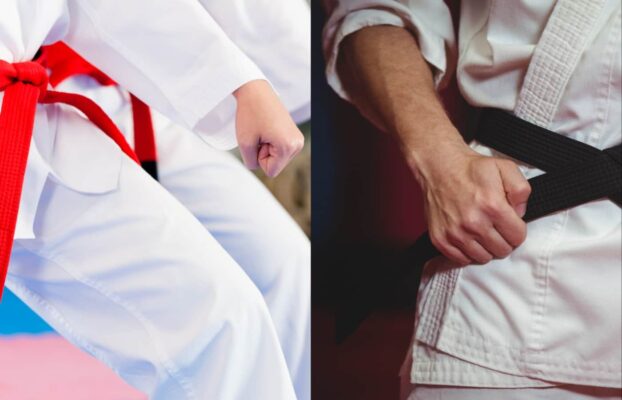
Taekwondo (TKD) and Karate are two of the most popular Asian martial arts, spread worldwide and practiced by millions of people of all ages and genders. Although these two martial arts look quite similar, there are more than a few differences, one of the key being the belt ranking system.

Karate has 8 colored belts for adults: white, yellow, orange, green, blue, purple, brown, and black. In contrast, Taekwondo has 10 belt ranks (World TKD standard): white, yellow, orange, green, purple, blue, brown, red, Jr. black, and black.

And before moving on, please note that both taekwondo and karate have multiple styles, each with its own ranking system. This means that the number of belts, colors, and promotions may differ between schools and styles. To simplify things, this article will mainly focus on the belt ranking system most commonly used for adults in taekwondo and karate, as well as their key differences.

Taekwondo Belt Ranking System

Taekwondo rank belts originate from Judo and the system developed by Kano Jigoro in the 19th century. The belt ranks are split between junior ranks and senior ranks. Junior ranks include 10 different solid-colored belts called “geup” which translates to “grade” where each one represents a level of proficiency and experience.

Since Taekwondo has multiple organizations, the number of belts as well as the color might vary from 8 to 12. For instance, World Taekwondo (WT) has 12 ranks, while the International Taekwondo Federation (ITF) has 10 ranks. Also, each color belt has multiple colored stripes representing a student’s level within a given belt rank. 

Once a student earns all the belts in the junior ranks, they move to the senior ranks called “dan” which translates to “degrees” or “levels.” Senior ranks include 10 dan ranks, which are basically 10 different levels of a black belt.

Here are tables for the ITF and WT belt ranking systems that outline the student and senior ranks in Taekwondo. This simplifies the information and makes it easier to understand.

International Taekwondo Federation (ITF) Belt Ranking System:

World Taekwondo (official Olympic style) belt ranking system:

RECOMMENDED READING:
What Are the Different Styles of Korean Martial Arts?

Karate Belt Ranking System

Karate belt ranks are also rooted in Judo and the color belt ranking concept developed by Kano Jigoro. The initial variation of the system emerged in 1924, when the legendary karateka and the founder of Shotokan Karate, Gichin Funakoshi, decided to adopt the judo belt system in karate.

But before moving forward, remember that karate has dozens of different styles and organizations. As a result, the exact number of belts, colors, and requirements significantly vary between the styles. But the core concept of solid-colored belt ranks and stripes within each rank remains the same.

According to the traditional Shotokan curriculum, the karate belt ranking system consists of 8 different colored belts, each of which represents proficiency and experience.

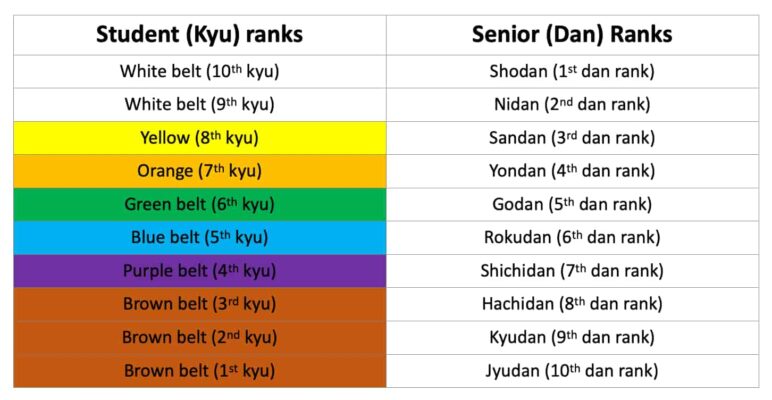
Like in Taekwondo, the system is split between student ranks called “kyu” and senior ranks known as “dan” ranks. Student ranks have 10 levels, and the ranking goes in descending order. It starts at the lowest rank, which is the 10th kyu (white belt), and goes down to the 1st kyu rank (brown). Once students earn a brown belt, they move to “Dan” ranks (black belts).

“Dan” ranks include 10 different black belts, and the ranking goes in ascending order this time. The lowest rank is the 1st-degree black belt (1st dan), and the system goes all the way up to the 10th-degree black belt (10th dan). To make it all easier to understand, here is a table explaining the “kyu” and “Dan” karate ranks.

RECOMMENDED READING:
What Are the Different Styles of Japanese Martial Arts?

Key Differences Between TKD and Karate Belt Ranking Systems

The biggest difference is the number of junior (kyu/geup) color belts, as karate includes 7 while Taekwondo includes 10.

Following is a detailed and easy-to-understand explanation of all the key differences between the Taekwondo and Karate belt ranking systems.

Time it takes to get a black belt

Taekwondo and Karate are quite similar in terms of difficulty and the time one needs to spend on the mat before earning a black belt rank. The exact time is based on many factors, such as individual talent for athleticism, dedication, passion, and consistency. It is also based on the style you train in, the quality of the instructors, and the criteria level.

In general, it takes between 3 and 5 years for a dedicated student to reach a black belt rank in Taekwondo. Students with average talent are supposed to go through all the geup (student) ranks within this time span, but it can also take much more than that. In some schools, students are not eligible to earn a black belt without 4 or 5 years of training.

According to the International Taekwondo Association, you need a minimum of 40 months of training, 3 times a week, to be granted a black belt.

Here’s a table easily explaining a complete timeline for achieving a TKD black belt from the start as a white belt.

As for Karate, the time it takes to earn a black belt is very similar, between 4 and 5 years on average. However, bear in mind that the time varies between styles and organizations.

There are schools where you can earn a black belt in less than two years because the criteria and requirements are low. But you won’t be as skilled as karatekas who train in dojos that embrace traditional teaching methods and requirements.

Here’s a table easily explaining a complete timeline for achieving a Karate black belt from the start as a white belt.

Number of Katas

Both Taekwondo and Karate prioritize the practice of standardized sets of offensive and defensive movements called forms. These forms consist of precise and choreographed sequences of martial arts movements that are designed to be practiced individually.

In karate, forms are known as “katas,” while in Taekwondo, they are called “poomsae,” which is a Korean word for forms. In both arts, students spend a lot of training time doing forms because performing these pre-arranged sets of movements is included in each belt promotion testing.

So in order to progress to a higher rank, students must master all the forms to perfection and learn how to execute them in a relaxed and focused manner. Shotokan Karate, the most famous karate style, has 26 forms/katas, while Taekwondo has 24 forms/poomsae, which represent 24 hours in a day.

Here’s a table that lists the names of different katas and poomsae.

Karate forms (katas)ITF Taekwondo forms (poomsae)
Heian ShodanChon-Ji
Heian NidanDan-Gun
Heian SandanDo-San
Heian YondanWon-Hyo
Heian GodanYul-Gok
Tekki ShodanJoong-Gun
Tekki NidanToi-Gye
Tekki SandanHwa-Rang
Bassai DaiChoong-Moo
Bassai ShoKwang-Gae
Kanku DaiPo-Eun
Kanku ShoGae-Baek
EnpiEui-Am
JionChoong-Jang
GankakuJuche or Ko-Dang
HangetsuSam-Il
JitteYoo-Sin
ChinteChoi-Yong
SochinYong-Gae
MeikyoUl-Ji
JiinMoon-Moo
Gojushisho DaiSo-San
Gojushiho ShoSe-Jong
NijushihoTong-Il
Wankan
Unsu

Similarities Between Karate and Taekwondo Belt Ranks

Although these are two separate martial arts that emphasize different aspects of combat, the Karate and Taekwondo belt ranking systems share some similarities. The following is a detailed explanation of their similarities.

The same origins

Both Taekwondo and Karate have adopted the concept of color belt ranking from Judo. Although the number of belts and ranks may vary between the styles, the core concept is the same, which is why the belt ranks are so similar.

Kano Jigoro, the creator of Kodokan Judo, drew inspiration from the board game “Go” to create the first belt ranking system. The initial variation had only three colors: whitebrown, and black, but the number of ranks and belts would gradually increase over the years.

Shotokan Karate was the first to follow the concept of the belt ranking system from Judo in 1924, thanks to its founder, Gichin Funakoshi, and then Taekwondo did the same in the 1950s.

Progression to the higher belts

The process of advancing to higher ranks in both Karate and Taekwondo is quite similar. Of course, the requirements are different in terms of techniques and forms because these are two different combat systems. But in order to earn a higher belt rank, students in both arts need to undergo official belt testing, which takes place every few months depending on their rank. Lower belt testing is organized every 2-3 months, while black belt testing is every 6 months to a year.

Students will first receive an invitation to take a belt promotion before attending an official test where they must perform in front of the examiners. Together with their instructors, they will focus on mastering all the required forms and other aspects for the belt rank they are trying to obtain. The exact requirements vary between styles of Karate and Taekwondo as well as the ranks.

For the lower ranks, students usually need to show proficiency in executing offensive and defensive forms, an improved level of fitness, and pass the written test related to terminology and history. Students at the higher ranks do more advanced forms, and they often spar to showcase the practical application of techniques and might also have to demonstrate their ability to break boards.

Once the board of examiners agrees that a student meets the required skill level, they will promote them to a higher rank. And this process is the same in both Karate and Taekwondo.

The same belt meaning

The belt is not just a piece of cloth martial artists wear to keep their Gi uniform in place. No, each color belt represents a rank and has a philosophical meaning. This meaning is the same across all martial arts that use the Judo belt ranking concept, including karate and taekwondo.

Here’s what each color of belt represents:

White belt — the plant is born and breaks through the ground to meet the white sunlight. This symbolizes the beginning and the students’ desire to learn.

Yellow belt — the plant is exposed to the first beams of sunlight. It symbolizes a student who has learned the basic moves.

Orange belt — the warmth of the sun gets hotter, and it becomes difficult for the plant to grow. This symbolizes students’ struggles as the training and techniques get more difficult.

Green belt — the plant gets greener, and it starts growing new leaves. This means that a student is growing and mastering the basics at a faster rate.

Blue belt — the plant is growing taller and is reaching the blue sky above. Students’ martial art knowledge is rapidly expanding.

Purple belt — the sun sets, and the day slowly turns to night, with the blue sky darkening to purple. A student has mastered all the basics and is moving to the advanced stage of learning.

Brown belt — as the darkness increases, the plant bows down to the brown soil and is ready for harvesting. Students are maturing as martial artists and getting highly proficient in executing complex techniques.

Black belt — the plant dies, and the new one will grow. This means that every end is another beginning. Students have learned a lot, but their martial art journey has only begun.

What Are the Different Styles of Korean Martial Arts?

0
Kumdo (left), Hapkido (top right), Tang Soo Do (bottom right)
Credit: Minivalley (top right pic)

Martial arts practice is deeply rooted in Korean tradition, history, and culture. Throughout history, the people of Korea have developed dozens of different combat systems for different purposes. In a nutshell, Korean martial arts styles can be summarized as follows:

Korean martial arts styles are primarily centered on striking, and Taekwondo is the best example of their striking art. Korean martial arts styles also include grappling arts (Ssireum), hybrid arts (Hapkido), and weapon-based arts (Kumdo). However, these are less well-known than Taekwondo.

Continue reading this article to expand your knowledge of Korean martial arts, including their history, development, and some of the most popular Korean martial arts styles you may have yet to hear of.

A Brief Summary of Korean Martial Arts History

The history of Korean martial arts dates all the way back to the Goguryeo (Korean: 고구려) dynasty, which ruled from 37 BC to 668.

The two combat systems recognized as the oldest during that period were Ssireum and Subak. These two combat systems were a part of the military training and were also practiced for basic physical education by the Korean people. Ssireum is a concept based on wrestling and grappling, while Subak is more oriented toward striking.

The development of Korean martial arts continued through the Goryeo (Korean: 고려) dynasty (935–1392). This was an era when the sports variation of Subak had emerged which quickly became one of the most popular sports activities in the country. 

But with the Mongol conquest, Koreans developed expertise in using the composite bow and mounted archery during a rebellion against their Mongol Yuan rulers. Composite bows, in particular, proved to be very effective on the battlefield.

Later, during the Joseon Dynasty (Korean: 조선), the Korean combat systems would be influenced by the Chinese and Japanese martial arts. During the 17th and 18th centuries, the Korean army started incorporating various other weapons into their training, such as double-sword fighting, spear fighting, stick fighting, and many others. They also adopted hand-to-hand grappling and striking techniques from Judo, Jujutsu, Aikido, Kung Fu, Karate, etc.

Emperor Gojong himself once invited the finest sword masters from Japan to start teaching Korean soldiers and police officers martial arts techniques. At the end of the 19th century, he established Gungdo, the art of archery, as the official sport.

King Gojong of Korea (1852-1919)

Original systems like Ssireum and Gungdo continued to be practiced during the Japanese occupation in the early 20th century. But after the liberation in 1945 from Japanese colonialism, Korean martial arts schools (kwans) would unite and create a unified Korean system called “Tang Soo Do,” rooted in the traditional arts Taekkyon, Subak, and Gwonbeop. The name would later change to “Taekwondo” and become a national and Olympic sport.

RELATED:
What Are the Different Styles of Japanese Martial Arts?

Korean Striking Arts

Taekwondo

Although the traditional concept includes limited grappling techniques, Taekwondo (TKD) is primarily classified as a striking martial art. TKD emerged after World War II in the 1950s as a Korean military self-defense combat system. Its origins come from traditional Korean practices such as Subak, Taekkyon, and Gwonbeop.

In terms of techniques, Taekwondo is versatile as it includes hand and leg strikes as well as limited grappling. The main emphasis is on kicks because its founders believed legs were more powerful and versatile weapons compared to punches, which have limited range and power.

As a result, TKD students spend most of their time practicing all types of different jumping and spinning kicking techniques. Punches are considered a secondary weapon, used mostly for direct attacks and to set up kicks. Due to its heavy emphasis on kicks, each athlete must develop a high level of flexibility, as well as strength and cardio.

Taekwondo practice also emphasizes realistic methods of training. Students often engage in full-contact sparring, where they practice how to apply techniques in real-life situations. They also do various types of breathing exercises to improve focus and learn how to stay calm in stressful situations.

In its initial form, Taekwondo was designed for real-life fighting and training a person for various types of self-defense situations. But over the years, the emphasis on training shifted from self-defense to competition, especially after Taekwondo became a national sport in Korea and an Olympic sport.

As a result, most modern schools emphasize sports variation, where students learn how to obey the rules and win matches rather than how to fight. The learning syllabus emphasizes kicks, footwork, and punches to the upper body below the neck. Although some schools still stick to traditional practices, they might be hard to find.

Tang Soo Do

Although some people think Tang Soo Doo and Taekwondo are the same, Koreans see them as two separate systems. Tang Soo Do includes various techniques from northern Chinese martial arts, karate, and traditional Korean arts such as Subak and Taekkyeon. It never became as popular as other arts, primarily for political reasons.

The system was put together in 1944 by nine leading Korean martial art schools called “Kwans.” It was the unification of different martial arts practices into one unified system.

However, the Korean political leadership didn’t want to use the name “Tang Soo Do” at the time. For them, the name was associated with China, notably the word “Tang,” which represented the Chinese Tang Dynasty. As a result, they first changed the name to “Tae Kwon Do” before changing the entire emphasis from traditional values and principles to sport and competition.

In Korea and the martial arts world in general, Tang Soo Doo is often considered the original and traditional version of the unified martial art styles created by nine main “kwans.” At the same time, “Taekwondo” is a sport variation that came almost a decade later.

Tang Soo Doo primarily focuses on kicking techniques, punches, knee and elbow strikes, and blocks. The training syllabus emphasizes forms known as “Hyeong” as a method to memorize the moves and stamp them into muscle memory. Later, students move to more realistic teaching methods, such as free sparring.

Most schools include 9 main forms in their curriculum from 9 main kwans (schools). Students also learn self-defense techniques, notably at close range, such as against grabbing.

In modern times, many Korean martial arts schools continue to teach Tang Soo Do. Over the years, many of these schools would develop their own variations or styles of the system:

  • Chung Do Kwan
  • Moo Duk Kwan
  • Mi Guk Kwan
  • Moo Yea Tang Soo Do
  • American Tang Soo Do

Taekkyon

Taekkyon is widely regarded as the oldest Korean martial art. It has influenced the birth of many other styles, including Taekwondo. This style combines fluid dance-like movements resembling Capoeira with striking techniques using hands and feet while also incorporating some grappling techniques.

Taekkyon is listed as a striking-based martial art. It teaches a person how to use all limbs to throw punches, kicks, knee, and elbow strikes, as well as defensive blocks. However, the primary weapons remain all types of kicking techniques. The key is to learn how to use triangular footwork (pumbalki) in coordination with fast and direct hand and leg attacks. Apart from the fist, Taekkyon practitioners also strike with the palm.

On top of that, Taekkyon includes grappling skills. The goal is to learn how to combine dynamic, constant movement in all directions with hand and foot attacks to manipulate the opponents’ balance and take them down with trips and throws. The system also covers self-defense moves such as attacking pressure points, joint locks, and headbutts.

In modern times, there are four main Taekkyon organizations in Korea:

  • Widae Taekkyeon Preservation Society
  • Korea Traditional Taekgyeon Association (KTTA)
  • Korea Taekkyon Federation (KTF)
  • Kyulyun Taekyun Association (KTK)
RECOMMENDED READING:
Why Does Taekwondo Have a Bad Reputation?

Korean Grappling Arts

Ssireum

Ssireum is one of the oldest Korean martial arts, primarily focusing on wrestling. It is conceptually very similar to wrestling and Judo, with the main difference being the rules. In Ssireum, if any part of the opponent’s body above the knee touches the ground, the competitor wins the match.

Next, practitioners wear long fabric belts around their waists and thighs, which allows them to pull and lift the opponent in a posture of the waist. The key is manipulating the opponent’s weight and turning their torso to execute a throw. There are no striking or self-defense tactics, as Ssireum is primarily a combat sport.

Ssireum is a national sport in Korea, practiced since the Goguryeo period. The matches take place in a circular ring that is around 7 meters in diameter, and it visually looks a lot like Sumo. But unlike in Sumo, you don’t get any points for pushing the opponent outside the pit area. Instead, the winner of the match is a wrestler who manages to force the opponent to touch the ground with any part of the body that is at knee level or higher.

Korean Weapons Arts

Korea has a long history of weapon-based martial arts, with some of the systems dating back to the 1st century BCE. Following is a brief explanation of the most popular ones.

  • Gungdo (a.k.a. Gukgung) — is the art of the reflex bow and is believed to have been developed by the founder of Goguryeo, Go Jumong, a highly skilled archer. It became a key part of military training during the Mongol conquest of Korea when the composite bow proved to be the most effective method in a fight against the Mongols. It remained a part of arm combat training up until the 19th century.
  • Kumdo — translates to the “way of the sword,”  is a Korean weapon-based martial art derived from Japanese Kendo. One of the major differences between the two is related to the native terminology, competition rules, and small uniform changes. Each practitioner wears a Hogu uniform, including a helmet, cotton craft under the helmet, a chest protector, a leather skirt worn around the waist, and hand protectors. People also use the word “Kumdo” as a universal term for all the Korean swordsmanship arts.
Hogu uniform
Photo by Bruce W Sims
  • Hwa Rang Do — is a self-defense martial art that includes striking, grappling, and weapon training. Its origins go as far back as 2000 years ago, but the modern variation was developed in the 1960s by brothers Jong Bang Lee and Joo Sang Lee. Some of the weapons used in Hwa Rang Do are Nunchucks (SSang Jyel Bong), long staff (Jang Bong), and swords (Jang Gum).

Korean Hybrid Arts

Hapkido

Hapkido is the most famous hybrid Korean martial art that has spread worldwide. It is a complex combat system that focuses on both armed and unarmed fighting techniques. Koreans see it as the ultimate self-defense system designed to cover most scenarios. It is rooted in traditional arts like Taekkyon, Chinese arts, and Japanese arts such as Judo.

However, Hapkido is not entirely a full-contact martial art. It rather stands somewhere in the middle between hard and soft. Students learn how to execute techniques in a soft manner, like in Aikido, for example, as the goal is to utilize opponents’ attacking momentum against them and redirect the attack. But on the other side, there are segments of training where the intensity increases significantly when it comes to striking.

Hapkido principles heavily revolve around fast movement, executing techniques in a natural, flowing, and relaxed manner, and manipulating the opponents’ energy.

In terms of striking, Hapkido covers all the ranges. Like in other Korean styles, kicking techniques are the most important. But in contrast with most other modern arts like Taekwondo, Hapkido focuses heavily on the kicks below the waist (low/leg kicks).

Hand strikes are considered secondary weapons, primarily used to set up kicks or close the distance before applying joint locking and throwing techniques. Students learn how to strike with punches, open hands, and fingernail targeting the throat and eyes. The curriculum also includes different blocks and counterattacks.

Hapkido grappling techniques originate from Aikido and Jujutsu and mainly consist of various types of throws, wristlocks, and elbow locks.

Gongkwon Yusul

Gongkwon Yusul is a modern Korean combat system founded in 1996 by Kang Jun. It combines striking and grappling techniques rooted in martial arts such as Hapkido, Jujutsu, Judo, and Hakko-ryu. It is very similar to Hapkido regarding techniques, but the overall application and principles differ significantly. While Hapkido emphasizes forms and static application, Gongkwon Yusul is geared toward sparring.

Gongkwon Yusul primarily focuses on the spontaneous and free-flowing application of techniques in situations that resemble fighting in real life. Students learn how to mix hand and leg strikes with locking and throwing techniques, and training also includes groundwork where students practice techniques and skills from Judo and BJJ.

In some way, Gongkwon Yusul is designed to resemble modern MMA practice and freestyle combat. However, it retains many traditional elements of Korean martial arts, such as uniforms, ranking, and terminology.

Teukgong Moosool

The South Korean special forces developed Teukgong Moosool in the 1970s as a countermeasure to North Korean Special Forces infiltrating their territory. North Korean special forces easily defeated the Korean commandos in hand-to-hand combat. Therefore, there was an urgent need for a new form of self-defense.

Teukgong Moosool is a hybrid martial arts system that can be used with or without weapons. It was created by gathering input from grandmasters of different styles of Korean martial arts.

The entire focus of Tekgong Moosool practice is on self-defense and preparing a person for real-life combat. Thus, training is intense and involves a lot of hard sparring. Practitioners often train with standard attacking weapons such as knives and bats.

What Are the Different Styles of Japanese Martial Arts?

0
Judo (left), Karate (middle), Sumo (right)

Japan is a country synonymous with grappling, striking, and self-defense martial arts. This country has a long history and tradition of martial arts practice in the name of honor, respect, personal growth, and self-defense. But what are the different Japanese martial arts? How many styles, actually?

Japanese martial arts include dozens of different combat systems that differ in various aspects, notably emphasis, philosophy, and orientation. These arts are also practiced for different purposes, such as sports, personal growth, self-defense, or fitness. Some of the most popular ones are striking arts such as karate and grappling systems like Judo and Jujutsu.

Let’s dive deeper into the world of Japanese martial arts and explore its history, styles, and many other aspects.

The Evolution of Japanese Martial Arts

The country of Japan has a long history of martial arts practice. But when did it all begin, and how did this specific country become home to some of the most famous combat systems in the world?

The history and development of Japanese martial arts are closely associated with the different periods, social shifts, and political changes this country has undergone.

According to historical evidence, the earliest records of Japanese martial arts date all the way back to ancient times. But the majority of advanced systems originated from the feudal period and Samurai warriors who used them for warfare. They designed these hand-to-hand fighting techniques to be practical on the battlefield and combined with weapons. This includes various types of swords, knives, bo staff, etc.

The learning syllabus included both offensive and defensive tactics. The main goal was to learn how to neutralize the enemy in the fastest way possible. If that meant breaking their neck, that’s what a samurai was supposed to do.

During the feudal period in Japan, there were thousands of schools teaching martial arts. All of these schools had their own tools, training methods, and they emphasized different aspects of combat and weapons. But one of the most popular was Jujutsu, which was a precursor to Judo and later BJJ. Some of the other systems were:

  • “Kenjutsu”- swordsmanship schools
  • “Kyujutsu”- the art of archery
  • “Sojutsu” – the art of spear

During this period, the Japanese practiced martial arts solely for self-defense. The training was brutal, dangerous, and designed to prepare Samurai for war. There was no competition, and no one outside of the military trained in these schools. But this started to change in the late 19th century with the Meiji Restoration. The biggest change was the abolition of the Samurai class and the fact that the Japanese culture became more westernized.

And with that, the brutal practice of combat systems was no longer fitting within the social context. And it was at this moment when martial arts shifted from Bujutsu to Budo. Simply put, martial art practice became more “civilized,” and schools started teaching regular citizens.

These new schools and techniques remained self-defense oriented. However, the practice became much safer, emphasizing personal development, discipline, and character building. This was when martial arts such as Judo and Aikido emerged.

And the popularity of martial arts practice in Japan exploded in the 20th century. The Japanese annexation of Okinawan islands triggered a migration of people to the main islands, including skilled martial artists. One of them, Gichin Funakoshi, introduced Karate from Okinawa to mainland Japan in the early 20th century. Karate, on its own, played a significant role in Japan becoming the home of martial arts.

Karate Master Gichin Funakoshi

Today, Japanese martial arts include a wide range of disciplines, including Aikido, Karate, Judo, Kyudo, and more. All these arts are spread worldwide, and they promote Japanese culture and history apart from fighting techniques.

Koryu Bujutsu vs. Gendai Budo: What’s the Difference?

All Japanese combat systems are divided into two groups. The first one is “Koryu Bujutsu,” which includes military fighting systems used by the Samurai warriors, mostly weapon-based.

The second is “Gendai Budo,” which includes modern martial arts practices for self-defense, fitness, personal development, etc. These martial arts started in Japan following the Meiji Restoration (1866–1869).

Here’s a list of notable martial arts from both groups:

Koryu BujutsuGendai Budo (modern combat systems)
KenjutsuJudo
JujutsuAikido
SumoKarate
BattojutsuKendo
IaijutsuKyudo
NaginatajutsuIaido
SojutsuShorinji Kempo
RECOMMENDED:
What is Bushido?

What Are the Different Styles of Japanese Martial Arts?

The Japanese martial arts can be categorized into four main styles based on their emphasis:

  • Striking arts: primarily focusing on striking their opponents with their limbs
  • Grappling arts: primarily non-striking arts that are based on throws, takedowns, and ground fighting.
  • Weapon arts: primarily focused on using objects to fight their opponents, such as swords or sticks.
  • Hybrid arts: a combination of two or more of the above arts put together.

The following illustrates some of the different Japanese martial arts styles that have had a significant impact on the martial arts world.

Japanese Striking Arts

Japanese striking arts began to emerge in the 20th century. This was a time when skilled martial artists migrated from the Okinawa islands to the main islands of Japan. One of the systems they brought was Karate, arguably the most popular combat system worldwide.

Karate

Karate emerged in the Okinawa Islands as a self-defense method. However, it became popular on the main islands in the 20th century. As a system, karate is primarily based on quick striking with direct punches and advanced kicking techniques. These strikes are mixed together with fast footwork, and the focus is on overwhelming the attacker with technique rather than sheer force.

However, over time, the emphasis of training has switched to sports competition and point fighting rules, which have had a big impact on the overall effectiveness of the system.

There are four original karate styles that developed in the Okinawa Islands.

  • Goju-Ryu
  • Wado-Ryu
  • Shito-Ryu
  • Shotokan-Ryu (the most popular)

Later on, these four main styles would influence the birth of dozens more karate variations, such as:

  • Kyokushin (mix of Shotokan and Goju-Ryu)
  • Shukokai (mix of Shito-Ryu and Goju-Ryu)
  • Shorin-Ryu (combination of Shuri-te and Tomari-te styles)
  • Gosok-Ryu (mix of Shotokan and Goju-Ryu)

Japanese Kickboxing

Japanese kickboxing, or “modern kickboxing,” as people call it, emerged in the 1950s. At the time, there was a big rivalry between Kyokushin and Muay Thai fighters. Kickboxing, as a concept, emerged as a bridge between these two combat systems. On one side, most of the techniques come from Kyokushin, while the rule set is from Muay Thai.

It is one of the most effective full-contact martial arts, known as a mix of Western boxing and karate kicks. The emphasis is on power and damage, making it very useful in real-life self-defense situations. Soon after, Japanese kickboxing started to spread like wildfire all across the world and influenced the birth of many other styles, such as Dutch, American (a.k.a. full-contact kickboxing), and K-1.

Japanese Grappling Arts

Many Japanese combat systems teach grappling skills. However, there are three main martial arts that focus solely on standup grappling and ground fighting: Sumo, Judo, and Aikido

Sumo

Sumo is considered a “Gendai Budo,” or modern martial art, and it is a national sport. However, ancient writings indicate that this martial art has existed since ancient times. One of the ancient Japanese books written in 712 AD, Kojiki, implies that sumo was originally a ritual dance and prayer for a good harvest.

Sumo wrestlers compete on a raised, circular platform where the main goal is to throw the opponent down or outside the pit area.

Each Sumo athlete dedicates their life to martial art practice and must follow a strict training and diet regimen. From the rules and meals they eat to the way they dress, the Sumo lifestyle embraces tradition in every way. Although it is less popular outside of the country than other martial arts on this list, Sumo athletes are superstars in Japan.

Judo

Judo is a grappling-based martial art developed in 1882 by the legendary martial artist Kano Jigoro. Judo has evolved from and is rooted in Jujutsu, a martial art system that the Samurai warriors used. And in some way, Judo emerged as the “safer” and “sports” variations. Kano got rid of all the dangerous elements, including punches, to create a system that entirely focuses on grappling.

Judo founder Kano Jigoro (1860-1938)

The main goal in Judo is to take the opponent down from a standing position using powerful throws, trips, and sweeps. The emphasis is on leverage, technique, and manipulating the opponents’ balance and weight distribution to take them down. Once the exchange goes to the ground, the goal is to subdue them with pins, holds, chokes, or joint locks.

Along with karate, Judo is one of the most popular sports spread all around the world and has been an Olympic sport since 1964.

Aikido

Aikido is a grappling martial art developed by Morihei Ueshiba. The main focus of Aikido as a combat system is on intercepting and redirecting an opponent’s attack and momentum and using it against them rather than meeting force with force.

It emphasizes fast and fluid movements, circular motions, wrist locks, and throws, and students are taught to execute all the techniques in a light and gentle way. It also emphasizes the mental aspect and reaching a state of mind-body unity so that you can respond to aggression with calmness and control.

Although Aikido is a versatile system, hard to learn, and even rooted in self-defense, it is not considered practical in real life. The majority of its techniques are almost impossible to apply against fully resisting opponents. On top of that, teaching methods clearly lack realism, as there is no sparring, for example.

Japanese Weapon Arts

There are dozens of different Japanese weapon-based martial arts, with each one focusing on different types of weapons:

  • Araki Ryu — is a hybrid weapon-based system that focuses on multiple weapons such as the sword (katana), spear (yari), staff (bo), and many others. The system also includes grappling while wearing light Samurai armor.
  • Bojutsu — a system that emphasizes long-staff (bo), one of the best weapons for countering Samurai’s katana sword.
  • Jukendo — teaches how to use a bayonet weapon. The Japanese military uses its techniques and principles and is part of its education regime. Teaching methods include offensive and defensive katas as well as competitive sparring (kumite).
  • Kendo — is a popular martial art that focuses on sword fighting techniques like Bokken and Katana. While doing katas, students use hard wooden swords (bokken) and “Bogu” gear when sparring.

Japanese Hybrid Martial Arts

Japanese martial arts also include combat systems that incorporate different fighting elements like striking and grappling together, such as:

Jujutsu

Japanese Jujutsu is one of the most influential martial arts and a precursor to many other systems, such as Judo and different styles of Jiu-Jitsu. It was practiced by the Samurai warriors who used the art of Jujutsu on the battlefield during the feudal period.

The system was designed to cover all the elements of fighting and teach you how to neutralize the enemy in the most efficient way possible. It teaches you how to deal with both armed and unarmed opponents using punches, kicks, clinch fighting, takedowns, as well as painful chokes, and joint locks.

Apart from conventional techniques, Samurai also learned how to break bones and necks or use other dirty methods to cause as much pain and damage as possible.

Although jujutsu is a versatile system, Samurai often rely more on aggressive grappling techniques to gain a dominant position over their opponent and then use any brutal means necessary, such as weapons, biting, or eye gouging, to terminate their enemy quickly.

At the time, grappling was considered more effective than striking because the samurai’s body armor limited their movement to strike, while the enemy’s body armor could absorb the impact of strikes.

Demonstrating traditional Japanese Jujitsu

Shooto

Shooto is a hybrid martial art developed by Satoru Sayama back in 1985, and it is a system based on Shoot wrestling that resembles modern MMA fighting. The majority of striking techniques come from the arts, such as Karate and Muay Thai. This includes punches, kicks, and knee strikes. On the other hand, the grappling techniques come from wrestling, Russian Sambo, and Judo.

Shooto events are considered to be one of the first mixed martial arts competitions. Fighters competed inside the squared ring wearing specialized open-fingered gloves, and they could win by knocking their opponent out, submitting, or by a decision.

All other promotions that emerged later, such as UFC or Pancrase, were based on the Shooto hybrid concept, and the rules are very much the same.

Shooto demonstration

Nippon Kempo

Nippon Kempo is a Japanese hybrid martial art system that teaches a person how to apply punches, kicks, joint locks, and throwing techniques in self-defense. The majority of techniques come from martial arts such as karate, boxing, judo, and jujutsu. It falls into the category of modern martial arts as it was developed in 1932 by Muneomi Sawayama.

Nippon is popular outside Japan, too, notably in countries like the US, England, and France. It is characterized by the unique protective gear all students must wear during sparring, called “Bogu.” It includes padded boxing gloves, a chest protector, a facemask, a groin protector, and a GI uniform.

https://youtu.be/0lnLv22Rsxk
RELATED:
What Are the Different Styles of Korean Martial Arts?

Is The Bruce Lee-Inspired ‘Warrior’ TV Series a True Story?

0
Credit: HBO

Warrior is an action-packed martial arts tribute to Bruce Lee, taking place during the late 19th century.  Featuring incredible fights and glimpses of history, the story seems almost too good to be true. So how accurate is Warrior? Is Warrior based on a true story?

Warrior is not based on a true story but is based on the writings of Bruce Lee and produced by his daughter, Shannon Lee. The show has many references to real events and is entirely historical fiction. Warrior is a superb show that portrays Chinese culture in the American West during the late 1870s.

Warrior is based on Bruce Lee’s writings that he pitched for an American TV show, which have been updated to reference some of the historical events. Keep reading to learn the truth about the events that happen throughout the show.

What Is the ‘Warrior’ TV Series About?

Warrior is a TV series that tells the story of Ah Sahm, a highly skilled martial artist who journeys from China to Chinatown in San Francisco to find his lost sister. Unfortunately, he finds himself caught up in the middle of gang wars among the Chinese community and faces the challenges of anti-Asian racism.

Did Bruce Lee Write The Story of Warrior? 

Bruce Lee wrote the fundamental storyline of the TV Series Warrior that was pitched and rejected in the early 1970s.  

Later, Shannon Lee (Bruce Lee’s daughter) found her father’s 8-page manuscript and brought it to life in the show Warrior. The original plotline is about the life of a Chinese martial artist who ventured into the American West and pitched his idea to movie studios.

The show and its original concept share similarities, but Bruce Lee’s original ideas have been modified for modern audiences. For example, in Bruce Lee’s treatment, he imagined the setting to be in the Old West, while the show Warrior takes place in Chinatown during the Tong Wars with a larger emphasis on Chinese culture. 

So Bruce Lee wrote the show’s foundation, but it has been tweaked to create a popular TV Series.

RELATED:
How Bruce Lee Changed the World: The Legacy of the Dragon

Is The Warrior Series Historically Accurate? 

The Warrior Series has links to historical events, but they have been dramatized for media purposes. 

Some historical events that occur throughout the show are: 

  • The Tong Wars
  • Chinese Immigrant Experiences
  • The Chinese Exclusion Act
  • Tension Between Irish and Chinese Communities

Shannon Lee, the executive director of Warrior, had to do immense research when producing the show. Although Shannon had the manuscript from her father, she needed more sources to create a historically accurate show. 

Shannon states in an interview, “There was a fire in San Francisco during which a lot of records were lost, a lot of the stories,” leaving her with limited sources around the topic as well as her father’s memory to produce the show.

That being said, there is some truth to the events in the show. 

The Tong Wars 

In the Warrior series, Ah Sahm was recruited by a gang known as the Tongs. The Tongs were a discreet, political-religious organization of ethnically Chinese people in the 1800s. 

These secret societies protected Chinese immigrants against discrimination, including the Chinese Exclusion Act of 1882.  Unfortunately, these organizations may have initially offered protection, but ultimately became involved in the drug trade and prostitution.

The entire storyline of Warrior is based upon the Tong Wars, in which Ah Sahm is recruited by one of the most powerful Tongs in China Town as a hatchetman. Yet, like in real life, there are more than one Tong, and allegiance had to be shown to be protected. 

Throughout the show, you can see the reality of the Tongs and the drug trading they were involved in to gain power and protection, leading to violence and fights. 

So while Ah Sahm and others may be fictional characters, the events portrayed in the show can be seen as accurate and historically researched. 

Irish and Chinese Tensions

Warrior also portrays the rising tension between the Irish and Chinese communities at the end of season 2 and the beginning of season 3.

At the end of the 1800s, The Irish and Chinese had nothing in common except that they were hard-working, had limited skills, and needed to make money. They lived in different areas and were part of various organizations. 

Yet, during the depression, the competition for work escalated, leading to hostility and violence between the two groups. 

Eventually, Irish communities discriminated against Chinese communities and blamed them for the recession during the 1800s. They explicitly and violently rioted against Chinese laborers leading to what is known as the San Franciso Riot of 1877

Later, these conflicts resulted in the passage of the Chinese Exclusion Act of 1882, which is demonstrated throughout the series.

RECOMMENDED READING:
Is the Movie “Bloodsport” Based on a True Story?

Are the Actors in “Warriors” Real Martial Artists?

The actors in the TV series have backgrounds in martial arts. 

Each of the following actors has practiced martial arts and trained before their acts in Warrior:

  • Andrew Koji (Ah Sahm)
  • Dustin Nguyen (Zing)
  • Jason Tobin (Young Jun)
  • Chen Tang (Hong)
  • Joe Taslim (Li Yong)

Andrew Koji (Ah Sahm)

Andrew Koji is a half-English, half-Japanese martial artist who temporarily stopped training in martial arts to pursue acting. Koji is trained in Taekwondo, Kyokushin Karate, Wing Chun Kung Fu, and Shaolin Kung Fu.

Dustin Nguyen (Zing)

Dustin Nguyen (Zing), born in Vietnam, practices Muay Thai Kickboxing, Taekwondo, Jeet Kune Do, Kali, and Escrima. He plays Zing in the Warrior series and has also directed the sixth episode of season 2. 

Jason Tobin (Young Jun)

Jason Tobin (Young Jun) was born in Hong Kong and is trained in Thai boxing and Bruce Lee’s Jeet Kune Do.

Chen Tang (Hong)

Chen Tang (Hong) was born in Japan and grew up in China before moving to the United States. He states that he had martial arts experience, but his role in Warrior is his first actual stunt work project. 

Joe Taslim (Li Yong)

Joe Taslim (Yi Long) is an Indonesian actor and a former Judo athlete. He was trained in Wushu, Judo, and Taekwondodo. He was a professional athlete and won several gold medals from 1997-2009.

RECOMMENDED READING:
10 Movie Stars Who Are/Were True Martial Artists

Where Can I Watch The Warrior Series? 

The Warrior Series is aired on Max, formally known as HBO Max.

Credit: HBO

Max can be watched on Android, Ios, Chromecast, Roku, and Amazon Fire TV. You can also watch the series on Amazon Prime Video by subscribing to Max. Season three of Warrior premiered June 29, 2023, with new episodes every Thursday.

RECOMMENDED READING:
Top 11 Best MMA Movies that are More Fun than Real MMA Fights

Final Thoughts

Bruce Lee’s transcript is the foundation for the Warrior TV series, but it’s been modernized to fit modern audiences. It also has links to real-life events and has been based on the history of Chinese immigrants in West America, but it is considered entirely fictional. Regardless, if you enjoy martial arts, Warrior is a great way to get a glimpse at Chinese immigrant experiences and the importance of martial arts.