Home Blog Page 2

Karate vs. Taekwondo: Key Differences And Similarities

0

Karate and Taekwondo are two of the most popular traditional martial arts practiced worldwide. At first glance, these two styles might appear very similar to most people, but some underlying key differences set them apart.

The most important difference is that Karate originated in Japan and involves striking with punches and kicks in equal balance, whereas Taekwondo originated in Korea and primarily focuses on kicking with limited punching.

This is just a brief highlight explanation of the difference, so be sure to read the rest of this article to learn deeper into these two martial arts, their differences and similarities, and how they compare in different aspects.

History of Karate

Karate is a Japanese martial art developed in the Ryukyu Kingdom, now Okinawa. Its origins come from different combat systems, primarily Chinese martial arts. The name translates to “empty hand” which indicates that karate focuses on unarmed techniques. It started to rise in the 20th century when Japan annexed Okinawa, which triggered the migration of skilled karatekas to the main island.

Karate has dozens of different styles, and the most emphasize mixing kicking with hand-striking techniques and blocks, linear movement, fluid motions, evasions, and using attackers’ momentum against them.

The traditional practice developed in Okinawa is designed for real fighting and preparing a person for different self-defense scenarios they may face in real life.

However, the modern Japanese variation emphasizes the competition aspect and is known as sports karate. Students train to learn how to win matches under point-fighting formats, which, by many, have a big impact on downgrading the overall effectiveness of karate.

The four major karate styles are:

History of Taekwondo

Taekwondo (TKD) is a Korean martial art developed in the 1950s as a military hand-to-hand fighting method. Its origins come from various traditional Korean systems and Chinese martial arts. The name translates to “the way of the foot and fists,” which suggests that the concept primarily focuses on striking with kicks and punches.

Traditional Taekwondo, which was developed for the military, is a versatile system rooted in self-defense practice. The system emphasizes advanced kicking techniques, while punches are considered to be a secondary weapon.

Over the years, the system’s emphasis changed from self-defense to sports competition, especially after Taekwondo became an Olympic sport in 2000. In modern times, there are two main styles. The first one is ITF, which embraces traditional teaching methods and proper self-defense skill development. The second is World Taekwondo (WT), widely known as the Olympic style.

RELATED:
What Are the Different Styles of Taekwondo? Beginner’s Guide

Key Differences Between Karate and Taekwondo

The main difference is the concept as Karate focuses on mixing hand strikes and punches (including to the head) while Taekwondo primarily emphasizes kicking techniques.

Here is a list of notable differences:

History and origins

Karate is a traditional martial art developed in the 17th century in the Ryukyu Kingdom, Okinawa. It became widely popular when it was brought to the main island of Japan in the 20th century by the founder of Shotokan karate, Gichin Funakoshi. Its origins come from martial arts developed in China and East Asia.

Father of Karate, Gichin Funakoshi

Taekwondo emerged in Korea in the 1950s. It was developed as a result of the unification of all the Korean styles, and the process was initially supervised by the army General Choi Hong-hi. Its development was influenced by martial arts like Taekkyon, Chinese martial arts, and Karate.

Father of Taekwondo, General Choi Hong-hi

Concept and emphasis

The concept in most karate styles revolves around mixing kicks and punches with linear movement, fast footwork, attacking in a blitz, and hitting the opponent without being hit back. Karate puts more focus on tight guards, blocks, katas (forms), light contact, quick counterattacks, and upper and lower body striking.

The main goal of karate is to use the attackers’ momentum against them and overwhelm them with a high level of technique and precision rather than using full force and wasting energy. When it comes to techniques, the focus is on direct and rapid punching and kicking techniques like roundhouse and front kicks.

Taekwondo is different because it heavily favors kicking techniques and striking the upper body area above the waist, while punches are considered secondary weapons. This is mainly because the TKD founders believed legs cover more range and are more powerful than hand strikes, and the competition rules and point system also favor kicks over other techniques.

As a result, TKD students spend most of their time practicing all types of jumping and spinning leg strikes while neglecting offensive and defensive punching skills such as punching the head, blocks, or guard.

Belt ranking system

Below are colored tables showing the differences in belt ranking systems between Karate and Taekwondo, from white belt to black belt.

Karate belt ranking system:
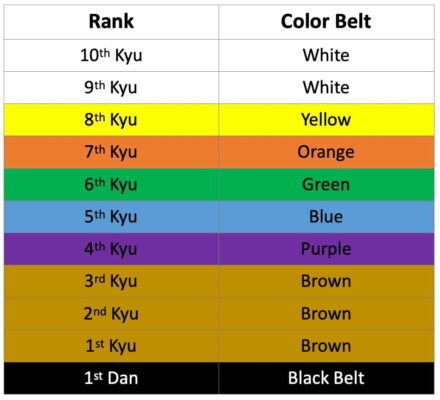
Taekwondo belt ranking system:

Olympic Rules

Both disciplines have many different rule sets. However, since both disciplines are included in the Olympics, we will compare their Olympic rules as standards to differentiate between them:

Karate (Kumite and kata)

Kumite:

  • Matches are contested on a square or octagonal mat known as a tatami.
  • The competition consists of three rounds, each lasting two minutes for men and two minutes and ten seconds for women.
  • Points are awarded for clean, controlled strikes to specific target areas, including the head, trunk, and abdomen. 3 points for hitting the head or neck with a kick. 2 points for a kick to the belly, side, back, or torso. 1 point for a punch with a closed hand. 
  • Contestants wear uniforms, padded gloves, and foot protection.

Kata (form): 

  • Each competitor performs individually for around 3-4 minutes.
  • Competitors are judged on the basis of their technique, timing, and precision.
  • There are seven judges that evaluate performance based on technical performance and athletic performance.
  • Judges evaluate the overall performance, looking for correct stances, proper form, and a demonstration of the principles of power, balance, and focus.
https://youtu.be/HCur4ARiUXs?si=5sZ7ezTxeLWOsYSe
Men’s kata event at the 2020 Summer Olympics in Tokyo, Japan

Taekwondo

  • Matches last three rounds, with each round being 2 minutes long, and there is a 1-minute break between each round.
  •  Points are awarded for valid techniques to specific areas of the body. 1 point for a punch to the trunk protector. 2 points for a valid kick to the body. 3 points for a valid kick to the head. 4 points for a valid turning kick to the head. 
  •  Contestants wear a dobok uniform, head protector, trunk protector, gloves, sensing socks, forearm, and shin guards, and mouth guard.
  • In contrast to Karate, Taekwondo poomsae (forms) events are not included in the Olympic competition.

Key Similarities between Karate and Taekwondo

Karate and Taekwondo share several similarities, both in terms of their techniques and cultural aspects. Here are some key shared similarities between these two martial arts:

Uniforms (Gi/ Dobok)

Both Karate and Taekwondo practitioners wear traditional martial arts uniforms adopted from Judo (judogi uniform). In Karate, it’s called a “gi,” while in Taekwondo, it’s referred to as a “dobok.” These uniforms typically consist of a jacket, pants, and a belt rank made out of thick cotton. Though there are some minor differences when it comes to style, these uniforms visually look the same.

Kicking Techniques

Both martial arts place a strong emphasis on fast kicking techniques. Surely, there are some differences when it comes to variations and the fact that Taekwondo places more emphasis on this segment, making its kicks more powerful and acrobatic. But Karate includes very much the same techniques, such as roundhouse kicks, spinning kicks, front kicks, etc.

Forms or Katas

Forms, known as “katas” in Karate and “poomsae” in Taekwondo, are sequences of solo movements that simulate a fight against the opponents, similar to what shadowboxing does in boxing by practicing certain movements alone. These forms serve as a way to practice and demonstrate techniques, stances, and transitions. They play a significant role in both martial arts, helping practitioners develop muscle memory, focus, and precision.

Traditional Teaching Methods

Both Karate and Taekwondo often incorporate traditional teaching methods, including the use of formal titles for instructors (such as sensei in Karate or sabom in Taekwondo), a hierarchical belt system to indicate rank, and a focus on discipline and respect between the students. 

Olympic Sports

Both Karate and Taekwondo are recognized Olympic sports. Karate made its Olympic debut at the Tokyo 2020 Summer Olympics, which were held in 2021. On the other side, Taekwondo became an Olympic sport at the Sydney 2000 Summer Olympics, which took place in Sydney, Australia.

Karate vs. Taekwondo: Which is Better for Self-Defense?

Both disciplines share a similar level of effectiveness and overall practicality in real-life situations. Karate is generally more effective in self-defense as it does a better job of mixing kicks, hand strikes, and leg strikes, but Taekwondo does not fall behind that much.

Karate can be effective as a self-defense system in real-life situations, especially if a person trains in traditional styles or modern Kyokushin that embraces full-contact striking and sparring (kumite). Classes teach legitimate techniques like direct punching, kicking, blocks, and movement that will make you superior to most people. It is notably effective in open-space areas where you can mix these strikes with movement to maximize efficiency.

Taekwondo is more limited due to its heavy emphasis on kicking techniques. Throwing kicks in a fight requires a lot of space, energy, and time, which you may not have against an aggressive attacker. Like karatekas, TKD works best at a distance and in open spaces where you can easily move around, use kicks to maintain distance and do damage, and use punches to catch the attacker coming in. Its biggest downside remains the lack of advanced hand striking and blocking, which are crucial for any type of fighting scenario.

However, although both are designed for self-defense in their initial forms, bear in mind that modern practice primarily emphasizes competition, and this limits and downgrades the effectiveness of the system.

Training in most dojos includes preparing a student to win matches under strict rules, not how to fight in real life. Both disciplines are not solely focused on real-life self-defense, due to the presence of katas or poomsae, limited sparring, light contact, and lack of advanced self-defense tactics or drills.

Karate vs. Taekwondo: Which Is Harder to Learn?

The difficulty of learning Karate versus Taekwondo depends on various factors, including the individual’s physical abilities and limitations, prior experience with sports, personal preference, goals you want to achieve, and many others.

Although these two martial arts are conceptually different and emphasize different aspects of combat, the learning syllabus is actually quite similar. Both focus on traditional practices rooted in discipline, honor, and respect; they emphasize speed and quick footwork, point-based competition and sparring, dynamic kicking techniques, forms (katas/poomsae), and stances, and all of this makes them very similar when it comes to the level of difficulty.

In terms of fitness, the focus is on workouts that primarily improve core strength, balance, fast twitch muscle fibers, endurance, and flexibility. A high degree of flexibility is also mandatory, especially in the kicks and stances.

If you are not naturally flexible, it might take time to develop the necessary range of motion needed to perform techniques the right way. The same stands for hand-eye coordination and overall body awareness, which you can only improve by investing a lot of time and effort.

The following tables illustrate the estimated duration for the average student to progress from white belt to black belt in Taekwondo and Karate:

Karate

The estimated time to go from white belt to black belt in Karate

Taekwondo

The estimated time to go from white belt to black belt in Taekwondo

Karate vs. Taekwondo: Which One Is Better for MMA?

Both disciplines are present in modern MMA, and there have been many fighters with strong backgrounds in either karate or TKD. These two systems are not as efficient in freestyle combat as some others, such as Muay Thai or wrestling, but still represent a solid foundation of skills on top of which a fighter can add more and succeed.

What Taekwondo brings into MMA are incredible kicks, fast movement, fighting from both stances, and a distinct feeling of distance and timing. The ability to land fast and precise low kicks and high kicks has become one of the most important skills in cage fighting, and this plays to their advantage. Combine this with their ability to fight from both stances, and you get why the fighters listed below are among the most unpredictable in the game.

Over the years, there have been many great UFC fighters with strong foundation in TKD. Some of the most famous ones are:

  • Anthony Pettis — is a 3rd dan black belt and a former UFC Lightweight champion.
  • Bas Rutten — is a 2nd-degree black belt and a former UFC Heavyweight champion.
  • Anderson Silva — is a 5th dan black belt and the former UFC Middleweight champion.

On the other hand, karatekas have an amazing feel for distance and the ability to move in to land a strike and angle out without being hit back. They primarily rely on linear movement, attacking in a blitz, protecting the range, and avoiding any type of close-range brawls.

At a distance, karatekas are a nightmare matchup for any fighter, and some of the well-known representatives of this style are:

  • Lyoto Machida – 3rd dan black belt in Shotokan karate and a former UFC Light heavyweight champion.
  • Stephen Thompson – 5th degree black belt in Kempo and the former UFC title challenger. 
  • Robert Whittaker – black belt in Goju-ryu karate and the former UFC Middleweight champion.

Related Questions:

Karate or Taekwondo—Which One Is Better For Kids?

At kids’ age, either of the two is fineThis is really based on the personal interest of the child as well as what they find to work better for them. The best way is to go to the nearest Taekwondo and Karate schools, where your kid can take part in a trial class before they can finally say which martial art they prefer.

One thing is sure: all kids will have a ton of fun training in both Taekwondo and Karate. Both are playful arts that will keep them active and healthy and teach them all about respect and discipline. Above all, they are very safe to train, and the risk of any potential injuries is low. This is mainly because kids have to wear protective gear during the parts of training that may lead to injuries, such as sparring.

As for the parents, you should always pick a school that focuses on safety and keeping their dojo clean. Don’t hesitate for a second to check the dressing rooms and bathroom to be sure the school is maintaining a high level of hygiene. You should always ask the instructor about their martial arts background and achievements.

Karate and Taekwondo classes for kids have similar benefits. They will keep kids strong and flexible and help them grow into a person with good values.

RECOMMENDED FOR YOU:
Top 3 Best Martial Arts For Kids – A Basic Guide For Parents

10 Popular Martial Arts With No Belt Ranking Systems

0
Photo by Lasershturm (top right pic)

Color belt ranks are a hallmark of martial arts training. This piece of cloth practitioners wear around their waist is a visual representation of their skill level and progress and a symbol of dedication, discipline, and mastery.

However, many people often assume that every martial art has a belt ranking system as a method of structural progression, which is wrong. There are actually quite a few martial arts that do not rely on such a system and use alternative ways of recognizing practitioners’ levels of proficiency and progress.

So, in this article, we will bring you a list of popular martial arts that do not have belt-ranking systems and dig deeper into what methods these systems use to convey students’ progress and development.

1. Boxing

Slavikboxerr/depositphotos.com

Boxing is one of the oldest combat sports that has been around since ancient times. However, unlike most other martial arts with such a rich history, boxing never adopted a formalized belt ranking system. What’s more, boxing doesn’t use any type of ranking system, and student’s level of proficiency is solely based on their performance in sparring and competition.

The training program is designed to prepare a person to compete under strict rules and win matches in competition. Training doesn’t include any philosophies, structural concepts of progression, or religious elements because the emphasis is on the practical application of skill and success in competition.

Boxing coaches and trainers constantly observe students’ technique, footwork, defensive skills, and overall boxing proficiency during training sessions and sparring. In fact, sparring is a crucial component of training as having students “fight” in a controlled environment and pace can provide insights into their abilities, strengths, weaknesses, and areas they need to improve. The next factor they take into consideration is physical fitness and conditioning, which are also indicators of proficiency.

Most gyms have different classes or training groups based on skill levels to ensure that each boxer trains in a group that shares a similar level of experience and goals. This generally includes amateur groups, fitness groups, and competition groups.

RELATED:
What Is Golden Gloves Boxing? 

2. Wrestling

The sport of wrestling has been around for thousands of years and is practiced worldwide, and there are dozens of different styles and variations. However, none of these styles include the belt ranking concept.

Instead, wrestling has always been recognized as a popular sport that primarily focuses on athletes’ development through different levels of competition. Wrestlers may progress through various competitive levels based on their success in matches and tournaments, and they are usually recognized for the divisions they compete in. Practitioners are usually split into the following levels:

  • Level 0 — beginners who are just starting without prior wrestling experience.
  • Level 1 (novice) — wrestlers in their first or second year of training who are starting to compete in amateur tournaments.
  • Level 2 (experienced) — are senior students who have accumulated knowledge and experience in competition.
  • Level 3 (advanced) — are students who have progressed far beyond others. Students at this level are capable of recognizing patterns and executing techniques relying on their muscle memory, instinct, and feeling.
  • Level 4 (elite) — These are wrestlers with an incredible feel for body positions, balance, weight distribution, situational awareness, and tactics, and they are also proficient in chain wrestling.
  • Level 5 (Top wrestler) — is a category reserved for finest national and international wrestlers.

In youth wrestling, categories often include age groups to ensure that wrestlers compete against opponents of similar age and size. Typical age groups include Bantam (6–8 years old), Intermediate (9–10 years old), Novice (11–12 years old), and so on.

3. Muay Thai

Muay Thai, often referred to as the “Art of Eight Limbs,” is a martial art that originated in Thailand and is one of the most popular striking martial arts in modern times. Developed in the 19th century, Muay Thai incorporates striking with punches, kicks, knees, and elbows both at the distance and inside the clinch. It is widely regarded as a complete package when it comes to striking and is a very effective combat system.

When it comes to grading for progression, traditional Muay Thai in Thailand doesn’t include belt ranking. Instead, these schools often prioritize a more organic progression based on practical experience, fight records, and the mastery of techniques. The focus is placed on a deeper understanding of the art and its real-life application.

So, instead of preparing for the exam or reaching the required skill level for a higher belt, students dedicate each second of their training to developing proper fighting skills and how to use them in combat.

However, as Muay Thai started to spread in the West, notably in the US, many schools adopted a belt ranking system as a method of more structured progression. Although the system may vary between the organizations, the grading usually includes 15 different color belts. Still, bear in mind that belt grading is NOT a part of Thailand’s traditional Thai boxing practice.

RECOMMENDED READING:
Taekwondo Belt Ranking System 

4. Mixed Martial Arts (MMA)

steho/depositphotos.com

MMA is a hybrid combat sport that incorporates elements of various martial arts disciplines, primarily striking and grappling. It emerged in the early 1990s with the foundation of the Ultimate Fighting Championship (UFC) organization, which served as a platform to determine which fighting style was most effective for real combat.

MMA as its own entity and martial art was established years later when athletes began cross-training between striking and grappling and blending techniques from these two elements together.

To cover all the aspects of the sport, MMA fighters must train and be proficient in multiple martial arts, such as BJJ, wrestling, boxing, and Muay Thai. Each week of training is a mix of grappling and striking classes, hybrid sessions where they mix it all together, and, of course, strength and conditioning. There are no rankings of any kind, and their skill level is solely based on their ability to practically apply MMA skills in combat.

Regular sparring sessions allow instructors to assess students’ ability to apply techniques in a live, dynamic situation. This includes striking, grappling, and transitions between different phases of combat. If they see a beginner student dominating training partners of the same level, they will start matching them with more experienced students to progress further.

For those students who choose to compete in actual MMA bouts, their performance in fights becomes a crucial factor in determining their skill level. Wins, losses, and overall performance in competitions are often considered when evaluating their progress.

Regular attendance, commitment to training, and overall time spent on the mats are also factors coaches take into consideration.

RELATED:
How To Become A UFC Fighter? 

5. Krav Maga

Krav Maga is a practical and efficient self-defense system focusing on real-world situations. It was developed by the Israeli military in the 1950s as the ultimate combat system designed to prepare a person for any combat situation they may face in real life.

The learning program teaches only the most effective techniques, such as striking using all limbs, wrestling on the feet, grappling on the ground, using dirty tactics, weapon-based training, and many other skills that you can use to neutralize threats.

When it comes to learning structure, Krav Maga typically does not have a color belt ranking system like traditional martial arts. Instead, it often uses a system of levels or grades to indicate a practitioner’s proficiency, and this generally includes three categories (practitioner, graduate, and expert), each further divided into 5 levels.

  • Practitioner — students learn to defend against common attacks, enhance fighting skills, and develop strategies for different situations.
  •  Graduate — these are mainly Krav Maga instructors or highly proficient students who haven’t obtained the instructor license/certificate yet.
  •  Expert — high-level instructors with years of experience in leading the classes. They also specialized in working as instructors with special units, police, and the military.

Bear in mind that Krav Maga is spread worldwide, and there are many organizations where the process of grading and determining students’ skill levels might be different.

6. Kickboxing

The modern variation of kickboxing first appeared in Japan in the 1950s as a combat sport that was essentially a mix of Kyokushin karate techniques and Muay Thai full-contact rules. Over the years, the art of mixing kicks with punches (and knees) spread into other continents, with many countries developing their own signature style. The most famous ones are Dutch, American, and Japanese styles, and none of these have adopted the grading system of color belt ranking.

In most schools, students are split into two different groups. The first one is the amateur group that includes beginners and people looking to develop proper technique or improve fitness. The second is a competition group where more dedicated students prepare for amateur or professional competitions.

The level of proficiency and skill is subjective and solely based on the instructor’s opinion. They evaluate students’ progress based on how they execute techniques in sparring, instincts, awareness during the exchanges, and many other factors. Despite the lack of formalized rankings, each student is trained in a group with similar experience and skill levels.

Also, kickboxing as a system is quite simple, and many experts believe that there is no need to overcomplicate the learning process by adding different color belts and testing.

7. Systema

Systema is a Russian hybrid martial art developed as a military hand-to-hand combat system in the late 80s and early 90s. Its origins come from different Russian martial arts, such as Sambo, and the concept is a hybrid mix of striking, grappling, and self-defense tactics. The system is designed to be adaptable and efficient in real-world situations, which is one of the reasons why systema is practiced by the Russian Special Forces and the military.

The learning program embraces a pragmatic and adaptable approach to self-defense, which enables practitioners to train and develop their own signature style. There is also a notable absence of a standardized belt ranking system. Unlike many martial arts that use belts to signify progression, Systema places more emphasis on the development of practical skills and teaching students how to maximize their strengths and minimize their weaknesses in different combat scenarios. 

8. Wing Chun

Wing Chun, a traditional Chinese martial art, does not typically use a color belt ranking system, as is commonly seen in other popular Asian martial arts, such as karate or taekwondo. Instead, the progression is usually divided into a few key levels, with students advancing through these levels as they demonstrate a higher level of proficiency and understanding of the system.

The exact structure and names of these levels can vary among different Wing Chun schools. Some schools use a numbering system, while others may use descriptive terms. In most cases, the levels range from student, practitioner, instructor, and master. One such example of Wing Chun grading is the following:

  • Sil lim Tau (Little Idea)
  • Chum Kiu (Detecting the Bridge)
  • Bil Jee (Darting Fingers)
  • Mook Yan Jong (The Dummy)
  • Bart Jarm Do (Eight Cutting Knives)
  • Lok Dim Boon Gwan (Long Pole)

It’s important to note that some Wing Chun schools have adopted elements of belt systems from other martial arts, especially in the west.

9. Jeet Kune Do

Credit: BruceLee.com

Jeet Kune Do is a martial art and philosophy developed by Bruce Lee in the 1960s. It is a hybrid concept designed to be effective and practical in freestyle combat. The core principle of Jeet Kune Do is to adapt and integrate practical grappling, striking, and self-defense moves from various martial arts into one system, which makes it very similar to modern MMA.

Bruce Lee’s version of Jeet Kune Do didn’t adopt the idea of giving belts to students like in other martial arts. This is mainly because the system wasn’t as standardized in terms of techniques and development programs. But over time, the art of Jeet Kune Do became more organized, especially in the US, where many schools have adopted the concept of belt promotion similar to the one used in Judo and developed by Kano Jigoro.

Still, there are schools that embrace traditional teaching methods without the belt rankings. It ultimately depends on whether the schools take the modern or traditional approach to teaching.

10. Lethwei

Photo by Lethwei Master

Lethwei is a traditional Burmese martial art conceptually very similar to striking systems like Muay Thai and Kickboxing but more brutal. It is also known as the “Art of Nine Limbs,” as fighters can strike using punches, kicks, knees, elbows, and headbutts. It is a full-contact sport where, apart from using dirty techniques, fighters compete bare-knuckle. All of this makes Lethwei one of the most brutal combat sports and illegal in most countries outside of Myanmar.

Lethwei doesn’t have a color belt ranking system or any other type of ranking system. The level of proficiency is entirely based on the student’s ability to practically apply techniques in sparring or competition and their results.

RECOMMENDED:
TKD vs. Karate – Key Differences in the Belt Ranking System

What Is the Difference Between WT and ITF Taekwondo Styles?

0
Credit: worldtaekwondo.org (left), itftkd.sport (right)

Taekwondo is a widely practiced martial art with different styles that most people don’t know about. The two most popular styles are World Taekwondo (WT) and the International Taekwondo Federation (ITF). However, many people find this confusing and scratch their heads about how these two styles differ from one another while both are called Taekwondo (TKD).

WT is widely regarded as a sports style because it emphasizes competition and is also an official Olympic style of Taekwondo. ITF is different as it primarily focuses on traditional principles and teaches self-defense skills that align with real-life fighting.

Although WT and ITF are conceptually similar, these two styles differ a lot when it comes to techniques, teaching methods, strategies, and tactics.

Let’s further explore all the differences between these two styles in more detail.

What Is World Taekwondo (WT)?

WTF Taekwondo, which stands for “World Taekwondo Federation Taekwondo,” was the name used for the international governing body for the sport of Taekwondo. It was originally founded in 1973 and was the official organization responsible for regulating and promoting the sport worldwide.

However, in 2017, the World Taekwondo Federation changed its name to “World Taekwondo (WT)” in order to rebrand from the acronym “WTF,” which in modern-day culture had become negative connotations. The new name was made to make the sport more appealing and accessible to a global audience.

World Taekwondo (WT) continues to oversee and govern the sport on an international level. It is recognized by the International Olympic Committee (IOC) and plays a significant role in organizing competitions at the Olympic Games and other major international events. It is arguably the most popular TKD style due to its competition significance, well established worldwide.

What Is International Taekwondo Federation (ITF)?

ITF, which stands for International Taekwon-Do Federation Taekwondo, is a separate and distinct organization and style founded with the mission to promote the martial art of Taekwondo. It was founded by General Choi Hong Hi in 1966 and is known as a style that embraces traditional teaching methods.

General Choi Hong Hi
Credit: ITF

General Choi was one of the pioneers of Taekwondo, who played a significant role in its development. He was the one advocating for the unification of kwans (schools) and all Korean styles into one unified style called Taekwondo.

However, General Choi’s vision of Taekwondo often clashed with the political and organizational direction of other members of the organization. His approach emphasized the original Korean roots of the martial arts and the use of Taekwondo techniques for self-defense, while other kwans had a different vision.

Choi also wanted to maintain a sense of independence and autonomy in the development and promotion of Taekwondo, and there were also some personal conflicts. So, eventually, he decided to split and found a new organization. Unlike WT, ITF is not included in the Olympics.

WT vs. ITF – What Is the Key Difference?

The key difference between these two styles is the emphasis as World Taekwondo (WT) focuses more on promoting Taekwondo through sports and competition, while the International Taekwondo Federation (ITF) emphasizes traditional methods designed for self-defense and fighting in real life. This makes them different in various other aspects, such as training methods, techniques, strategies, etc.

Here is a breakdown of key differences:

Techniques and Philosophy

WT places an emphasis on sports competition, athleticism, and the pursuit of a professional career on the international level. As a result, the learning curriculum is designed to prepare you to compete under the official rules and win matches. From drilling-specific techniques and sparring to intense strength and cardio workouts, the main purpose of training is to maximize your performance in tournaments, not geared toward teaching you how to fight in real life.

ITF is the opposite as it emphasizes the historical and philosophical aspects of Taekwondo, and the learning curriculum is designed to be more realistic and in line with the type of fighting you may encounter in real life. Training primarily focuses on traditional techniques designed for self-defense combat, and although there is competition, it is less important.

Punches (strikes)

As a style more designed toward self-defense, ITF taekwondo teaches punching techniques to the upper body area above the waist, including punches to the head. The focus is on direct attacks in the centerline, as this is considered the fastest and most efficient way of hitting the attacker. However, ITF students train to hit the side of the head and avoid hitting sensitive areas such as the nose, eyes, or mouth.

WT style also includes punching forms (poomsae), but as far as sparring is concerned, punches to the head are not allowed. Contestants are only allowed to punch the upper body area below the neck (chest area), which makes this style quite different from the ITF.

Kicks

ITF puts a lot of emphasis on kicks because the founders of TKD believed legs are longer and more powerful strikes than punches and can cause more damage. ITF style utilizes fewer jumping and acrobatic kicks because these moves are too complex and require more time and energy to execute, so this style emphasizes direct and simple kicking techniques. Also, the ITF style teaches students how to land low kicks below the waist, but these strikes are not allowed in competition and are supposed to be used only for self-defense.

WT is known for its high, fast, and dynamic kicking techniques, including head kicks. It was designed to be a more flashy style, so students learn a lot of jumping and spinning high-kicks, and they spend a lot of time working on improving flexibility and core in order to be able to execute those kicks. Kicking below the waist (low kicks) is not allowed.

Forms (Patterns)

ITF puts a strong emphasis on patterns (known as “Tuls” or “Hyungs”), which are pre-arranged movements that practitioners must learn and perform, and originally, 24 forms were created to symbolize 24 hours in a day. Students perform forms alone in a focused manner to improve technique, balance, and overall skills. These patterns also have historical significance and are essential to ITF training.

ITF patterns

WT Taekwondo includes forms (known as “poomsae”), but this training method is actually not as important as in ITF. In WT, the focus is primarily on sparring and competition, with forms being a separate aspect of training students practice to develop proper technique and muscle memory. In most dojos, students learn 8 different forms while at color belt levels and an additional 9 forms at senior ranks (black belt levels).

WT poomsae

Sparring

In ITF, sparring is performed with semi-contact, and the focus is on dynamic movements. Athletes are not allowed to throw strikes with full force and can actually get disqualified or lose a point if they do so. Sparring typically involves a lower stance, with less emphasis on high kicks.

WT Taekwondo is known for its high, dynamic, and acrobatic kicks, and Olympic-style sparring strongly emphasizes head kicks. Since the introduction of the electronic scoring system, the importance of power in striking has decreased. Nevertheless, WT athletes still deliver strikes with more force compared to ITF athletes.

WT vs. ITF Rule Differences

WT and ITF Taekwondo have distinct competition rules and formats. Here are some of the key differences between these two styles:

Scoring Systems

WT Taekwondo uses an electronic scoring system installed in the head and trunk protections called “Protector and Scoring Systems (PSS).” Points are awarded for clean and controlled kicks and punches to the specific body areas:

  • 1 point — for a punch to the trunk protector
  • 2 points — for a kick to the trunk protector
  • 3 points — for a kick to the head
  • 4 points — for a turning kick to the trunk protector
  • 5 points — for a turning kick to the head

ITF uses a more subjective scoring system for sparring. Judges award points based on their perception of the effectiveness and control of techniques. 

  • 1 point — for a punch to the body or head, or for a kick to the body
  • 2 points — for a kick to the head, jumping kick to the body, or hand attack to the head
  • 3 points — for a jumping kick to the head

Uniform and gear

Practitioners in both styles wear similar uniforms, which include long pants, a jacket, and a rank belt around the waist, all made out of thick cotton. This is a universal style uniform adopted from other traditional styles such as Karate and Judo. However, there are minor differences when it comes to design.

ITF competition gear vs. WT competition gear
Credit: itftkd.sport (left), worldtaekwondo.org (right)

ITF practitioners often wear a different style of uniform, typically with a v-neck and no black trim. In competition, contestants wear well-cushioned gloves, footguards, and headguards. WT also has a v-neck, but the trim is black color, which makes it recognizable compared to other styles. In competition, WT contestants wear open-fingered gloves, footguards, head guards, shin and forearm protectors, and chest protectors.

Target Areas

In ITF, contestants are allowed to land punches and kick both to the head and body. However, only light contact is allowed at all levels. But these rules may vary between schools, countries, and organizations.

WT contestants are enabled to kick the opponent in the chest protector, headgear, and face and are not allowed to throw kicks below the waist. Punching is allowed, but unlike in ITF, they can target only the chest protector, as hand strikes to the head are not allowed.

Match Duration

According to most ITF rule sets, the regular bouts include two rounds, with each round being 2 minutes long (for seniors) or 90 seconds for junior matches. The finals usually have 3 rounds, each round being 2 minutes long, and there is a one-minute break between the rounds. In case of a draw, there is an extra round, which is 1 minute long. This is just a general explanation, and these rules vary significantly between organizations, levels of competition, and belt ranks.

WT matches have three rounds, with each round being 2 minutes long, and there is a one-minute break between each round.

Contact

ITF taekwondo is semi-contact, meaning that contestants are not allowed to use full force, cause serious injuries, or hurt the opponent too much. Instead, the focus is on speed, timing, and precision, and each strike must land cleanly.

WT taekwondo has always been known as a hard-hitting style because contestants often use full force, so knockouts and severe injuries were quite common. But modern taekwondo has become more tactical, with the main focus on scoring points off your opponent’s mistakes and weaknesses instead of emphasizing damage and finish. As a result of these changes, WT is becoming similar to ITF in terms of contact.

RELATED:
Is Taekwondo Effective for MMA Fighting? 

WT vs. ITF: Belt Ranking System Difference

Both WT and ITF styles of Taekwondo share the same senior (Dan) belt ranking system but have different ranking systems for junior (geups) belts. The chart below illustrates the difference between junior belt rankings in WT and ITF.

World Taekwondo (WT) belt ranking system (junior)

WT belt ranking system for junior

International Taekwondo Federation (ITF) Belt Ranking System (junior)

IDF belt ranking system for junior
RELATED:
Is Taekwondo Good for Kids?

What Are the Different Styles of Taekwondo?

Taekwondo has four main styles, which are essentially three different organizations that promote the sport using different rule sets:

  • World Taekwondo — was established in 1973 as the international governing body. It is widely regarded as the sports style of Taekwondo included in the Olympic Games.
  •  International Taekwondo Federation — was established in 1966 when one of the founders of Taekwondo, Korean military General Hong Hi Choi, decided to develop his own variation of the system and launch a new organization. In contrast with other styles, ITF primarily focuses on self-defense and traditional principles and teachings.
  •  American Taekwondo Association (ATA) — was founded in 1970 by a former TKD military instructor in the Korean military, Haeng Ung Lee, as the official American style of TKD. 
  •  Traditional style — is a style practiced before the unification of kwans, around the 1940s when the term Taekwondo hadn’t been used yet. The traditional style primarily focuses on self-defense techniques and tactics, striking using all limbs, and even the basics of grappling.
RECOMMENDED READING:
Why Does Taekwondo Have a Bad Reputation?

What Do “Pound-for-Pound” Rankings Mean in the UFC? FAQ

0
Credit: UFC

As an MMA fan, you can often hear people using the term “pound-for-pound” rankings (also commonly referred to as P4P) and how important this list is to fighters as it defines their careers and legacies. But what do the UFC pound-for-pound rankings actually mean, and why do UFC fighters strive to be ranked on them?

UFC Pound-for-Pound Ranking (P4P) is a list of the 15 best overall fighters in the UFC who are currently active, regardless of their weight class.

P4P ranking takes into account different factors such as their records, accomplishments, and overall dominance in their respective weight divisions. Even if a fighter is not currently a champion, he or she can be on the P4P because the UFC recognizes them as one of the best in the UFC.

And there is so much to learn about this unique UFC ranking system. So keep reading because this article will explain everything you need to know about the P4P rankings and how this system works.

What Is the UFC Pound-for-Pound rankings?

UFC Pound-for-Pound (P4P) rankings list the current top 15 fighters regardless of their weight class, with the number one rank awarded to the best overall fighter.

P4P ranking system is a list that ranks the best fighters in the UFC based on subjective criteria. The fighters on the P4P list do not compete against each other to move up in the ranking, as they all compete in their respective weight divisions only. There are different P4P lists for men and women.

It is important to note that a fighter does not necessarily have to be a champion to be on the P4P ranking since the UFC considers the overall achievement of a fighter.

P4P rankings are determined by the panel of journalists and experts who use different criteria to vote and create the P4P list, and these criteria primarily focus on their individual accomplishments. This includes fighters’ win/lose record, finishing rate, quality of opponents, title defenses, and many others.

However, please keep in mind that this is only a general assumption. There are no strict criteria or rules the voting panel must adhere to, which is why the P4P system is often viewed as subjective and not absolute.

Still, the P4P list is important and has a big impact on fighters’ legacies because every UFC fighter wants to be recognized as the best, which is why every single athlete who wins the championship also sets their eye on taking the P4P number one spot.

When Did the UFC Start Using Pound-for-Pound Rankings?

The UFC officially introduced P4P rankings in its organization in July 2013. The initial version included a list of the top 10 fighters for each weight class and a pound-for-pound list of the top fighters regardless of their weight. But the list was expanded to the top 15 shortly after.

Beginning of July 2013, the very first UFC pound-for-pound list looked like this:

  • Anderson Silva
  • Jon Jones
  • Georges St-Pierre
  • Jose Aldo
  • Benson Henderson
  • Cain Velasquez
  • Dominick Cruz
  • Demetrious Johnson
  • Frankie Edgar
  • Dan Henderson

Other big MMA promotions would follow UFC’s examples and introduce their versions of rankings years later. ONE FC started ranking its fighters in 2020, while Bellator did it a year later, in 2021.

In the present day, credible media outlets such as ESPN, Sherdog, Fight Matrix, MMA Fighting, and Tapology also maintain their unofficial UFC P4P rankings.

It is worth mentioning that the concept of ranking the fighters first appeared in boxing when the famous “The Ring” magazine began naming the top 10 pound-for-pound boxers in 1989. The very first official pound-for-pound boxer was heavyweight champion Mike Tyson.

Who Votes for UFC Pound-for-Pound Rankings?

The UFC P4P rankings are known to be determined by a panel of media members, experts, and analysts who cover the sport of MMA. This includes more than 20 journalists from countries where the sport of MMA is well-developed, such as the US, Russia, Australia, Great Britain, Brazil, and Mexico. They work independently, meaning that the UFC is not allowed to influence their votes by any means.

Each member relies on their experience and knowledge to form an opinion on who they see as the best fighter of each division and P4P best fighters, and they have to provide their votes each week regardless if there was an event on Saturday or not. The UFC will then sum up all the votes and update the rankings each week.

Back in the day, the UFC was more transparent about the rankings, and you could find the names of people who had the right to vote on their official website. However, this is no longer the case, and no one really knows who these people are or exactly how many of them have the right to vote.

The panel is believed to include between 20 and 30 members from the MMA media, but the public doesn’t know what makes them qualified to vote.

The only information you can find on their website is the following statement:

The rankings panel is comprised of media members from the following outlets: KHON Honolulu, MMA Oddsbreaker, CFMU 93.3, Bursprak.se, FightNews, Fight Network, Gazeta Esportiva, Cherokee Scout, Burbank Leader, MMA Weekly, KIOZ 105.3, Vladusport.com, Wrestling Observer, Top Turtle Podcast, MMA Fight Radio, BoxeoMundial, Kimura.se, MMA Soldier, MMA NYTT, Blood & Sweat, Inside Fighting Radio

courtesy of UFC

Why Do Some Critics Have Problems with UFC P4P Rankings?

The UFC’s ranking system has faced some criticism over the years due to the following potential issues:.

Lack of Transparency

The process for selecting the panel of media members who vote in the rankings is not always transparent. Some critics believe that the lack of transparency can lead to questionable or biased votes and that outside influences can affect their decision-making.

The company was more transparent about the rankings back when the system was introduced in 2013, as you could see the most updated panelists’ names on their website. But this is no longer the case, and apart from the general statement, fans do not know exactly who the voting panelists actually are.

Lack of criteria

Another issue with the UFC ranking system is the lack of clear and consistent criteria for how panel members should rank fighters and deal with specific situations, as the system hasn’t really changed much since its introduction.

This lack of standardized criteria can lead to confusion and inconsistency in how fighters are ranked, which may result in unfair matchups or give fans wrong information on the fighters’ standings.

Fighters and fans may not always clearly understand why one fighter is ranked higher or lower than another, and the absence of specific guidelines can make the rankings seem irrelevant at times.

Critics argue that having well-defined and transparent criteria for evaluating fighters’ performances and achievements would go a long way in addressing this concern and improving the overall credibility of the ranking system. This would help panel members make more informed decisions, reduce subjectivity, and provide fighters and fans with a better understanding of how rankings are determined.

Lack of accountability

There is currently no established process for holding panel members accountable for their decisions, which is problematic for rankings. No independent oversight or governing body that monitors or reviews the decisions made by panel members, which means there is no way to address inconsistencies, biases, or errors in the rankings.

In cases where panel members make inaccurate or questionable rankings, there is no formal process for correcting or revising these rankings. This means that they can continue to make mistakes, which may have a big impact on fighters’ careers, without any consequences.

In an ideal ranking system, there would be mechanisms for accountability, such as regular reviews, standardized criteria, guidelines, or an independent body overseeing the process. These measures could help ensure that rankings are fair, accurate, and in the best interest of the sport and fighters.

What Is the Difference Between UFC P4P and UFC Ranking?

The UFC pound-for-pound rankings (P4P) and the official UFC rankings are two different ways of ranking fighters within the organization.

Only two separate pound-for-pound (P4P) rankings exist for men and women in the UFC. P4P ranking lists the top 15 active fighters in the UFC, regardless of their weight class. Fighters are ranked based on their dominance of their performance, title defenses, and records they hold rather than their success within a specific weight division. This means that P4P rankings do not reflect fighters’ current rankings within their respective weight classes.

On the other hand, the UFC official rankings are specific to each weight class. The UFC official rankings present the top 15 fighters in every weight class, from flyweight to heavyweight. The official rankings play a more direct role in matchmaking and title-shot opportunities. Fighters in higher positions in the official rankings are more likely to get title shots or face other top contenders in their weight division.

What Is the Difference Between P4P and GOAT?

“Pound-for-pound” (P4P) and “Greatest oAll Time” (G.O.A.T) are related concepts but have distinct meanings.

Former UFC champ Khabib Nurmagomedov is considered one of the G.O.A.T.
Credit: UFC

Pound-for-pound is a subjective ranking system that lists the best fighters at the moment, regardless of weight class. Several key factors determining the best P4P fighters are based on the fighter’s dominance, accomplishments, and records.

The term “Greatest of All Time” (GOAT) is more about a fighter’s historical significance and legacy. It aims to identify the most accomplished and influential fighter in the sport’s history.

The GOAT status is based on similar factors used in P4P, including accomplishments, titles, and dominance. But it also adds other factors such as popularity, their contribution to the sport, and cultural significance that extends beyond the fighter’s active career. This is why GOAT status is one of the most intensely debated topics among fans, pundits, and experts.

RELATED:
Is Fedor Emelianenko the MMA Heavyweight GOAT?

Who Are the Best P4P Fighters of All Time in UFC?

There have been many incredible fighters throughout the history of the UFC, each with their own unique accomplishments and contributions to the sport. When it comes to the best P4P list, the following fighters are considered amongst the greatest who have been on the P4P list.

  • Anderson Silva – held the UFC Middleweight Championship for a record-breaking 2,457 days and had a long reign as one of the most dominant fighters in the sport’s history.
  • Georges St-Pierre – is a two-division champion (welterweight and middleweight) and is known for his well-rounded skills and consistent success in the octagon.
  • Jon Jones – is considered one of the most talented fighters in MMA history. He is the former light heavyweight and heavyweight UFC champion with 11 successful title defenses. He also holds many other records, such as for the longest unbeaten streak, which stands at 19. 
  • Demetrious Johnson – is a former UFC and ONE FC Flyweight Champion and is widely regarded as one of the best pound-for-pound fighters due to his exceptional technical skills and years of dominance. 
  • Amanda Nunes – is widely regarded as one of the greatest female fighters in MMA history. She is a two-division champion, holding titles in both the bantamweight and featherweight divisions. Nunes is known for her striking power, technical skills, and her ability to finish fights. She has successfully defended her titles against some of the toughest opponents in women’s MMA and holds a record for most UFC wins in women’s history, most finishes, and for the longest combined title reign (3755 days). All of this makes her the greatest female UFC fighter of all time.

It’s important to note that opinions on the best pound-for-pound fighter may vary, and many other fighters have left their mark on the sport.

American Kickboxing vs. Dutch Kickboxing: What’s the Difference?

0
American-style kickboxing vs. Dutch-style kickboxing
Photo by Don Wilson (left), MAZA FIGHT GALLERY (right)

Kickboxing has many different styles out of which American and Dutch styles are among the most popular ones. Despite both styles being considered kickboxing, there are clear differences between these two kickboxing styles that make them unique in their own right. So, what are these key differences that set the two styles apart?

The key difference is that Dutch kickboxing allows fighters to kick both above and below the waist, while American kickboxing only allows kicking above the waist, so no low kicks are allowed. As such, the Dutch style allows more ways to attack their opponent than the American style.

There are also various other differences, such as the fighting gear and attire and the rules of competition. Keep reading this article to learn more about how these two styles differ from one another, which makes them unique in their own style.

What Is American Kickboxing?

American kickboxing is a hybrid combat sport that blends elements of Western boxing with kicking techniques from different traditional martial arts such as karate and taekwondo. It emerged in the United States in the 1970s as a form of Karate competition but under full-contact rules, with one of the pioneers being the legendary karateka Joe Lewis.

Joe Lewis, the legendary American karateka

At the time, kickboxing was spreading like fire all over the world, so naturally, Americans came up with their own variation of it, and there are two different sub-styles:

  • Semi-contact — is similar to point fighting in karate where the emphasis is on scoring points by landing kicks and punches to specific areas. The emphasis is on speed and technique rather than power.
  • Full-contact — is a style where fighters use full power to cause damage and knock the opponent out.

The actual name of the sport or discipline in the combat sports world is “Full Contact” or “Full Contact Kickboxing.” However, the term “American kickboxing” is often used as a way to distinguish the sport from other similar ones. 

What Is Dutch Kickboxing?

Dutch kickboxing is widely regarded as the most popular style of kickboxing and one of the most exciting as well. Back in the early 1970s, the Dutch martial artist Jan Plas traveled to Japan to master this new combat sport called kickboxing at Meijiro Gym.

Jan Plas (the pioneer of Dutch kickboxing)
Photo by Nanorsuaq

Jan Plas would then travel back to Amsterdam, Netherlands, to open the European Meijiro Academy to start teaching kickboxing in his unique way by mixing Japanese kickboxing with Western boxing techniques, focusing more on hand strikes.

This style is now known as Dutch kickboxing, and it has produced many world kickboxing champions. Kickboxing quickly became the most popular sport in the Netherlands, and it quickly became popular all across Europe.

Stylistically, Dutch kickboxing is essentially a hybrid mix of techniques from three different martial arts: boxing, Kyokushin Karate, and Muay Thai.

RELATED:
Greatest Ever: Top 11 Dutch Kickboxers of All Time

Key Differences between American and Dutch style

The first obvious difference is the fighting gear, as American style kickboxers wear trousers and shoes while Dutch-style kickboxers compete barefoot wearing shorts. Following is a list of other notable differences between the two.

Striking arsenal

Dutch style involves striking with punches, kicks, and even knees both above and below the waist. They use regular boxing techniques and combine them with footwork, low-kicks, high kicks, and spinning attacks.

Low-kicks, in particular, are a very important and effective method they use to damage the opponents’ legs and limit their movement. The modern variation of Dutch kickboxing also includes limited clinch work where fighters are allowed to land a couple of knees to the head and body.

American kickboxing is very similar but different because there is no striking below the waist. Fighters are not allowed to use low-kicks, which completely changes other elements, such as the fighting stances and offensive and defensive tactics. As a result, they rely more on using their hands and landing different types of high kicks to the body or head. Any type of clinching and grappling is strictly forbidden.

Rounds and clothing

American kickboxing matches include between 2 and 10 rounds, depending on the importance of the match. Each round is 2 minutes long, and there is a 1-minute rest between each round.

Dutch kickboxing, on the other hand, very much resembles modern K-1 rules where there are 3 rounds, each one being 3 minutes long, and there is a 1-minute rest between each one.

Clothing is also different. American kickboxers wear long trousers, kick boots, and full-padded boxing gloves (see below). Dutch kickboxers wear shorts and padded boxing gloves and compete barefoot, closely resembling the look of a professional boxer with bare feet.

American-style kickboxer
Don “The Dragon” Wilson (pictured)
Photo by kick24.info

Pace and aggressiveness

Dutch kickboxing matches are shorter in duration, so fighters generally don’t have to worry too much about managing their cardio, often resulting in fast-paced action from both fighters. Apart from the high output of strikes, Dutch-style fighters are also more aggressive in their approach, and they tend to throw with more power and chase a finish.

American kickboxers primarily rely on landing long-range kicks from a distance. The concept is heavily influenced by karate fighting, so the fighters primarily rely on landing shots with speed and high accuracy instead of using full power, which makes this style less aggressive.

Stance and movement

Stance is also much different. Due to the lack of low kicks, American-style kickboxers usually stand in a bladed, side-on stance with the lead leg extended in front because their lead leg is not at risk. This also enables them to rely more on footwork and angles to defend or attack.

Dutch kickboxers constantly need to worry about the low-kicks, which can quickly damage their legs and limit their mobility. Thus, Dutch-style kickboxers stand in a more squared stance with the hips facing forward, which limits their movement to a certain degree.

Similarities between American and Dutch Style

American and Dutch styles of kickboxing are conceptually very similar and share more than a few things in common. Following is a list of notable similarities.

Punching techniques

Both of these disciplines put a lot of emphasis on hand-striking techniques that originate from boxing. They use very much the same punches from Western boxing, like hooks, jabs, uppercuts, and crosses, to create combinations, and they rarely use any other unconventional hand-striking techniques.

American-style fighters are a bit more advanced in this segment because they can put more weight on their lead legs (due to the lack of leg kicks), which enables them to throw boxing combos with better technique and more power.

High-Kicks

High-kicks are among the most powerful techniques and are very important in both styles. American style emphasizes this aspect more because the only kicks allowed are actually high kicks.

But the Dutch fighters also use the same high kicks, such as roundhouse kicks you see in American style, to target the opponents’ bodies or heads, along with front kicks, spinning wheel kicks, and many others. And the way they execute and land those kicks with their foot instead of a shin is also the same.

Competition format

The competition format is also the same. In both disciplines, fighters compete inside the squared boxing ring, and the matches are split into rounds. There are three judges sitting in different corners of the ring, evaluating and scoring the match, and one referee controls the action inside the ring.

American vs. Dutch kickboxing: Which Is Better for MMA?

Dutch style is more in line with the rules and concept of MMA fighting, which makes the Dutch style far better for MMA fighting inside the cage than the American style. This is mainly because Dutch kickboxing is more versatile due to its allowance of low kicks and knees, while American kickboxing prohibits them.

In modern MMA fighting, low-kicks have become one of the most important fundamental techniques that every MMA fighter learns. A skilled striker can use kicks to the calf or thigh to damage the opponent’s legs, limit their mobility and balance, and create other offensive opportunities. And although calf kicks often look “soft,” you can’t take them as many, and most fighters crumble upon receiving a couple of hard ones.

Low-kicks are also low-risk because they can be landed from a distance without getting hit. MMA fighters often use them to keep their range or set up combinations.

But in MMA, American-style kickboxers won’t be prepared to throw or defend low-kicks as they lack the knowledge and experience for it. On the other hand, Dutch-style kickboxers are well-versed in delivering and defending low-kicks, making them more adept at fighting under MMA rules than their American-style counterparts.

The same stands for knee strike in the clinch, which is allowed in Dutch-style kickboxing but not allowed in American style. Although clinch time is limited, Dutch-style kickboxers still learn to use offensive and defensive clinch techniques effectively and inflict damage with their knees. This makes Dutch kickboxing a better option for MMA than American-style kickboxing, which does not teach clinching and knee strikes.

RELATED:
Top 15 Greatest Kickboxers In UFC History 

American kickboxing vs. Dutch kickboxing: Who Wins?

If two kickboxers were to compete against each other using only their respective styles, the Dutch-style kickboxer would likely win due to their additional arsenal of low-kicks.

Although both styles utilize similar punching combinations and high kicks, it is the leg kicks from Dutch-style kickboxing that give them a definite edge in this stylistic matchup. American-style kickboxers may not be proficient enough to handle low-kick attacks, giving the Dutch-style kickboxer an advantage in a one-on-one match.

During a fight, American-style fighters stand in a wide-bladed stance, which enables Dutch fighters to start attacking American-style fighters lead leg immediately. A fighter who does not condition their legs and train to absorb these strikes will crumble down to the ground in pain upon receiving two hard ones.

This is not to imply that American-style kickboxing is inferior; it just means that Dutch-style kickboxing has more weapons to choose from that would lead to a more likely win than American-style kickboxing.

5 Top Famous American Kickboxing Style Fighters

  • Benny “The Jet” Urquidez — is widely regarded as one of the pioneers of American kickboxing. He was known for his exceptional kicking techniques and amassed an impressive record of 63 wins and 1 loss in both full-contact and point fighting and he won many world titles.
  • Don “The Dragon” Wilson — is a legendary kickboxer who dominated the sport during the 1980s and ’90s. He held multiple world championships and was known for his powerful kicks and versatility in the ring. Wilson’s success helped popularize kickboxing in the United States and inspired many young people to join the sport. Wilson also became a very successful Hollywood martial arts action star and made a string of hit action movies in the 1990s.
  • Joe Lewis — is often referred to as the “Father of American Kickboxing.” He was a pioneer in bringing karate techniques into the world of kickboxing, and he played a crucial role in shaping the sport’s early rules and development.
  • Rick Roufus — is known for his exceptional striking skills and punching power. He held multiple world titles and was a dominant force in the kickboxing world during the 1990s. Roufus’ aggressive fighting style and knockout power made him a fan favorite.
  • Bill “Superfoot” Wallace — was a prominent American kickboxer known for his lightning-fast kicks and exceptional flexibility. He was a dominant force in the sport during the 1970s and he retired undefeated in full-contact karate with a record of 23 wins and 0 losses.

5 Top Famous Dutch Kickboxing Style Fighters

  • Ramon “The Diamond” Dekkers — is a legendary Dutch kickboxer known for his aggressive fighting style and powerful boxing. He competed in both Muay Thai and kickboxing and is often considered one of the greatest kickboxers of all time. Dekkers’ fearless approach and numerous world titles made him an icon in the sport.
  • Peter “The Dutch Lumberjack” Aerts — is a three-time K-1 World Grand Prix champion and a dominant force in heavyweight kickboxing. Known for his powerful leg kicks and striking prowess, Aerts is celebrated for his longevity in the sport and his remarkable achievements.
  • Ernesto “Mr. Perfect” Hoost — is a Dutch kickboxing legend who also excelled in K-1 competitions, where he won the prestigious K-1 World GP title 4 times. He was known for his exceptional combination of technique, power, and strategy, and the kickboxing world celebrates him as one of the most technical strikers of all time.
  • Andy Souwer — is a highly skilled Dutch kickboxer known for his speed and precision. He is a multiple-time K-1 and Shootboxing champion, and his striking abilities and adaptability in the ring have earned him a place among the elite fighters in the sport.
  • Semmy Schilt — is a multiple-time K-1 World Grand Prix champion, known for his powerful knee strikes and clinch work. Schilt’s dominance in the heavyweight division solidified his status as one of the best K-1 kickboxers of all time.

American vs. Dutch Style: Which One Should I Choose?

In the world of kickboxing, American and Dutch styles are among the most popular, each with strengths and weaknesses. Which better fits you depends on your personal preferences as well as your location.

The Dutch style is more popular and well-established in all parts of the world, while the American style is practiced primarily in the US, and you will have a hard time finding a school to train in other countries outside of the US.

Also, the American style puts more emphasis on technique, especially semi-contact variation, which is very popular among beginners because it enables them to develop proper technique, while the Dutch style is also technical but is a much harder style overall. So, most people in the US start by training in the American style before moving to more challenging styles.

In conclusion, either of these styles teaches combat-proven techniques that are very practical in real-life situations and will help you when faced with self-defense situations. Thus, if you want to learn how to fight, you won’t make a mistake choosing any of the two.

But if you are considering choosing either of two styles to become an MMA fighter, then go with Dutch-style kickboxing because it will prepare you much better for MMA fighting than the American style.

Which Country Is the Best at Wrestling? Top 5 List

0
Credit: Mohammad Hassanzadeh/Tasnimnews (center left)

Wrestling is one of the oldest martial arts that has been around since ancient times, and a very popular sport included in the Olympic Games. It is practiced by many people in every country worldwide, with some countries being known for producing better wrestlers and being more successful than others. But which country is the best at wrestling?

Russia is statistically the best wrestling country in the world, having won the most gold medals across different styles of wrestling in both the Olympics and the World Wrestling Championships, the top two most prestigious wrestling competitions.

In this article, we will explore the top wrestling countries by examining their competition records and discussing the reasons behind their success.

History Of Wrestling

Wrestling is one of the oldest forms of combat, with a rich history dating back as far as 15 thousand years ago. Its origins can be traced to different ancient civilizations, such as Egyptians, Greeks, and Sumerians, where wrestling was used both for entertainment and military training. Over the centuries, wrestling has spread onto all continents, but it was the Greeks, in particular, who standardized and formalized wrestling as a sport and included it in the ancient Olympic Games.

Wrestling continued to evolve over time, with various cultures coming up with their own styles and variations. For example, China had its own style called Shuai Jiao, while folk wrestling was very popular in Europe. The modern variation of wrestling we have today began to emerge in the 19th century with the introduction of rules and regulations.

The sport style of wrestling received worldwide recognition when it debuted at the first modern Olympic Games in 1896. The two modern styles included in the Olympics are Freestyle, rooted in catch wrestling, and Greco-Roman, rooted in folk wrestling. 

The US came up with a variation called collegiate wrestling, which is conceptually very similar to freestyle. But more importantly, collegiate wrestling is integrated into all educational levels and is considered a national sport.

Wrestling became more popular with the emergence of professional wrestling, an entertainment form where wrestlers engage in choreographed matches, performing pre-arranged moves. This form gained massive mainstream popularity worldwide, with some of the most famous athletes like Hulk Hogan or Dwayne “The Rock” Johnson becoming sports icons.

Which Country Produces the Best Wrestlers?

Russia and the United States are known for producing the most successful wrestlers in history, and their programs are considered the most efficient when it comes to talent development.

However, determining which country is the best is often subjective, as different countries excel in different wrestling styles. But if you focus solely on the globally accepted styles like freestyle and Greco-Roman, then the following countries are widely regarded as the best.

Russia

Russia has established itself as a top wrestling country, and its athletes regularly dominate international competitions. The key behind their success comprises different factors, primarily the high-level infrastructure for talent development, state-sponsored financial and political support, comprehensive wrestling programs, and technical excellence.

Though Russia is a geographically large country, one region in particular is known for producing many Olympic and World champions: Dagestan and Chechnya. These small regions alone have produced dozens of Olympic and World champions.

In the Olympics, Russia has won a total of 56 medals:

  • 31 gold medals
  • 11 silver medals
  • 14 bronze medals

In the World Wrestling Championships, Russia has won a total of 275 medals:

  • 111 gold medals
  • 68 silver medals
  • 96 bronze medals

In Russia, many children start practicing wrestling at a very young age. Their wrestling program is designed to immerse these young children early in the wrestling culture to develop their skills to reach their full potential quickly.

On top of that, wrestling holds greater importance in Russian culture, history, and modern-day lifestyle than just viewing wrestling as a sport. Highly accomplished wrestlers are revered as national heroes. As such, it is no secret why many Russians become the best wrestlers. Some of the most famous Russian wrestlers in history are:

  • Alexander Karelin — is the most accomplished Greco-Roman wrestler of all time. He won three Olympic gold medals and nine World Championships. Karelin is often considered to be the most intimidating wrestler of all time. Even very popular podcaster Joe Rogan has called him the scariest wrestler of all time. (Below is the video of Alexander Karelin)
  • Buvaisar Saitiev — is a legendary freestyle wrestler who won six World Championships and three Olympic gold medals. He is celebrated in the wrestling community for his technical brilliance and longevity in the sport.
  • Mavlet Batirov — is a Russian freestyle wrestler who won gold medals in Athens (2004) and Beijing (2008). He also won the gold medal at the 2007 World Championships.
  • Abdulrashid Sadulaev – is also known as “The Russian Tank,” Sadulaev is a freestyle wrestler with two Olympic gold medals in Rio (2016) and Tokyo (2020) and 4 World Championship titles. He is known for his strength and versatility on the mat.

United States (US)

The United States is widely regarded as the top wrestling country due to its impressive record in international competitions and its long wrestling tradition. The country has a strong wrestling culture because, like Russia, it also has a comprehensive wrestling program that has consistently produced champions for over a hundred years.

In total, the US has won 138 Olympic medals:

  • 55 gold medals
  • 44 silver medals
  • 39 bronze medals

In the World Wrestling Championships, the US won a total of 300 medals:

  • 86 gold medals
  • 105 silver medals
  • 109 bronze medals

Folkstyle, or collegiate wrestling, is the most practiced style in the United States, deeply integrated into American sports culture and educational system. Just about all elementary schools, high schools, and universities across the country offer competitive wrestling programs that provide a pathway to international competition.

The US is also known for having one of the world’s finest high-level wrestling coaching staffs, which features former Olympians and World Champions working collaboratively to develop future champions.

Some of the most famous American wrestlers are:

  • John Smith — is a two-time Olympic gold medalist in freestyle wrestling (1992 Barcelona and 1988 Seoul) and a four-time World Champion. He is known for his technical mastery.
  • Dan Gable—within the amateur wrestling community in the U.S., he is widely regarded as the most respected wrestler and the true icon of the sport. After winning NCAA championships, Gable won a gold medal in the World Wrestling Championships and then a gold medal in the 1972 Summer Olympic Games as a freestyle wrestler. Gable’s lifetime achievements were recognized when he received the Presidential Medal of Freedom in 2020.
  • Cael Sanderson — Sanderson was an undefeated collegiate wrestler who won four NCAA titles. He also captured an Olympic gold medal In Athens in 2004.
  • Jordan Burroughs is a freestyle wrestler who has won multiple World Championships and an Olympic gold medal in London in 2012. He is known for his athleticism and explosive style.
  • Kyle Snyder — is another accomplished freestyle wrestler with Olympic and World Championship titles. He became the youngest American wrestler to win an Olympic gold medal in 2016 in Rio de Janeiro.
  • Kurt Angle—before becoming a WWE Hall of Fame professional wrestler, Kurt Angle was a highly skilled freestyle wrestler who won a gold medal at the 1996 Olympic Games despite suffering severe neck injuries early in the Olympic trials.
Kurt Angle winning an Olympic gold

Iran

Wrestling is considered the most respected sport in Iran, and this country has one of the most passionate and dedicated wrestling fan bases. The sport is deeply rooted in Persian traditions and history, making it an integral part of the culture. Iranians see wrestlers as role models.

In the Olympics, Iran has a total of 47 medals:

  • 11 gold medals
  • 15 silver medals
  • 21 bronze medals

In the World Wrestling Championships, Iran has a total of 215 medals:

  • 70 gold medals
  • 66 silver medals
  • 79 bronze medals

Wrestling matches are broadcasted on all sports networks in Iran due to its popularity and large audience at major events. But what enables Iran to produce decorated wrestlers consistently is a well-established structure and programs. The Iranian government provides substantial support for developing top wrestlers, including funding for training facilities, coaches, and athlete development.

Iranian wrestlers have consistently performed well on the international stage, earning medals at the Olympic Games and World Wrestling Championships, and their wrestlers particularly excel in freestyle and Greco-Roman styles. Some of the most famous Iranian wrestlers are:

  • Gholamreza Takhti — won the Olympic gold medal in freestyle wrestling in 1965 and is a two-time World Champion. He remains an iconic figure in Iranian sports history.
  • Mansour Barzegar — is a highly successful Greco-Roman wrestler who won multiple World Championships and the silver Olympic medal in 1976.
  • Hamid Soryan – is a Greco-Roman wrestler who won the Olympic gold medal in 2012 at the London Olympics and has 6 World Championship titles to his name. He is celebrated for his tactical brilliance.
  • Hassan Yazdani – is a freestyle wrestler who won the gold medal in 2016 at the Rio De Janeiro Olympics. He is known for his powerful wrestling style and agility.

Japan

Wrestling has a long history in Japan, with styles like Sumo practiced since ancient times. Amateur wrestling was introduced in the late 19th century during the Meiji era, while professional wrestling became popular in the 20th century.

Japan is home to several top wrestling promotion companies, including New Japan Pro-Wrestling (NJPW), All Japan Pro-Wrestling (AJPW), Pro-Wrestling NOAH, and DDT Pro-Wrestling. But unbeknownst to many, the country also excels in producing high-level amateur freestyle and Greco-Roman wrestlers who regularly bring in gold medals from all international competitions, especially athletes from the women’s wrestling team.

Japanese wrestlers are known for their technical prowess, strong work ethic, and dedication to the craft. They often blend traditional wrestling principles with innovative techniques, making their style unique.

Some of the most popular Japanese wrestlers are:

  • Kaori Icho – is one of the most successful Olympic wrestlers in history. She has won four consecutive gold medals in freestyle wrestling at the Olympic Games. Her gold medals came in the 2004 Athens Olympics, the 2008 Beijing Olympics, the 2012 London Olympics, and the 2016 Rio de Janeiro Olympics, all in different weight classes.
  • Tatsuhiro Yonemitsu – is another accomplished male freestyle wrestler from Japan. He is known for his gold medal win at the 2012 London Olympics, a significant achievement in Japanese wrestling history.
  • Saori Yoshida – is another highly decorated Japanese wrestler. She won three consecutive gold medals in freestyle wrestling at the Olympics: the 2004 Athens Olympics, the 2008 Beijing Olympics, and the 2012 London Olympics. Yoshida established herself as one of the all-time greats in women’s wrestling. On top of that, she won the World Championships an astonishing 13 times.
  • Yui Susaki – She’s a phenomenal technical freestyle wrestler who’s won four gold medals in the World Wrestling Championship. Yui also won a gold medal at the 2020 Tokyo Olympics to cement her legacy as one of the greatest female wrestlers in history.

Turkey

Wrestling is a deep-rooted tradition in Turkish culture. In Turkey, wrestling practice dates back to ancient times. Turkey is known to have a very interesting form of wrestling called Yagli Gures (Turkish oil wrestling), a cultural phenomenon. Apart from oil wrestling, another popular Turkish folk wrestling style is Karakucak Guresi.

Turkish Oil Wrestling (Yagil Gures)

In the Olympics, Turkey has won 66 medals in total:

  • 29 gold medals
  • 18 silver medals
  • 19 bronze medals

In the World Wrestling Championships, Turkey has a total of 205 medals:

  • 60 gold medals
  • 62 silver medals
  • 83 bronze medals

Over the course of history, Turkey has produced many legendary wrestlers, and the following is a short list of the most popular ones:

  • Hamza Yerlikaya — is one of Turkey’s most iconic wrestlers, having won two Olympic gold medals in Greco-Roman wrestling in Atlanta (1996) and Sydney (2000) and multiple World Championships.
  • Riza Kayaalp – is a prominent Greco-Roman wrestler known for his consistency in winning medals. He has won 2 gold medals in the Olympic Games (2000 and 1996) and 3 World Championships and is also an 8-time European champion.
  • Taha Akgül – is a freestyle wrestler who has achieved great success, including an Olympic gold medal in 2016 in Rio de Janeiro, three World Championship titles, and 9 European titles.

Which Country Has the Most World Wrestling Champions?

With a total of 415 medals, the Soviet Union is still technically the most successful nation in the World Wrestling Championship, despite the fact that this transcontinental country collapsed in 1991. If you exclude the Soviet Union, the most dominant country is Japan, with 296 medals, followed by Russia with 275 and the United States with 300. See the table below for a breakdown of medals won by each top wrestling country.

RankNationGoldSilverBronzeTotal
1Soviet Union2539369415
2Japan1357487296
3Russia1116896275
4United States86105109300
5Iran706679215
All-time medal table (credit: Wikipedia)

Which Country Has the Most Olympic Wrestling Champions?

Although the Soviet Union has won fewer total medals (116) than the United States (142), they are considered the most successful wrestling nation in history due to winning more gold medals than any other nation.

RankNationGoldSilverBronzeTotal
1Soviet Union (URS)623123116
2United States (US)574540142
3Japan (JPN)37221776
4Russia (RUS)31141459
5Turkey (TUR)29181966
All-time medal table (credit: Olympia)

What Are the Different Styles of Wrestling?

There are dozens of different wrestling styles out of which the most popular ones are:

  • Freestyle (Olympic style)
  • Greco-Roman (Olympic style)
  • Shuai Jiao (China)
  • Folkstyle (Collegiate; United States)
  • Professional Wrestling (Japan; US)

Freestyle vs. Greco wrestling—What is the Difference?

Freestyle wrestling involves using both arms and legs to attack all parts of the body. In contrast, the Greco-Roman style only uses the upper body as it does not allow attacking below the waist.

This means freestyle wrestlers can use their arms and legs to attack or defend the opponent. They can grab the opponent by the legs and use various holds, takedowns, and throws to score points.

On the other hand, Greco-Roman wrestlers are only allowed to use their torso and arms to attack their opponents. For this reason, they are prohibited from attacking the opponent below the waist, so they must focus solely on the upper body to score takedowns. As a result, the Greco style places heavy emphasis on explosive throws and lifts.

Since these two styles emphasize different segments of wrestling and use different techniques, there is also a lot of difference when it comes to scoring, tactics, and strategies.