Home Blog Page 9

Is the Movie “Bloodsport” Based on a True Story? Let’s Examine

0
Credit: Newt Arnold. (Director). (1988). Bloodsport [Film]. Warner Brothers Pictures.

Editor’s note: The views and opinions expressed below are those of the author.

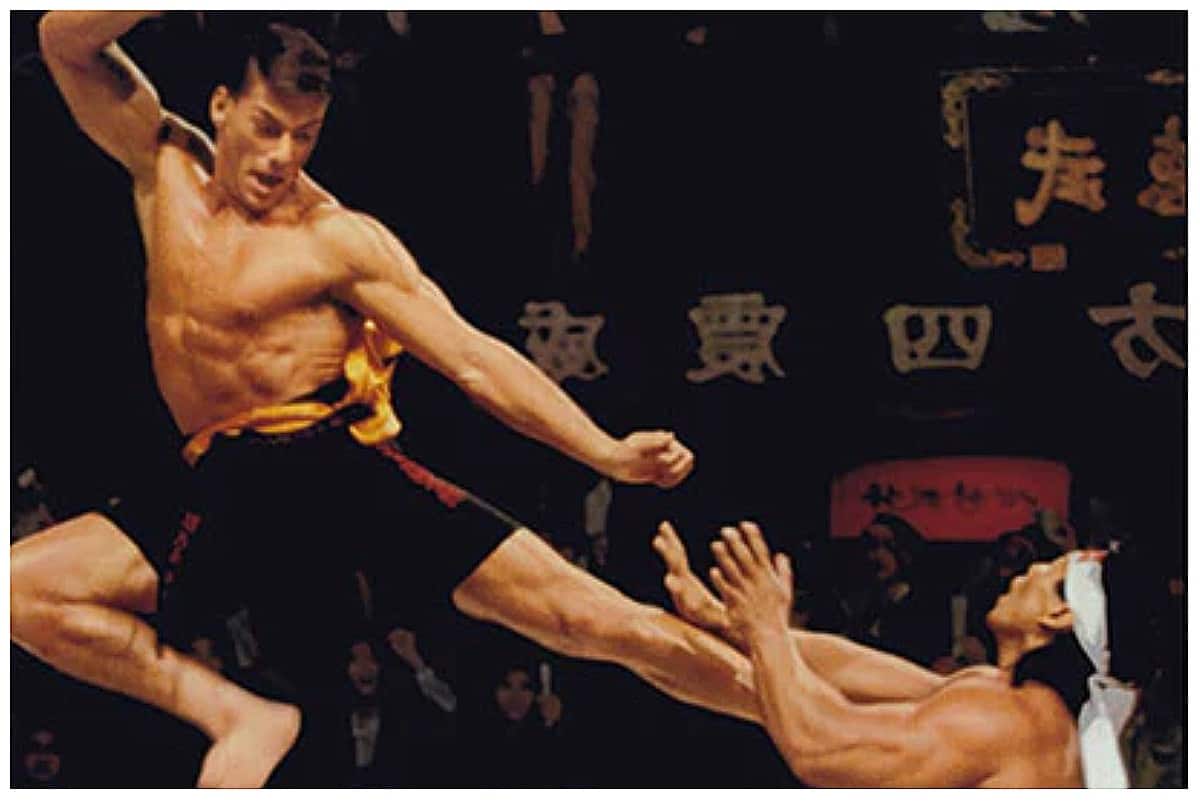
The movie Bloodsport closely resembles the very early events of the UFC by featuring fighters with different martial arts backgrounds pitted against each other. It was style versus style in no holds barred bouts. Some suggest it inspired the birth of the UFC. As a result, this film has become a cult classic among MMA fans.

The producers of Bloodsport claim it is based on real-life events from the life of Frank Dux. Controversy has arisen about the truth of these claims and other events in Dux’s life that cannot be substantiated by hard evidence. It is a great movie, but whether fact or fiction remains a mystery.

Bloodsport was an epic martial arts movie that showcased combat sports with excellent fight sequences and a storyline that had us all rooting for the underdog Frank Dux. The movie is claimed to be based on a true story, which has seen some controversy over the years.

What is the Bloodsport movie about?

The movie is based around the central character, Frank Dux, a soldier in the American army and martial arts expert. Jean-Claude Van Damme played the role of Frank Dux, and it was a definitive movie for his career.

The movie relates the early years of Frank Dux when he was taken in by martial arts expert Senzo Tanaka, who lost his son in a Kumite tournament. 

Tanaka took Dux in as his own son and taught him the art of ninjutsu as he would have done for his lost son. Years go by, and Dux enters the military. While in the army, he gets to hear of an underground fight tournament called the Kumite, about to take place in Hong Kong.

The Kumite only took place every five years, and Dux saw it as an opportunity to participate and regain honor for the Tanaka family. An invitation was sent to the Tanaka family to send a representative to the tournament because Tanaka’s son died in the previous event.

Frank Dux uses this invitation to gain a place in the tournament and intends to face off against the reigning champion, who had killed Tanaka’s son in the previous event.

The Kumite is a combat tournament where fighters from multiple disciplines are invited to fight in a no holds barred competition with no weight distinctions. The fight continues until a knockout or submission is achieved or a fighter cannot continue.

The movie follows the story of Frank Dux as he disobeys orders from the military not to participate in the Kumite and the fighters he comes up against throughout the competition.

Hi makes his way through the ranks of fighters to the final bout against the bloodthirsty, cruel champion, Chong Li, who killed his opponent in the semi-final bout.

The role of Frank Dux was played by Jean-Claude Van Damme and was a career-launching role for the martial arts expert. The role of his arch nemesis, Chong Li, was played by Bolo Yeung, a bodybuilder and martial arts expert from Hong Kong who also played a villain role in Bruce Lee’s movie, “Enter the Dragon.

Is the movie Bloodsport based on a true story?

The movie claims that it is based on tue life events, but there is some doubt as to the legitimacy of the story and the events.

The movie itself is an excellent martial arts action film and catapulted martial arts movies back into the limelight. The Kumite concept is similar to modern MMA bouts, where fighters from multiple combat disciplines match their skills against each other.

Many supporters propose that Bloodsport set the foundation for the development and popularity of the modern MMA concept and structure.

The controversy arose because the movie claims to be based on factual events from the life of Frank Dux, who is a real person. Investigations into the claims of the real Frank Dux led to some discrepancies in his story, which seemed to discredit parts of the story that he touted to be factual to the real events.

Many aspects of the story cannot be verified due to several circumstances and the passage of time, which makes it impossible to say whether the story portrayed in the movie accurately represents actual events.

RELATED:
Top 11 Best MMA Movies that are More Fun than Real MMA Fights

Who is Frank Dux?

Frank Dux, the main character in the movie, is a real person, and he was born in Toronto, Canada, in 1956. When he was 7 years old, his family relocated to California, USA.

While in the US, Frank Dux claims he met Senzo Tanaka, who trained him in martial arts and took him to Masuda, Japan, when he was 16 years old to train in ninjutsu.

Frank Dux joined the US Marine Corps and served from 1975 to 1981, and we are told that he participated in covert ops into southeast Asia during his service. Dux claims that he was awarded the Medal of Honor for his service in this region.

After his military service, Dux opened several martial arts schools, teaching his own style, Dux Ryu ninjutsu. He also claims to have a black belt in Taekwondo and other martial arts disciplines.

Frank Dux currently lives in Seattle, Washington, where he is an entrepreneur and facilitator. He still has ties in the movie industry, choreographed and co-wrote several martial arts action films, and is a published author.

As people began to investigate the claim that the Bloodsport movie was based on true events, holes began to appear in Frank Dux’s story.

Investigators could not find out much about the Kumite, but perhaps that is due to the secrecy around the underground event. 

Further discrepancies came to light when the research was conducted into Dux’s military career. No evidence could be found that he went overseas nor that he was awarded the Medal of Honor. 

While this raises eyebrows, it is not beyond the realms of possibility that covert missions and the participants were never documented by the military or have been swept under the proverbial rug.

Snippets of information have arisen that seem to corroborate Frank Dux’s story and the events depicted in the Kumite, but there is little hard evidence.

While the truth may never be known, there remains enough controversy about Frank Dux’s claims to cast doubt on the validity of his story.

Is there really a Kumite tournament?

According to the movie’s storyline, the Kumite was an underground martial arts tournament held every 5 years.

The tournament was illegal because it was not sanctioned by any formal fighting association and because of the brutality of the event. Some participants were killed in fights during the competition due to the lack of rules regarding full-contact fighting and the “no holds barred” nature of the event. 

Is the Kumite tournament an actual event? Is there any proof that it exists?

While it is difficult to find facts about a secret underground tournament, Kumite tournaments do exist today but are not the brutal competitions depicted in the Bloodsport movie.

During the era when Frank Dux fought in the Kumite, there was no internet and no camera phones, which would have made documenting such a secret event easier.

The November 1980 issue of the popular Black Belt Magazine claims that an underground full-contact, no holds barred Kumite tournament does exist and is held every 5 years. The magazine claims the tournament is organized by the IFAA, or International Fighting Arts Association.

Vague threads of information from this era seem to indicate that the tournament is real, but there is no tangible evidence to back them up.

Is Bloodsport 2 movie coming out?

The Bloodsport franchise followed up with a 1996 sequel, “Bloodsport II: The Next Kumite,” which does not follow Frank Dux but changes to a new character, Alex Cardo, played by Daniel Bernhardt.

This second Bloodsport movie is entirely fictional and doe not claim to be based on any real-life events. 

A third movie, Bloodsport III, released in 1997, continues the story of Alex Cardo, introduced in Bloodsport II. 

Rumors have arisen that Jean-Claude Van Damme was planning to film a sequel to the original Bloodsport movie, but this has yet to come about.

Conclusion

It’s unclear how much of Frank Dux’s claim is true or not. Whatever you think of Frank Dux, one thing is certain about his contribution.

That is, whether you believe the Bloodsport movie was based on real-life events or not, there is no disputing that it was a visionary movie that inspired the style of multi-discipline fights we see in modern MMA bouts. That itself, at least, cannot be discredited where credit is due.

What is ADCC Submission Fighting World Championship? A Simple Guide

0
Credit: adcombat.com

Grappling-based sports have been on a tremendous rise in modern times. Various organizations are promoting different styles of grappling matches, with ADCC being the most popular. But what is ADCC submission grappling, and why is it so popular amongst grapplers?

ADCC submission fighting world championship is a submission grappling competition promoted by the Abu Dhabi Combat Club (ADCC), where the absolute elite grapplers around the world come together to compete for the title. The ADCC events have been organized every two years since 1998.

Winning the ADCC Submission Grappling World Championship is regarded as the ultimate achievement for submission grapplers. Let’s take a closer look at ADCC as an organization, the rules, and what makes this event so special.

What is ADCC Submission Fighting World Championship?

The Abu Dhabi Combat Club, or ADCC Submission Fighting World Championship, is the premier submission grappling championship. ADCC is the UFC, NBA, or NFL of submission grappling, where only the world’s greatest grapplers compete for the championship, legacy, and cash prize.

Credit: adcombat.com

This form of competition emerged way back in 1998, when submission grappling had just started to become popular. The original founder of ADCC was Sheik Tahnoon Bin Zayed Al Nahyan. A passionate BJJ practitioner and the son of the United Arab Emirates president, Sheikh Zayed bin Sultan Al Nahyan.

The UAE’s Sheikh Tahnoon Bin Zayed Al Nahyan may be the most influential figure in Jiu-Jitsu whose last name isn’t Gracie.

Bjj Eastern Europe. (2020, September 22)

Initially, his main goal was to spread martial arts in the UAE by opening the academy. Then he would create a form of freestyle competition where athletes with different grappling styles could compete. The main goal was to determine which grappling style was the most practical and who was the best grappler.

The ADCC format is more in line with Brazilian Jiu-Jitsu and its set of competition rules. This is why the competitors mostly come from no-gi BJJ and are the most successful. But the athletes from other grappling arts such as freestyle wrestling, judo, sambo, and shoot wrestling are more than present.

As a form of competition, ADCC is special in many different ways. Winning an ADCC championship belt is considered the pinnacle of athletic achievement for grapplers. It is often equated with winning gold in the Olympics. ADCC events are organized every two years, and not every great grappler can secure a spot in the tournament.

You may secure a spot by receiving an invite, but this only makes up around half of the list. The other half must earn a spot through trial events. ADCC trial events are hosted in North and South America, Europe, Asia, and Oceania.

In the end, only the 16 finest submission grappling athletes in each weight class make it to the ADCC, which adds to the importance and quality of the tournament.

Over time, the ADCC format has become popular globally, and many other organizations have adopted the same concept of competition and rules.

ADCC Rules Explained

The ADCC Submission Fighting World Championship is based on an elimination tournament where the winner goes through to the next round, and the last man standing wins the championship. Following is a detailed explanation of all the major rules. The following information about ADCC rules is sourced from the ADCC site.

Time limits

The length of the matches varies between the types of competition. The rules are different in World Championship and Trial matches.

ADCC Trial matches and National Championships include one round of action. Contestants first compete in the “qualifying round,” which lasts 6 minutes. The first 3 minutes are without points, while the second 3 minutes include both positive and negative points. If the match ends in a draw, it will go to 3-minute overtime.

The winners move on to the “Finals,” where the round is 8 minutes long, and in case of a draw, contestants compete in 4-minute overtime. The matches in the finals also differ when it comes to points. Contestants can receive only negative points in the first 4 minutes of the match, while the second 4 minutes count both negative and positive points.

World Championship

Matches at the World Championship level are longer in duration. Each match in the qualifying rounds is 10 minutes long, with 5 minutes of overtime in case of a draw. There are no points in the first 5 minutes of the match, while the second half includes both positive and negative points.

Contestants that move on to the finals compete in 20-minute matches, and the overtime is 10 minutes long. There is one overtime per match. The first 10 minutes of the match do not include points, while contestants can score both positive and negative points in the second half. Super Fight matches last 20 minutes each, with 10 minutes of overtime.

Uniform

Contestants are allowed to wear a Gi uniform, which consists of a jacket, long pants, and a rank belt around the waist. The rules also enable them to wear wrestling shoes. However, most contestants choose to compete without a gi (no-gi style). It is a strategic choice, as no-gi contestants have a big advantage over opponents who wear a uniform when it comes to grips and many other elements.

So instead of wearing a traditional uniform or wrestling shoes, most contestants compete bare-chested, wearing only shorts. Some might choose to wear a shirt or a rashguard, while others might wear only long pants. It is both a strategic choice and a personal preference.

Legal techniques

According to ADCC rules, contestants are allowed to utilize just about every takedown or submission move.

  • All types of leg-locking techniques, such as kneebars or ankle locks
  • Any arm-locking technique such as kimura or an arm bar
  • Shoulder locks, wrist locks, foot locks
  • Slamming is allowed only if you are caught in a submission

Illegal techniques

ADCC contestants are not allowed to utilize the following moves:

  • Submission attempts such as neck cranks, full nelson, or cross-face guillotine twisting.
  • Spiking the opponent on their head while going for a takedown, for example.
  • No dirty moves such as eye-gouging, hair-pulling, fish hooking, biting, etc.
  • No striking of any kind
  • They are not allowed to pick the opponent up and slam them down to the ground to break the guard.
  • No slippery substances such as Vaseline are allowed on the body or clothing.

How to score points in ADCC (positive and negative)

In the ADCC competition, there are positive and negative points. The following is an explanation of both.

Positive points

  • 4 points — Clean takedown (ends passed the guard, and 75% of the opponent’s back must be on the floor). Clean sweep (ends passed the guard; reversals are also considered sweeps).
  • 3 points — Passing the guard (only when 75% of the opponent’s back touches the mat. And for securing a back mount position with both hooks in.
  • 2 points — are given for the knee on the stomach position (the knee has to be placed in the middle of the opponent’s stomach). Takedowns and sweeps (the opponent’s butt or back must be on the ground for 3 seconds or more). Mount position (both knees must be touching the floor).

Negative points (penalties)

Contestants receive a one-point deduction for:

  • When a contestant pulls the guard or intentionally goes from a standing position to the ground and remains down for 3 seconds or longer.
  • When a contestant disengages from contact and starts avoiding the engagement and stalling the action.
  • A passive fighter will first receive two verbal warnings before being punished by losing one point.
  • If a contestant tries to escape from the submission by fleeing the match more than once,
  • For disobeying the referee’s commands. Using foul language or utilizing illegal techniques.

ADCC Weight classes

For the ADCC World Championship and Qualifiers, there are five weight classes and an absolute weight class (no limit) for men, and there are two weight classes for women (no absolute).

ADCC male weight classes (only for people over 16 years of age)

  • -65.9 kg (-145.2 lbs)
  • -76.9 kg (-169.5 lbs)
  • -87.9 kg (-193.7 lbs)
  • -98.9 kg (-218.0 lbs)
  • +99 kg (+220.5 lbs)

ADCC female weight classes

  • -60.0 kg (-132.2 lbs)
  • +60.0 kg (-132.2 lbs)

Does ADCC test for banned substances?

The ADCC organization does not test its athletes for performance-enhancing drugs (PED). This leaves much room for speculation regarding the use of substances such as anabolic steroids and other substances banned in other combat sports.

But in the ADCC community, the lack of PED testing has never been a big controversial topic because it is a grappling-only tournament with no striking. In the end, if you want to be a top grappler, you need to be technically skilled and agile, which requires working on the mat for countless hours honing your craft rather than lifting weights to build more muscles and strength to be a better grappler.

As a grappler, you need to move faster, be more flexible, and have better endurance. On the other hand, the ones with PED-enhanced bodies tend to gas out early in the grappling match as big muscles deplete oxygen quicker. On top of that, PED-enhanced bodies are generally slower and have less flexibility simply because they have more mass to move. As a result, many people believe that using PED has little to no effect on significantly improving grappling skills.

RECOMMENDED READING:
Why Are MMA Fighters Skinny And Don’t Have Big Muscles?

What is the prize in ADCC?

The prize money in the ADCC differs between male and female competitors. Men in non-absolute weight classes earn $10,000 for first place, $5,000 for second, $3,000 for third, and $1,000 for fourth. The ones who compete in an absolute weight class, however, earn $40,000 for first place, $10,000 for second, $5,000 for third, and $1,000 for fourth.

Female contestants receive $6,000 for first place, $3,000 for second, $2,000 for third, and $1,000 for fourth.

ADCC also includes bonuses for the best performances, fastest submissions, takedowns, etc. Contestants also boost their incomes through various sponsorship deals.

What is the ADCC Superfight?

ADCC Superfights are highly anticipated matches that feature only the best of the best grapplers in the world. It is a submission grappling contest between the reigning super champion against the winner of the absolute weight class in the most recent ADCC tournament. It is widely regarded as the most important match of the event.

Superfight rules are very much the same as in World Championship bouts, except for time limits. The duration of a super fight is 20 minutes, and in the case of a draw, the bout will be extended for an additional 10 minutes. If the overtime results in a draw, contestants will compete in the second 10-minute overtime.

Gordon Ryan vs. Andre Galvao is considered the greatest superfight in grappling history.

Do you have to be a BJJ practitioner to compete in ADCC?

ADCC is a submission grappling tournament, and as such, it incorporates all grappling styles. Any style of submission grappling is allowed as long as the techniques you utilize align with the rules.

That being said, the majority of ADCC athletes actually come from jiu-jitsu, as this specific martial art fits the rules better than most other grappling arts. This is confirmed by the number of ADCC champions with a background in jiu-jitsu, especially the no-gi style.

Some other martial arts that conceptually fit well are Russian Sambo as well as Judo and collegiate wrestling. Sambo is especially effective as it emphasizes explosive takedowns and aggressive groundwork. However, BJJ remains the most dominant martial art.

Who is the greatest ADCC competitor of all time?

Over the course of history, there have been many great grapplers who have dominated the competition. The following athletes are considered some of the greatest ADCC competitors in history.

Kyra Gracie — is one of the most dominant female grapplers in history. She won three ADCC gold medals and never lost a match in her division. She is also a four-time world jiu-jitsu champion.

Andre Galvao — is the ADCC legend with six championship titles. He holds the record for most super fight wins (4). In his career, he won just about every notable grappling tournament multiple times, and he had a decent MMA career fighting for “Dream” and “Strikeforce” promotions.

Mark Kerr — is a martial arts legend who has successfully competed both in MMA and submission grappling. He is a four-time ADCC world champion with a record of 12–1. In his prime, Kerr used his exceptional wrestling skills and superhuman strength to dominate his opponents.

Marcelo Garcia — is widely regarded as the best ADCC champion in history. In his career, he won the championship four times, and he went through wars to beat some of the biggest names, such as Kron Gracie, Pablo Popovitch, and Vitor Shaolin.

Gordon Ryan — is the most popular grappler in the world and is often seen as the best no-gi grappler in sports history. He won the ADCC world championship five times and is also a two-time IBJJF no-gi world champion.

RELATED:
What Makes John Danaher the Greatest BJJ Coach? A Closer Look

How do I participate in ADCC?

ADCC events include 16 competitors per weight class for men and 8 competitors for females, and there are three different ways you can be one of them.

First, winners from the previous tournament automatically qualify for the next event. Second, you may receive an invitation directly from the organization to participate in the tournament. Lastly, you must secure a place by winning one of the qualifying (trials) events organized worldwide.

Each male division has 8 athletes who qualified through trials, 7 who received an invitation, and the reigning champion. Female weight classes include eight competitors in total, with 4 securing a spot through trials, and 3 by receiving an invitation, and the last one being the champion.

RELATED:
How To Become A UFC Fighter?

What Makes John Danaher the Greatest BJJ Coach? A Closer Look

0
Photo via Instagram @danaherjohn

Editor’s note: The views and opinions expressed below are those of the author.

John Danaher is a renowned figure in the mixed martial arts (MMA) world, widely respected and revered as one of the greatest coaches in the industry. Holding a sixth-degree black belt in Brazilian jiu-jitsu (BJJ) and a reputation as one of the best instructors of all time, his name is well-known even among casual MMA fans.

He has coached some of the biggest talents in the world, such as Georges St-Pierre and Gordon Ryan, and has frequently appeared on popular podcasts.

But what sets John Danaher apart as a grappling coach and possibly the greatest BJJ coach of all time? Let’s delve deeper into his background and achievements to find out.

Who is John Danaher?

John Danaher is a New Zealander born in the United States on April 2nd, 1967. Although he did have some martial arts experience growing up, it wasn’t until he trained at the Renzo Gracie Academy in New York in the early 1990s where he truly started his grappling journey.

As a student of Renzo Gracie, he quickly rose through the ranks and started teaching classes at the academy as a blue belt after coaches like former UFC welterweight champion Matt Serra left the gym. Eventually, Danaher received his BJJ black belt from Renzo Gracie.

Over time, he started instructing on a full-time basis before developing a reputation for his expertise in BJJ as well as his innovative teaching methods. Danaher would go on to work with UFC champions such as Georges St-Pierre and Chris Weidman while also coaching jiu-jitsu prospects like Gordon Ryan, Garry Tonon, and many more.

Did John Danaher ever compete in a Jiu-Jitsu tournament?

In the world of martial arts, many top martial artists do not compete, but this does not diminish their expertise and competency in martial arts. However, in the case of John Danaher, he could never compete professionally, as he suffered from severe leg and hip problems throughout his life.

This allowed him to focus full-time on teaching. With that said, it’s well known that despite his physical issues, he would easily outclass the world’s best in the gym. Danaher explains in the following video why he didn’t compete.

What makes John Danaher possibly the greatest BJJ coach?

There are many reasons why Danaher is the greatest BJJ coach of all time. For starters, he’s a jiu-jitsu computer and encyclopedia, being a highly analytical thinker and developing a systematic approach to teaching the martial art.

Part of what helps is his extreme dedication to the sport. Even when he’s not teaching, he’s always studying tape, and when he does spend time on the mats, it can be for as much as 12 to 14 hours a day.

Since he started BJJ late, it’s his way of making up for lost time, ultimately helping him identify holes not only in his game, but the martial art as a whole.

The following excerpts are from John Danaher’s interview, in which you can sense his deep passion for learning BJJ and how he became good at teaching.

“I was known for spending large amounts of time on the mats,” Danaher said in an interview. “I taught two to three big group classes per day and was booked every hour between them for private classes. And I liked this because I was a very late starter in Jiu-Jitsu – starting at twenty eight years old – so I felt that I needed to accrue many hours of mat time quickly, to match the hours people who started much earlier in life had already amassed.

(2019, July 2). In Bjj Eastern Europe.

“Much of it was simply teaching people how to perform better in Jiu-Jitsu, but because Jiu-Jitsu is a very hands on sport and I personally drilled and sparred with everyone of my clients every time I taught, I got countless opportunities to identify problems in my game and the game in general, and would always try to improve the solutions I had been taught.”

(2021, December 26). In Bjj Eastern Europe

There’s also his system, mainly consisting of his revolutionary leg locks along with intricate and innovative set-ups, entries, and counters. Everyone in his team follows the same style and system with highly effective results. This is important as it shows his system can translate to anybody regardless of body type or personality.

Photo via Instagram @danaherjohn

Danaher also mainly teaches from niche positions. This is significant as many in the sport prefer to train solely at what they’re good at; they reach a certain level and just keep repeating the same process. But with Danaher, he primarily teaches positions such as full mount, guard, back, side control, and more.

This is why students like Gordon Ryan, regarded by many as the greatest jiu-jitsu practitioner today, are able to reinvent themselves and sweep past the competition no matter which position they’re in. Another added advantage is that while his students may have trained half as long as their opponents, they’ve actually got twice as much training time because they’re training in these niche positions.

There’s also the small matter of Danaher revolutionizing the sport with his many innovations. For starters, the straight-back attack system was developed by Danaher. Then the whole explosion in popularity of leg locks? That’s also down to Danaher. Before 2015, nobody was using leg locks. That was until Danaher introduced it to his team, who have since won everything in the sport utilizing leg locks.

More than anything, though, the results simply speak for themselves. Gordon Ryan is considered the greatest BJJ GOAT (Greatest Of All Time), Georges St-Pierre is a former two-weight UFC champion and widely regarded as the MMA GOAT, Giancarlo Bodoni is an ADCC gold medalist, Garry Tonon is an ADCC bronze medalist, Nicky Rodriguez is an ADCC silver medalist as a blue belt, Nicholas Meregali is an ADCC silver medalist, and Chris Weidman is a former UFC middleweight champion.

Those are just a few names, but the one thing they all have in common is that they’ve extensively worked under Danaher, further highlighting just how effective he is.

LEARN MORE:
How Does Belt Promotion Work in BJJ? Complete Beginner’s Guide

What is the John Danaher Death Squad?

Danaher eventually formed a team of elite BJJ practitioners, including himself, Gordon Ryan, Garry Tonon, Nicky Ryan, Eddie Cummings, and Nicky Rodriguez, collectively known as the Danaher Death Squad. The name, coined by a former training partner, Ryan Quinn, on Reddit, has since become a widely recognized term in the BJJ community.

As aforementioned, what made this group unique was their effective utilization of Danaher’s leg locks. However, they eventually split in 2021 as Danaher, Gordon Ryan, Garry Tonon formed New Wave Jiu-Jitsu with the likes of Giancarlo Bodoni, Dan Manasoui, and Nicholas Meregali. The others consisting of Craig Jones, Nicky Ryan, Nick Rodriguez, and Ethan Crelinsten, meanwhile formed their own B-Team.

It’s not been stated what the exact reason for the split was. However, the prime reason is likely due to a clash of personalities and egos, and this was stated as such by Danaher. The team notably relocated from New York to Puerto Rico to circumvent COVID-19 training restrictions. That also meant spending every minute together as they not only trained together, but lived together in the same house. This ultimately led to tension, especially between the Ryan brothers.

In the following excerpts, John Danaher describes the tension that led to the breakup of the Death Squad.

“Not only was it a team breakup, but it was a family breakup, which is much more serious,” Danaher said in a podcast. “I do believe that in time even the most intense family breakups can be reconciled and I also believe that once dialogue begins people will remember just how easy it is for us to get along and how tight we were for so many years. It’s so easy to let a minute of anger destroy 10 years of friendship.

“With everyone living in very close proximity to each other, any tensions got magnified because there was no relief from them… In particular, there was a family tension between two brothers which magnified over time. As time went by these tensions started increasing. It came to a point where it was difficult for them to be even in the training room together.”

Lex Fridman podcast interview with John Danaher
RELATED:
What Is American Jiu-Jitsu(AJJ)? Beginners Guide To AJJ

Does John Danaher teach BJJ to everyone?

It appears Danaher regularly teaches classes at Renzo Gracie’s gym in Austin, Texas. If you’re interested in learning from the renowned BJJ coach, book a class on a day when he’s scheduled to teach. Contact Renzo Gracie School in Austin for more details.

Of course, not everyone can go to Austin, so the next best option is to purchase one of Danaher’s many instructionals. These DVDs, which also serve as a major source of income for BJJ teachers, will help you learn and improve your game, whether it’s with back attacks, guard passing, drills, submissions, or just basic fundamentals.

RECOMMENDED READING:
BJJ Belt Ranking System – Easy To Understand For Beginners

Does John Danaher teach no-gi only?

As per the schedule at Renzo Gracie’s gym, Danaher does exclusively teach no-gi in Austin, Texas. However, he used to teach both gi and no-gi in the blue basement in New York. Sometimes, he would even do both at the same time in classes with over 100 students.

It’s also interesting to note that he trained Nicholas Meregali in the gi for the IBJJF World Championships in 2022. Meregali ended up winning gold in the open weight while becoming a silver medalist in his own weight class.

Conclusion: Why John Danaher is the greatest BJJ coach

In conclusion, John Danaher is a true legend in the world of mixed martial arts and Brazilian jiu-jitsu. As a sixth-degree black belt with a reputation as one of the best instructors of all time, he has taught some of the biggest talents in combat sports.

He is extremely dedicated to his craft, while his analytical thinking and innovative teaching methods and systems set him apart from other grappling coaches. With his deep understanding of the sport and his ability to translate his teachings to anyone, it is no surprise that for many, John Danaher is easily the greatest BJJ coach of all time. Perhaps Abert Eienstein’s quote perfectly sums up why Coach Danaher is so good at teaching jiu-jitsu.

“If you can’t explain it to a six year old, you don’t understand it yourself.”

Albert Einstein

The Art of War by Sun Tzu: Key Points Explained

0

Very few books have a more enduring legacy than The Art of War by Sun Tzu. Even though it was published two thousand years ago, contemporary audiences still read and appreciate it. So why has this book remained relevant and famous over the years? What is the Art of War all about? 

The Art of War is an influential book about tactical warfare and military strategies. The book covers opponent psychology and how to exploit their weaknesses, when to attack and when to retreat, how to handle a range of terrains, and how a general should lead his troops.

The world of warfare and combat has evolved dramatically since the time of Sun Tzu. But the teachings are still influencing leaders around the world today. Keep reading for a detailed breakdown of this book and some of its biggest lessons. 

What is Sun Tzu’s Art of War Book?

The Art of War was written by Chinese general Sun Tzu during the Warring States Period between 471 and 21 BCE. It’s based on military tactics and how generals should deal with situations. Today, this book is studied by a wide range of people for its psychological insights.

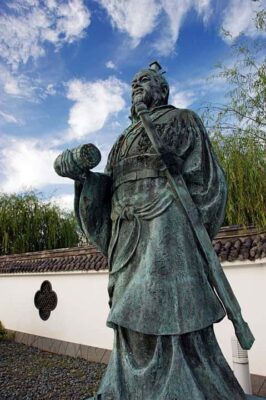
The statue of Sun Tzu
Photo by 663highland

Due to its age, it’s hard to pinpoint when this book was written. But the best guesses place it between 471 and 21 BCE. This was during a turbulent time in China’s history, known as the Warring States Period. This name was chosen because several kingdoms were vying for control. 

The conflict allowed Sun Tzu to refine his military tactics. However, little is known about the author. He was likely a high-ranking general in the Wu state who had a clear understanding of military techniques and strategies. 

Today, though, this book continues to inspire countless people around the world. For example, Chairman Mao, the leader of China, cites it as an influential novel. Many military leaders are known to have read its contents and used it to inspire their approaches to conflict.

Sun Tzu’s book on battlefield strategy, “The Art of War”, has been required reading for the thoughtful military officer for more than 2,500 years.

Smith, S. V. (2018, August 24).NPR.

What Are the Main Lessons of Art of War? 

There are several key lessons that Sun Tzu tries to impart during Art Of War; these include: 

  • Avoid lengthy sieges. He argues that this will wear down both the attacking and opposing armies. It’s best to seek victory as quickly as possible. 
  • Know your opponent. If you study your opponent, you can create a strategy that uses their weaknesses against them. Ideally, you should only attack once you are certain you can win. If you can’t win, you should retreat. 
  • Control your opponent. Leaders should try to deceive and manipulate their opponents, tricking them into moving into traps that exploit their weaknesses. It’s important to know when to defend and when you should be attacking. 
  • Divide and conquer. A united army will win more easily if they can divide the enemy into smaller factions. 
  • Remain flexible. In combat, there are always unprecedented situations. Sticking too rigidly to a plan can cause leaders to fall for traps or to miss potentially valuable opportunities.
LEARN MORE:
What Is Verbal Judo for Police? The Gentle Art of Persuasion Explained

What Are the Famous Quotes from “The Art of War”?

Numerous quotes sum up Sun Tzu’s approach to conflict; some of the most popular are: 

  • If you know the enemy and know yourself, you need not fear the result of a hundred battles. If you know yourself but not the enemy, for every victory gained, you will also suffer a defeat. You will succumb in every battle if you know neither the enemy nor yourself.
  • To secure ourselves against defeat lies in our own hands, but the enemy himself provides the opportunity of defeating the enemy.
  • The clever combatant imposes his will on the enemy but does not allow the enemy’s will to be imposed on him.
  • Let your plans be dark and impenetrable as night, and when you move, fall like a thunderbolt.
ALSO READ:
What Did Bruce Lee Mean By “Be Like Water?” Simply Explained

How Does the Art of War Apply to Combat Sports?

The most prominent topics covered in Art of War relevant to fighters in combat sports are; understanding your opponent’s motivations, how to manipulate them, deciding when to attack, and learning how to gain a tactical advantage over the opposition. 

The main target for The Art of War is military commanders. But the principles in this book have meaning for everyone involved with combat sports. It contains a lot of insight into how your opponent thinks. It delves into how you can use psychology to your benefit. For example, how you can lure your opposition into making a mistake. It also talks about when you should attack your opponent and when it’s the right time to retreat. 

In the world of combat sports, this will often be done by studying previous matches and looking for weaknesses that you can exploit. It’s also important to reflect on your previous fights and consider how you can create a more effective attack in the future. 

In The Art of War, Sun Tzu said, “Let your plans be as dark and impenetrable as night.” This lesson focuses on the importance of keeping your plans hidden from your opponent, which MMA fighters always do by keeping their game plans secret.

In doing so, you keep your opponent guessing about your fighting strategy throughout the fight. This makes it easier to manipulate your opponent, forcing them into situations that benefit you. For example, your opponent expected you to use more jiu-jitsu techniques, but you completely surprised them by attacking with more striking.

Lastly, this book goes into depth about the terrain and how armies can use it to their advantage. This mindset also applies within a fight. For example, if you keep the cage or ropes to your back, you can stop your opponent from attacking you from behind.

In the video below, UFC champion Henry Cejudo explains how “the art of war” strategy can be used in combat sports to defeat your opponent.

Who Should Read the Art of War?  

The Art of War is a highly recommended book for military and civilian leaders and combat athletes. Those in military and government leadership roles can gain valuable insights from the various approaches and tactics taught in the book. Those in combat sports can gain insight into their opponent’s mindset. 

Given the book’s nature, it has influenced military leaders in particular, but its words of advice can also apply to business leaders as well as combat sports players. Combat athletes would particularly enjoy the sections of the book that deal with the psychology of fighting. Sun Tzu talks about how a strong leader should behave and how to build a loyal group. These lessons can be adapted to fit the corporate world as well as those within the government. 

Lastly, an average joe can also gain wisdom from the Art of War because it is all about useful tactics and strategies rather than a specific warfare technology. The philosophical insights can be used for self-improvement. For example, Sun Tzu discusses why you should be prepared for anything life might throw your way.

Final Thoughts

The Art of War has truly stood the test of time, describing the psychology of conflict and the tactics required to win any battle. Even more remarkably, this novel is useful outside the military sphere. It has been used by athletes, business leaders, politicians, and regular people searching for a way to improve their lives. 

What is the Boxing 10 Point Must System? Beginner’s Guide

0

Many boxing matches actually end up in the hands of the judges, who decide the winner. And in order to determine the winner, these judges use the famous 10-point must system to score the fighters’ performances. But what exactly is the 10-point must system, and how does it work in practice?

The 10-point must system is a boxing scoring system. The winner gets 10 points, and the loser gets 9, 8, 7, or 6 points in each round, depending on how dominant the winner is. If the match goes the distance, the officials will tally up all three judges’ scores to determine the winner.

This is just a brief explanation of how the boxing 10-point must system works. Thus, be sure to read this article to learn more about it, as well as about point deductions and possible outcomes.

What is the “Boxing 10-Point Must System”?

Boxing is one of the oldest sports in general and has officially been around since ancient times. But the modern form emerged with the birth of “Marquess of Queensberry Rules” in 1867. This rule set introduced rounds, referees, weight classes, and many other changes. But back then, the referee of the match was the one who would determine the winner once the time expired, as there were no judges or point scoring systems.

The concept of judges and a 10-point must system emerged in 1968. At the time, boxing was on the rise, and the concept in which the referee picks the winner based on their subjective opinion was no longer practical.

There were many controversial calls, fixed matches, and inadequacies overall. The sport was in search of a new concept to improve the reliability of scoring and outcomes. The final result was a 10-point must system created by the World Boxing Council.

A 10-point must system is a point-scoring concept used in boxing. Boxing judges use this scoring system to decide the winner of a match if neither of the fighters wins by KO or TKO. After each round, they give the winner 10 points, while the loser gets 9, 8, 7, or 6 points. At the end of the fight, the officials would tally up the scorecards from all three judges and declare the winner.

Since the creation of 10-point must system, many other combat sports have adopted the system, such as MMA, kickboxing, Muay Thai, and others. Let’s see how the system works in practice.

How do boxing judges score a fight?

Each boxing match, whether it is professional or amateur, includes three judges sitting on three different sides of the ring. They rely on strict criteria to evaluate the action inside the boxing ring. These judges use a 10-point must system to score the match round by round.

During the match, judges are not allowed to interact with one another or in any way influence each other’s decisions. At the end of each round, all three judges will take their own scorecards and write down one of the following scores, depending on how the round played out.

Once they write down the score, the referee will collect all the scorecards and then hand them to the officials sitting beside the ring. These officials will then tally up all the scores.

The winner gets 10 points, while the loser gets 9, 8, 7, or 6. Here is a detailed explanation of each score.

10–9 — the majority of boxing rounds are scored 10–9. This signifies that the round was close but was given to a boxer who gained a small advantage during the exchanges. Even when the round seems equal, it should be awarded to the boxer who had even the slightest edge.

10–8 — is given when one boxer has dominated the round by landing hard, significant blows to the opponent, who, on the other side, didn’t have to offer much in return. It is also automatically given if the loser of the round gets knocked down.

10–7 — in most cases, judges give 10–7 when a boxer scores two knockdowns within a single round. For each knockdown, the judges would deduct one point, and when a losing fighter hits the canvas two times in a round, they will get only 7 points.

10–6 — is given when a boxer suffers three knockdowns in a single round, and this specific score is quite rare. Most boxing bouts actually get stopped before they get to the point where one fighter is knocked down three times. The risk of severe injury would be too great in most cases to remotely even allow three knockdowns.

10–10 — is given when the round is even and there is no difference or advantage between the fighters. This score is usually awarded during those rounds where there is no action or significant strikes are landed by both sides.

RELATED:
How Does Scoring Work In UFC? –  Here’s a Simple Explanation

Criteria for Boxing Scoring

Boxing judges must follow strict and standardized criteria when evaluating the action inside the ring. Even though the following criteria are strict, they allow the judges a lot of room to be subjective when judging the boxer.

Here is what the boxing judges are looking for in a boxing match:

Effective aggression

Effective aggression is one of the most important criteria. However, the word “effective” makes a lot of difference here. A fighter might be aggressive, throwing barrages of punches and backing the opponent.

But suppose the opponent is blocking most of the shots and landing some in return. In that case, that is not considered effective aggression. In order to be effective, an aggressive fighter must land clean and hard shots and show the willingness to finish the match.

Defense

A lot of fans overlook and underappreciate the importance of defense. But in the judges’ eyes, this is a very important criterion, as defending yourself requires a level of skill. A boxer can win a round by blocking strikes, angling out, and creating openings to land counterpunches on their aggressive opponent.

They might be backed against the ropes or forced to move around the ring. But as long as they are in control and land more significant shots, they will win the round.

Who controls the center of the ring

Boxers who are in control of the center of the ring are usually the ones dictating the pace of the fight and initiating exchanges. Suppose the round is even, with both fighters being equal when it comes to significant strikes. In this scenario, the judges will give the round to a fighter who controls the center of the ring.

Power and damage

Boxers throw around 45 punches per round in the boxing match. However, punches are landed with an accuracy of approximately 10 percent to 30 percent, so most thrown punches are either missed or blocked. The judges always look to determine which fighter is landing cleaner and more damaging shots. Simply put, the judges look for a clear impact and damage from the punch.

What is the possible outcome of a boxing match?

Boxing matches can end either by decision when the time expires or a stoppage caused by a knockout or injury. Here are all the possible outcomes explained:

Unanimous decision — is declared when all three judges score the match for the same fighter. This outcome happens when a boxer dominates the majority of the fight and is better than their opponent in all aspects.

Split decision  is declared when two judges score the match for fighter-A while the third judge sees fighter-B as the winner, which results in fighter-A winning the fight. Split decisions are common in fights where the momentum shifts back and forth, with each fighter having their moments.

Majority decision — is declared when two judges score the match in favor of one fighter, while the third judge sees the match as a draw. Since two judges have outscored the third, one boxer would be declared the winner.

Split Draw — is a rare outcome when all three judges see the fight differently. One judge would score it in favor of fighter-A, the second judge for fighter-B, and the third judge would score it as a draw.

Majority draw — is declared when two judges see the match as a draw but the third judge scores it in favor of one of the boxers. Since the majority of two out of three judges saw the fight as even, the match would end in a draw.

Unanimous draw is an extremely rare outcome, as this means all three judges agreed the match was even.

Technical decision— happens when an accidental head clash results in an injury. If enough rounds have passed, the judges will add up the scores up to that point and declare a winner.

Technical draw happens when an accidental head clash results in an injury. If enough rounds have passed and all three judges see the match as even up to that point, the match would be declared a technical draw.

TKO (technical KO) — happens when the referee decides to step in and stop the match because the fighter is no longer intelligently defending and is taking huge damage.

Knockout (KO) — happens when a boxer receives a hard punch to the face and falls down to the canvas, unconscious in most cases. It can also happen if they can’t recover from a hard body shot.

Retirement – happens when a fighter can no longer continue after one of the pauses in between the rounds. If the fighter cannot stand off the stool to fight, the referee has no other option but to wave the match off. Boxers can also retire or “give up” during the match by verbally informing the referee or by dropping down to the canvas and tapping out.

Towel stoppage — is a type of retirement. But this time, it’s the boxers’ cornermen who decide to stop the fight by throwing in the towel. Sometimes, boxers are too tough for their own good to stop despite absorbing too many damaging blows. For this reason, when their coaches notice their fighters receiving too much damage, they will throw in the towel to protect them.

No contests — occur when a boxing match ends due to reasons not directly related to the fighters or fight and there is no winner.

What is the 10-count rule in boxing?

The 10-count rule comes into play when a boxer gets knocked down to the ground upon receiving a hard punch to the head or body. The referee would instantly step in, pause the match, and start counting to ten. Or, in other words, give a knocked-down fighter 10 seconds to recover and continue to fight.

Photo by Biser Todorov

If a boxer rises within 10 seconds, the referee will check if they are recovered enough to continue and reset the match in the center. However, if a downed boxer cannot get back to their feet or does so in visibly bad condition (on wobbly legs, for instance), the referee will wave both arms to stop the match, which will result in a TKO.

However, there is a phenomenon called a “long count.” Some referees would give fighters more time to recover by counting slowly. So instead of being allotted 10 seconds, fighters may get up to 15 seconds. One study of knockdowns showed that the majority of boxing 10-counts actually last longer, and throughout history, there have been many controversial counts.

For example, when Billy Conn got knocked down against Joe Louis, he was given 12.4 seconds to recover. The same happened when Buster Douglas got dropped by Mike Tyson during the match as he received at least 12 seconds to recover.

Why did MMA adopt the boxing 10-point system?

MMA adopted a 10-point must system with the creation of the Unified Rules of MMA in 2000 in the US. At the time, the Boxing Association took MMA under its regulation, so naturally, the sport adopted the same, already proven boxing scoring system. This was not unusual, as some other combat sports, such as kickboxing or Muay Thai, also rely on the same 10-point system.

Although the concept of scoring is the same, there are more than a few differences:

No 10–8 for knockdowns in MMA — in boxing, when a boxer gets knocked down, the judges will deduct an additional point from the boxer who got dropped. If the second one happens, they would take another point and score the match 10–7. However, there is no such thing in MMA, as a fighter who gets knocked down doesn’t necessarily lose an additional point.

Almost no 10–7 scores in MMA — in boxing, 10–7 scores are quite common and happen when a fighter gets knocked down twice in a round. MMA didn’t adopt this rule, and a fighter who gets dropped twice would likely lose that round 10–8.

MMA has less room for mistakes — in boxing, most professional matches have 10–12 rounds. If a judge makes a mistake in a round or two, their decision won’t significantly impact the outcome. In MMA, regular fights are three rounds, while championship fights are five rounds. In a three-round fight, a single mistake by the judge can directly impact the outcome of the match.

MMA is harder to score  boxing is simple as fighters use only their hands to strike the upper body area above the waist. MMA is different as it includes striking with all limbs, clinch fighting, wrestling, and fighting on the ground with submissions and strikes. More variables in MMA make it much harder to judge, despite the criteria.

How do boxers get their points deducted?

Boxers get their points deducted from their scorecards when they commit a foul or do anything against the rules. This usually occurs when they land illegal blows—usually unintentionally.

Depending on the referee, they would get away with a verbal warning the first or second time. But suppose a boxer continues to land repeated illegal blows. In that case, the referee will, at some point, pause the match and notify the judges to deduct one or maybe two points from a fighter who broke the rules.

The other way to lose a point in boxing is by getting knocked down. Every knockdown that happens in a match deducts one point from the scorecards.

Related Questions

Who scores in a boxing match? Judges or referees?

Modern boxing includes three judges sitting beside the ring, evaluating and scoring the match round by round. A referee is a third person inside the ring responsible for keeping the match fair, within the rules, and above all, for the fighters’ safety.

However, back in the early days, the referees were responsible for keeping the action fair and safe and deciding the winner when the time expired. Like in modern times, they would declare the winner by raising the boxer’s hand. However, they didn’t use strict criteria or a point system but relied on their subjective evaluation. This changed in 1968, when WBC introduced the concept of judges and the 10-point must system.

What other combat sports use the 10-point must system?

A 10-point must system was created for the sport of boxing. But over time, many other sports would adopt this practical system, such as Muay Thai, kickboxing, Savate, and mixed martial arts. Although the scoring criteria may vary between these sports, the concept of points remains the same.

What Is Catch Wrestling? An Introduction to Catch Wrestling

0

Catch wrestling is one of the most influential wrestling styles ever developed. It is a precursor to modern wrestling styles, martial arts, and even combat sports. Though it has been around for a long time, many people still don’t know what catch wrestling is.

Catch wrestling is a style developed by John Graham Chambers in 1859. It is a grappling system involving takedowns, holds, and submissions like arm locks, leglocks, and neck cranks. Catch wrestling is regarded as the progenitor of more popular “Freestyle” and “Collegiate” wrestling.

This is just a brief explanation of catch wrestling. We will explain the catch wrestling to you in the simplest way possible so you can easily understand. Thus, be sure to read this article to learn more about its history, techniques, rules, influence, and how it compares against other styles and martial arts.

The History of Catch Wrestling

The exact origins of catch wrestling are not clear. However, its origin is believed to come from England and the famous “Lancashire” wrestling style. There was also a sporadic influence of other styles, such as the Irish “Collar and Elbow.”

Early development

During the 19th century, this new form of wrestling started to appear in various carnivals in England. It was also known as “catch-as-catch-can” due to its origins in Lancashire style, which means “catch anywhere you can.” Catch wrestlers would compete against locals in a “one-on-one” fight challenge and win most of the time.

The man most credited with creating this form of wrestling is John Graham Chambers. He developed the initial concept in 1871 and would regulate catch-wrestling eight years later, in 1878.

The initial variation was a loose-hold system focused on wrestling on all fours on the ground. It included similar takedown techniques and tactics, such as catching hold of the legs and twisting the arms, as in the Lancashire style.

Though initially met with resistance, catch-wrestling eventually got the general public’s approval. However, once the sport started spreading in the US, it would also see the expansion of techniques.

Catch-wrestling reaches the United States

Catch wrestlers would reach the United States at the beginning of the 20th century. Like in England, they were present at carnivals where local people could challenge the “carnival strongman” or a “best catch wrestler” and win a prize if they defeated them. There were multiple strongmen competing multiple times in a row.

To avoid long fights with tough local challengers, catch wrestlers started focusing on adopting more advanced techniques that would allow them to finish the fight faster. This is how moves like holds, joint locks, and cranks became a part of catch wrestling.

Catch wrestling slowly turned into a brutal fighting style, and carnival “catch-as-catch-can” matches turned into savage, no-holds-barred fights. However, the contests were very popular, so much so that this form of wrestling was included at the 1904 Olympic Games in St. Louis, US, with special rules that ban on dangerous moves.

Interestingly enough, many historians have often mentioned that the style of wrestling that was part of the 1904 Olympics was freestyle wrestling (due to rule changes) instead of catch wrestling. For this reason, it’s not very clear what the official name of wrestling during the 1904 Olympics was. Either way, freestyle wrestling is derived from catch wrestling.

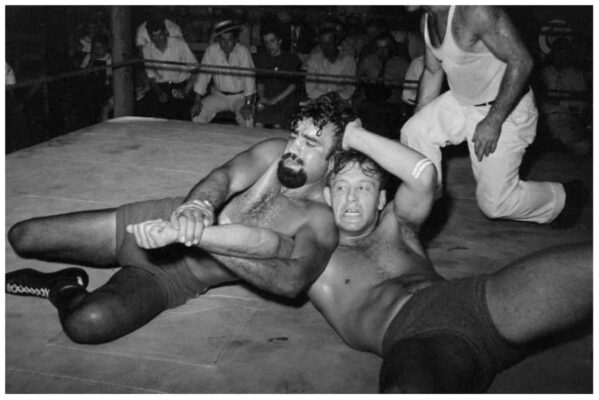
Early Catch Wrestling match

The birth of freestyle and professional wrestling

In a nutshell, freestyle wrestling was created as a result of banning all dangerous moves found in catch wrestling. Since its inception, the sport of freestyle wrestling has grown in popularity in the United States. Freestyle became so popular that it is now part of all high school and college sports programs in the U.S.

Catch wrestlers continued to perform at carnivals. And through the years, a part of this form would branch into what people know as “professional wrestling,” which is scripted wrestling entertainment that was an instant success.

Instead of engaging in an intense and dangerous physical fight, wrestlers became entertainers, with their unique personal charisma coming into the spotlight. They would choreograph the matches and, inside the ring, perform pre-arranged wrestling moves in an acrobatic manner. Professional wrestling has grown to be a significant part of the sports entertainment industry since the 1920s and has kept growing.

Catch wrestling in modern times

Catch wrestling became overshadowed by freestyle and Greco-Roman. During the mid-20th century, it was mostly present in no-holds-barred events such as Vale Tudo in Brazil and Sambo in Russia. In addition, catch wrestling techniques can be seen in combat systems such as Luta Livre.

However, this wrestling style is making a comeback with the rise of submission grappling events such as ADCC. The concept of catch wrestling fits well within the rules of combat sports.

For example, freestyle or Greco-Roman techniques work well in MMA fighting or grappling tournaments to take down their opponent to the ground. But these styles lack submission techniques to finish their opponents once on the ground, as you see in Brazilian jiu-jitsu.

However, catch wrestling teaches you how to take your opponent down and adds advanced submission moves that freestyle and greco-roman wrestling solely lack. After being forgotten for many years, an increasing number of people are slowly discovering that catch wrestling is a very effective form of wrestling.

An overview of what catch is in the simplest terms is to think of collegiate wrestling with submissions; that is essentially what catch is…

Former UFC fighter John Barnett explains what catch wrestling is
Former UFC fighter Josh Barnett explains catch wrestling

Catch-Wrestling Rules

Catch-wrestling rules are straightforward, as a wrestler can win a match by submission or pin. There are very few restrictions when it comes to takedowns, holds, joint locks, and locks. These moves are allowed as long as wrestlers do not combine dirty moves like eye-gouging or the notorious fish-hooking. Submissions like “Full Nelson” are also banned.

  • Match duration — in some competitions matches are split into rounds. In others, there is only one round.
  • Techniques — takedowns, throws, trips, leg locks, arm locks, chest locks, shoulder locks, neck cranks, wrist locks, “hook” is a broad term for any undefined submission move that spreads, twists, or compresses a joint or limb.
  • Illegal moves — dirty moves such as eye-gouging or striking the opponent
  • Ways to win — submit the opponent or pin their shoulder to the ground for three seconds. If there is no winner when the time runs out, the match continues until one of the wrestlers secures a submission or pin.
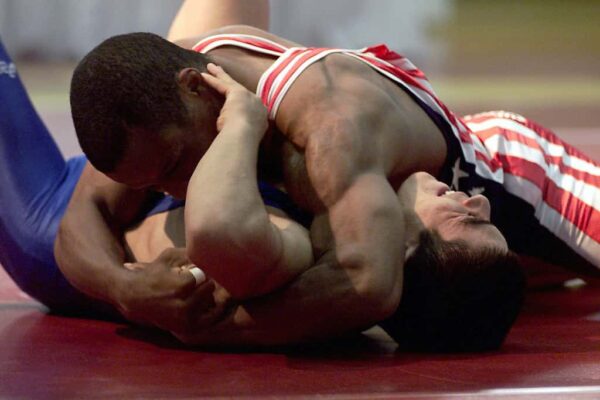
The wrestler on the bottom is getting pinned

The difference between Shootfighting and Catch Wrestling

Shootfighting originates from catch wrestling but also differs in certain areas. Catch wrestling is a mix of takedowns, throws and holds, and submissions. Catch wrestling rules do not allow dirty moves or striking each other with punches or kicks.

In contrast, shootfighting differs from catch wrestling because it also adds open-hand palm striking or kicking, apart from takedowns, holds, and submissions. You can win a match by pins or submissions (tap-out) or by knocking the opponent out cold with strikes. In some ways, it is similar to MMA in terms of hybrid freestyle fighting with fewer restrictions.

Shootfighting became very popular in Japan, where the famous combat promotion “Pancrase” organized the events. In MMA circles, Pancrase is one of the pioneers of combat sports.

The success of shootfighting also led to the development and rise of professional wrestling in Japan and America. But, unlike the original catch wrestling, pro-wrestling is scripted, and matches are set up to look exciting and fun. 

https://youtu.be/7FDEkXEcqaw
Bas Rutten in Pancrase shootfighting

MMA fighters with catch wrestling backgrounds

Catch wrestling trained fighters have made a name for themselves in the UFC.
Some of them are as follows:

  • Ken Shamrock
  • Josh Barnett
  • Kazushi Sakuraba
  • Karo Parisyan

What is the key difference between freestyle wrestling and catch wrestling?

While freestyle wrestling focuses only on takedowns and pins, catch wrestling includes submission holds such as joint locks and chokes.

Freestyle is one of the two styles included in the Olympic Games. The emphasis is on powerful takedowns and taking the opponent down to score points and win a match. Wrestlers get points (1–5) for takedowns, escapes, exposure, etc. There are no submission techniques in freestyle wrestling.

Catch wrestling is different both as a concept and in terms of rules. It is a more brutal style that includes the same takedown techniques very much. But the emphasis is on finishing the fight with submission holds or pins—only two ways to win in catch wrestling.

Catch wrestling notably focuses on brutal and dangerous moves such as neck cranks and leg locks. There are no points to earn in the competition, and the action keeps going until one wrestler achieves either of the two ways to win.

Is catch wrestling useful for self-defense?

Catch wrestling is among the most effective combat systems for any freestyle combat or self-defense scenario. The entire concept is in line with the violent nature of street fighting and will prepare you for intense scenarios you may encounter in real life.

The key advantage is the approach. Catch wrestlers are explosive, fast, and always looking to finish the fight quickly. They rely on battle-tested takedown techniques, submission holds, and pins to neutralize the opponent.

Although there is no striking, catch wrestling remains among the most effective systems for one key reason. Most regular people don’t know how to grapple or have the skills to defend a takedown.

Catch wrestlers need to grab just a single part of the attacker’s body; in most cases, it would be all over. They can take down their attacker in a split second, and just holding their attacker on the ground is enough to defeat them even without using any submission technique.

Related Questions

Is there any striking in catch wrestling?

Catch wrestling does not include any striking at all, as the system focuses only on grappling. The system later influenced the birth of other combat sports, such as shootfighting and MMA, which include striking. But the original catch wrestling focuses solely on takedowns, pins, and submissions.

How effective are catch wrestling submission techniques?

Catch wrestling includes only the most effective submissions, the same ones proven in modern mixed martial arts (MMA), such as armlocks, leglocks, and neck cranks. The aggressive approach also adds to the effectiveness as well as the brutality of the system.

RELATED: Why Wrestling Is So Important In MMA?

What are the different styles of wrestling?

Wrestling is among the oldest martial arts, and over time, dozens of different wrestling styles have been developed all around the world. The most popular ones are freestyle and Greco-Roman, both included in the Olympic Games. However, all wrestling styles can be divided into the following categories:

  • Traditional styles (Greek wrestling, Pankration, Roman Wrestling, Shuai Jiao, Lancashire wrestling)
  • Sports styles — Freestyle wrestling, Greco-Roman wrestling, Folkystyle (collegiate) wrestling, Folk wrestling, Sumo wrestling
  • Submission styles — Catch wrestling, Sambo, and Luta Livre
  • Professional wrestling — WWE, AEW, Impact Wrestling, etc. 
RELATED: What are the different styles of Jiu-Jitsu? Simply Explained