Home Blog Page 40

How Do MMA Judges Score Fights And Why So Controversial Explained

0

MMA judges and their work are, perhaps, one of the most hot topics in modern MMA. Nowadays, we can hear people arguing about judges’ decisions after every UFC event. 

But, why this comes about so often, and how MMA judges actually score fights? Is it the problem in judges or the system itself? 

First of all, one has to realize that judging a fight is much harder than you might think. The scoring system and criteria judges are using are complex and have many flaws which often lead to very controversial outcomes of the fight. In recent years, we are seeing an increase in split or majority decisions. Out of 225 decisions in 2017, we saw 58 split or majority decisions which is a disagreement rate of 26%.

But before blaming the judges, we should all educate on what is the science behind scoring fights in the first place. By doing so, one can become aware that the MMA judging system is far from being perfect. Due to the issues within the system, bad calls will happen no matter what.

So in this article, we are digging deep into MMA judging and bringing you all you need to know about how MMA fights are scored by judges to better understand why there are so many controversial decisions.

General rules of MMA Judging In UFC/MMA events

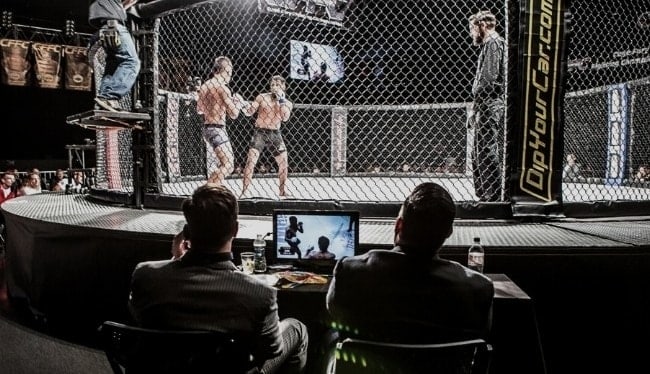
The MMA judging system is based on the “Unified Rules of MMA” that were put together in the early 2000s. Over the years, we haven’t seen any major changes within the system and here is how it works: 

  • Each MMA event consist of three judges sitting next to the cage/octagon. 
  • They score a fight round by round using the criteria from “Unified Rules of MMA”.
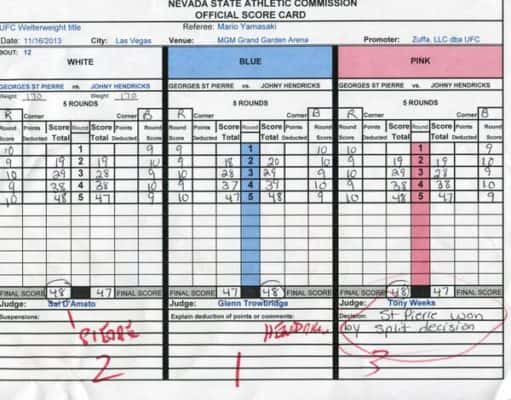
  • A fighter who wins a round gets 10 points on the scorecards while a losing fighter gets 9, 8, or 7 points. This is based on how one-sided the round was or whether the referee deducted a point due to a rule violation. 
  • Upon the end of each round, judges need to score a round and must hand in their cards to officials overlooking their work before the next round starts. 
  • If a fight goes to a decision, then the officials would tabulate the judges’ cards and give a win to a fighter with more points. 
  • If a fight ends in a KO, TKO, or submission, then the scorecards are no longer needed. 

With the general rules in place, we can now move to what type of criteria MMA judges use when evaluating the fight.

What Criteria MMA Judges Are Using When Scoring Fights?

“Unified Rules of MMA” include precise criteria MMA judges must use to score a fight. In UFC for instance, judges score the fight round by round using three main criteria:

Effective striking/grappling

Effective aggression

Fighting area control

from abcboxing.com

It’s important to know that judges use criteria in this order to decide the outcome of the round. And this is where judges and fans often go separate ways when it comes to who they think won the fight.

The thing is, fans and judges often don’t see a fight with the same pairs of eyes. Scoring a fight based on your personal feeling is not the same as when you score it following criteria. This is often a reason why fans may think judges have made a bad call while in fact they were right.

That said, let’s have a closer look at all three criteria and how judges are using them when scoring fights:

Effective Striking/Grappling

This is the first priority criteria MMA judges use to pick the winner of the round. They will look for strikes or grappling attacks that do damage or may lead to a finish of the match. And the immediate damage is more important than cumulative damage. 

In other words, the winner of the round is a fighter who:

  • lands more strikes or does more damage
  • scores more takedowns or attacks with submissions

Effective Aggression

This is the second priority criteria judges’ use only when fighters are equal in the first criteria. It often happens that the fight is equal in both striking and grappling. Then, MMA judges must determine which fighter has put more effort into finishing a fight. 

This doesn’t mean that a fighter chasing the rival across the cage and taking damage is “effective aggression”. No, he/she must push for a KO or submission while having control of the fight

Fighting Area Control

This is the third priority criteria MMA judges are using only when fighters are 100% equal in both Effective striking/grappling and Effective aggression criteria explained above. In that case, judges would pick a winner based on who is dictating the pace, place, and position of the fight. 

If fighters are equal in all three aspects then a judge will score a draw.

What Are The Unified Rules Of MMA?

Unified Rules of MMA” are the set of rules used by all major MMA promotions like UFC or Bellator. Apart from these two promotions, they are de facto a standard set of rules for pro-MMA matches in the entire US and many other parts of the world. 
It all started in 2001 when the sport of MMA needed a new set of rules to become a regulated sport. Various athletic commissions and experts have put together a set of rules known as “Unified Rules of MMA”. 

The birth of Unified Rules is often seen as a tipping point in MMA history that made the sport safe and suitable for a broad audience.  Here are some of the changes that came with this set of rules:

  • Weight classes
  • Judges scoring criteria and 10-point scoring system
  • Prohibited substances
  • Various fouls and penalties to keep the fighters safe and competition fair

What Is A 10 Point Scoring System In MMA?

A 10-point scoring system is what MMA judges are using to decide the outcome of the fight. This type of scoring system originates from boxing and it became a part of MMA in 2001. While working on Unified rules of MMA, they adopted a 10-point system as an initial solution that is still in use today. 

This system has its own pros and cons in MMA and the way judges are using it is very simple. In most cases, judges will give 10 points to a winner of the round and the loser would get 9. If the fighter dominates the round, nearly scores a finish, or produces a lot of damage, then the judges will score a round 10–8. 

What’s more, MMA judges can also score a 10–7 round but that doesn’t not happen often.

What Types Of Decisions There Are In MMA?

MMA fights go to a decision when fighters fail to finish the fight with KO, TKO or submission and the outcome has to be decided by the judges’ scorecards. When the decision is in the judge’s hands, there are two possible outcomes. Either one fighter would win a fight, or it ends as a draw. Since we have three judges who may score the fight differently, there are three types of decision win and two types of draw:

Decision Win

Unanimous– this type of decision happens when all three judges agree on which fighter won the match. 

Majority decision– this means that two of the three judges agreed on which fighter won the match. But the third judge scored a fight as a draw. 

Split decision– this means that two of the three judges picked the same winner while the third judge picked the other fighter. 

Draw

Unanimous draw– in this type of draw, all three judges agree that neither fighter won the fight. We must point out that this has never happened in the history of UFC. 

Majority draw– is an outcome when two of the three judges agree that neither fighter has won the bout. Meanwhile, the third judge has one fighter as the winner on their scorecards. One of the most famous majority draws was between Tyron Woodley and Stephen Thompson at UFC 205.

Split draw– this type of outcome occurs when one judge has one fighter as the winner, another judge has the other fighter and the third judge scores the fight as a draw.

What Happens If An MMA Fight Ends In A Draw?

In modern MMA, there are no extra rounds or overtime where there’s a draw like you see in other sports like kickboxing. 

So when a fight ends in a draw, the UFC would usually book the same fight again. This is because neither the fighters, fans, nor the UFC benefit from a draw. Fans love to see a winner and draw decisions stop fighters from moving forward. So booking the same fight again is the best solution as we would normally get the winner the second time around. 

In the past, some “K-1 Hero’s” included extra rounds when fights end in a draw. And the Japanese “Pride FC” had a different scoring system made in a way that we always had a winner.

How Does An MMA Fighter Lose A Point In A Fight?

MMA fighters can lose a point for violating rules like landing eye pokes or hitting the groin area. When a fighter violates the rule, then the referee would stop the fight and deduct a point or more from the fighter. So at the end of that round, each of the three judges needs to take away one point from a fighter who broke the rules.

For instance, let’s say that a fighter who got a point deducted ended up winning that round 10–9. The judges would, in that case, score a round 9–9 due to point deduction. In boxing, for instance, losing one point is not a big deal as there are 12 rounds. But in MMA it is a disaster since a fighter has only two rounds or less left to get that point back. 

In reality, however, MMA fighters would get away with a verbal warning from the referee for breaking most of the rules. Before the referee takes away a point, he/she would first stop the fight and issue a verbal warning. If a fighter does the same thing again, then the referee would deduct a point or warn a fighter once again. 

Apart from losing a point during the bout, fighters can also get disqualified by the referee at any point. This happened when UFC champion Jon Jones landed several illegal “12 to 6 elbows” on Matt Hammil during their bout in 2013. The referee disqualified Jones and awarded the fight to Hammil as a result.

Who Are MMA Judges And How Are They Selected?

The road to becoming a top MMA judge is similar to the way fighters are working their way up to the UFC. But of course, it is much less painful. The first step is to find and apply to an organization where you can earn a certified license to judge MMA fights.

Here are the major organizations in which one can become a certified MMA judge:

  • USA Mixed Martial Arts Federation (UMMAF)
  • International Sport Combat Federation (ISCF)
  • International Sport Karate Association (ISKA)

After passing a course, they start by judging amateur fights in UMMAF or ISCF MMA events. Before judging pro-MMA matches, each judge must work their way up in amateur matches first. But, how do they get selected to judge UFC fights?

If a judge thinks he/she has what it takes to judge a UFC fight, then the next step is to submit the application to Nevada State Athletic Commission (NSAC). According to NSAC, one must have previous experience judging amateur matches. But having a martial art background is not required to become a UFC judge. 

Reasons Why MMA Judges Make Controversial Decisions

Unified Rules of MMA are far from being ideal, notably when it comes to judging. The problem with bad decisions is a mix of issues within the system and judges scoring the fight. Here is a list of factors that are the main reason why we have so many bad decisions:

The Judging System Is Very Subjective
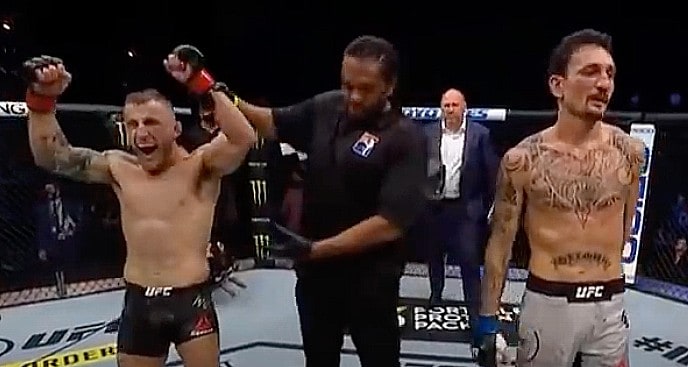
MMA judges must use three main criteria when scoring the fight. Even though these criteria are good, judges are the ones who have a final call and they are very subjective in the way they use these criteria. One judge may value the striking aspect more than grappling and vice versa. In fact, some judges value a takedown the same as knockdowns. 

This subjective system often leads to many controversial decisions. 

10-Point Scoring Was Not Made For MMA

10-point system comes from boxing and was adopted by MMA in 2001. This system does not work well simply because it wasn’t created for MMA fighting in the first place. 

For instance, pro boxing fights have 12 rounds while most MMA fights are three rounds except for title fights which include five rounds. When a boxer loses a round, he/she has more rounds to catch up. In MMA, losing one round means you must, at all costs, win the next round or you will lose a fight. 

Incapable Judges

As said earlier, you don’t have to have a background in MMA or martial arts to become a UFC judge. Although this may sound crazy to some, it is true. Generally speaking, most MMA judges have some background in fighting sports, but not in MMA. They usually come from boxing where they judged the fights before moving into MMA. The problem is, most of them do not understand all elements of MMA, and they never will. 

That is like putting an NFL referee to judge an NBA match, it’s basically the same thing and it will never work. These judges will never have the understanding of MMA like people associated with the sport like coaches or former fighters. 

Decision Fights Are On The Rise

In the past, we had just a few UFC events per year with much less decisions than in modern days. This is mainly due to the lack of rules during the 90s where fights rarely went to a decision. 

In modern times, we have UFC events almost every week, and around half of the fights go to decision. From 2001 to 2020, the percentage of fights that ended in a decisions has increased from 30% to 52%. Combine this number with issues within the system and incapable judges, and you get bad calls in every UFC event. 

UFC Fighters Where Are They Now? 15 Forgotten UFC Legends

0
Mark Kerr

Although MMA is still a young sport, it has already given us many legendary fighters. If it wasn’t for them, we would never see the sport rising to such heights. They are the ones who paved the way for the success of MMA we are all enjoying today. 

The times in which most of these fighters have fought were much, much different. Back then, they were earning much less money than modern fighters, and they were far less known to the public. To make matters worse, most of these legends have fallen into oblivion. It’s really a shame that millions of new MMA fans who follow MMA don’t know much about them. 

Yet, we have made a decision to react and make sure their names will never be forgotten. In this article, you will learn about these forgotten UFC legends and where are they now. We will refresh our memories by evoking their highest heights, and sadly in some cases, their lowest lows.

15. Murilo Bustamante

Bustamante was the first-ever fighter from Brazil to win the UFC title. He was also a world champ in BJJ and a founder of one of the most famous MMA gyms called “Brazilian Top Team”. In 2002, MMAFighting awarded him the “Middleweight Fighter of the Year” award. In some way, Bustamante was similar to UFC Demien Maia with much better striking skills.

Last we heard: We haven’t heard much about Murilo since he retired from the sport in 2012. He is living a calm family life and is dedicated to BJJ and running his gym. Over the years, he trained over 100 black belts and many great champions came out of his gym like Vitor Belfort and Antonio “Bigfoot” Silva. In 2019, the news came that Murilo received a red and black belt in BJJ after 42 years of training.

14. Marco Ruas

Ruas won the UFC 7 tournament and was one of the first fighters to realize that all fighting styles are important in MMA fighting. He was one of the first all-rounded fighters and a black belt in many martial arts such as BJJ, Taekwondo, Judo, and Muay Thai.

In the early days of UFC, he was the first one to show the world how effective leg kicks are in a fight. In 1995, he became the first-ever UFC fighter to TKO the opponent using leg kicks by putting out Paul Varelans. He also won the World Vale Tudo Superfight Belt by beating Steve Jennum in 1996. 

Last we heard: Ruas lives in Laguna Niguel, California. After retiring, he coached the Southern California Condors team in the International Fight League. But, this promotion was short lived and would collapse after just a couple of events. He also had small roles in movies “Kickboxer 3” and “The Eliminator”. 

13. Tank Abbott

Tank Abbott was a fan favorite during his time because he was always very determined to knock his opponent out. Taking a fight to decision was never his goal. His only mission was to knock his opponent out.

But despite taking part in five UFC tournaments, which is the most in history, Abbott never won the UFC gold. Still, he is one of the most famous fighters simply because of his wild and violent fighting style. Although he had strong wrestling background, most people know him as a standup brawler. 

After retiring from the UFC in 2003, Abbott went on to fight in other promotions like Pride FC, Strikeforce, and Elite XC. But, he could barely win a couple of bouts before retiring in 2013. 

Last we heard: In the following years, his wild lifestyle would finally caught up with him and his liver had to be replaced in 2018. The surgery didn’t go as planned as Abbott suffered multiple strokes but he managed to go through it. Upon recovering, he started his own podcast show “The Proving Ground with Tank Abbott”.

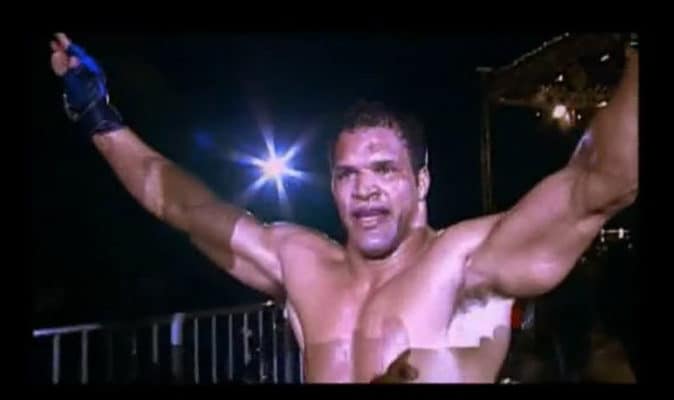
12. Kevin Randelman

Photo Credit: Larry Burton via Wikimedia Commons

Randelman is the former UFC heavyweight champion and one of the most feared fighters of his time. He was very athletic, had a lot of bulky muscles which mixed with his elite wrestling skills allowed him to dominate many great fighters. But, he was also known as a vicious knockout artist who KO’d none other than Mirko CroCop at Pride Total Elimination in 2004. He was also Universal Vale Tudo champ, and as a wrestler, he became the prestigious NCAA Division I wrestling champion in ’92 and ’93. 

Last we heard: Randleman had four children and was married to longtime girlfriend Elizabeth Broglia. After retiring from MMA in 2011, he founded a nonprofit program called Monster Wrestling Academy at Coronado High School. He put his entire focus on teaching kids how to wrestle and producing new champions. But on February 11, 2016, the sad news came that Randleman had died at the age of 44 due to complications of pneumonia. In 2020, the UFC inducted him into the Hall of Fame as one of the true pioneers of the sport.  

11. Ken Shamrock

Photo credit: Ben Kevan via Wikimedia Commons

Ken Shamrock is a UFC Hall of Famer, and synonymous with the early days of MMA. He came into the sport in the early 90s as a very accomplished wrestler and submission specialist. Before turning into a real superstar, Shamrock worked his way up fighting for the “Pancrase” promotion where he was an open weight champion. He shifted to the UFC in 1995 and won the heavyweight crown the same year by beating Dan Severn at UFC 6. His famous bout against Royce Gracie still holds the record for the longest MMA fight ever (36 minutes). 

Last we heard: Shamrock retired from MMA in 2016 after 23 years of competing as a pro. He is now a father of seven kids and has ten grandchildren. He stayed close with the sport by coaching other fighters and working as a self-defense instructor. In 2019, he founded his own bare-knuckle boxing promotion called “Valor” and their inaugural event included many UFC veterans.

10. Dan Severn

Photo Credit: Dansevern.com

Dan Severn is the former UFC 5 tournament winner and the first ever triple crown champ in UFC history. And he was the first Olympic caliber wrestler to compete in MMA fighting. During his career, he took part in around 127 MMA matches (101W; 19L). This makes him one of the most active fighters in the history of the sport. 

Last we heard: Severn retired from MMA fighting in 2012. He got inducted into the both UFC and Wrestling Hall of Fame for his amazing contributions. Nowadays, he spends his time teaching wrestling and MMA classes in his own MMA camp in Michigan. And he is also working as a law enforcement instructor. 

9. Bas Rutten 

Photo Credit: Basrutten.com

Rutten was one of the first elite strikers to make it big in MMA fighting. Over the years, he added a strong BJJ arsenal to his striking base which made him one of the first rounded fighters at the time. He made a career fighting in the Japanese “Pancrase” promotion where he was a champion. During this time, he was very popular and enjoying a god status in Japan. He would later shift to the UFC in ’99 to become the first-ever Dutch champion by beating Kevin Randleman. 

Last we heard: It’s fair to say Rutten is going strong outside of fighting too. Shortly after retiring in 2006, he began working as a broadcaster and analyst for various TV networks. He also had many roles in popular movies where he showed great talent for acting. He is living in Westlake Village, California with his wife Karin.

8. Tito Ortiz

Photo Credit: Mingle Media TV

Ortiz is the former UFC light heavyweight champ and perhaps the first-ever MMA superstar. He had many rivalries and the hype behind his fights was huge. But he was always able to back up all of his trash talk with relentless wrestling and grappling skills. 

Ortiz defended his 205lbs title an amazing five times and was also ADCC Submission wrestling bronze medalist. After leaving the UFC, he joined Bellator MMA in 2014 but he never won the title.

Last we heard: Despite being in the sport for more than two decades now, Tito Ortiz is not yet fully retired. He has two sons from his previous marriage and is in relationship with the former UFC Octagon girl, Amber Nichole Miller since 2014. 

He also had a couple of roles in movies and TV series such as Hell’s Kitchen, CSI: NY, and MADtv. Ortiz ran for local office, and he got elected to Huntington Beach city council.

7. Randy Couture

Randy Couture

Couture came into MMA from wrestling very late at the age of 34. But he was able to win the UFC 13 tournament and heavyweight title the same year he made his pro-MMA debut in 1997. 

The biggest moment of his career came when he dropped down in weight to beat Tito Ortiz and win the 205lbs title at the age of 40. By doing so, he became the first-ever UFC champion in two separate weight classes. And he also became the oldest UFC fighter to ever win the title four years later when he beat Tim Sylvia to become a heavyweight champ for a second time. 

Last we heard: Couture played many roles in movies while he was an active fighter and went on to do the same after retiring in 2009. The biggest role he’s had was in “The Hard Way” movie which was among the most popular on movies on Netflix. He also stayed with the sport and has been working as a broadcaster for the “PFL” MMA promotion. 

He is also a co-founder of the “Xtreme Couture” gym in Las Vegas which stands for one of the best in the MMA world. In 2019, he suffered a heart attack shortly after training, but like a true warrior, he was able to fully recover.

6. Matt Hughes

Photo Credit: Tom Nguyen via Wikimedia Commons

Hughes is the former UFC welterweight champ who defended his title seven times in two reigns using his strong wrestling skills to dominate his opponents.Fans loved him because he had a reputation for being a very aggressive fighter. He scored an amazing eleven UFC finishes out which eight were in title bouts. As you would expect, he also won plenty of fighter of the year awards and post-fight bonuses. 

Last we heard: Hughes joined the UFC Hall of Fame in 2010. He has two daughters and has been living with his wife Audra. After retiring from MMA, he put his entire focus on farming. But in 2016, he almost lost his life in a car accident where he got struck by a moving train. Even though he survived, Hughes has been partially paralyzed and has a hard time moving as well as speaking.

5. Mark Kerr

Kerr is one of the true pioneers of modern MMA whom people know for mainly two things:

  • UFC Legend who had top grappling skills 
  • His autobiography movie “The Smashing Machine”

Before MMA, Kerr was an NCAA Division I wrestling champ (1992) and USA Senior champ (1994). Shortly after becoming a USA Senior champ, he decided to shift over to a new sport called MMA. 

Kerr used his big body frame and elite grappling skills to win UFC 14 and UFC 15 tournaments. During this time, he also won the prestigious ADCC Submission wrestling title in ’99. Many fans got to know Kerr through his famous life story portrayed in the movie “The Smashing Machine” which came out in 2003. But many years have gone by since and many fans wonder where is Kerr now? 

Last we heard: Kerr is living with his long-time girlfriend in Arizona, and they have a son. He has been working as an auto salesman for many years now, and we must say he is a very successful one. But, many wars he had been into and the damage he took during his career have caught up with him. 

Kerr started GofundMe to help him dealing with peripheral neuropathy. This type of illness is a result of nerve damage outside of the brain caused by years of fighting in MMA. It’s been reported that Dwayne “The Rock” Johnson is starting and producing movie about Mark Kerr.

4. Mark Coleman

Image credit:twitter@Markcolemanmma

Coleman is a true legend of MMA and a UFC Hall of Famer. He is best known as the first fighter to use ground and pound techniques. So the next time you see MMA fighter finishing a match with a ground and pound, remember that Coleman is a father of that technique. 

Coleman came into MMA from wrestling where he was an NCAA Division I and Pan American Champion. In his career, he managed to crown himself with both UFC and Pride FC heavyweight titles. In fact, Coleman was the first-ever heavyweight champ in both Pride and UFC. And like that wasn’t enough, he was also a winner of UFC 10 and UFC 11 tournaments. 

Last we heard: Coleman retired from MMA in 2010 and he has been going through a lot of health issues and personal issues caused by the years of fighting. In 2020, he suffered a heart attack due to an artery blockage and the doctors managed to save his life. He has three daughters and has been living with his current partner Tina Pizzurro.

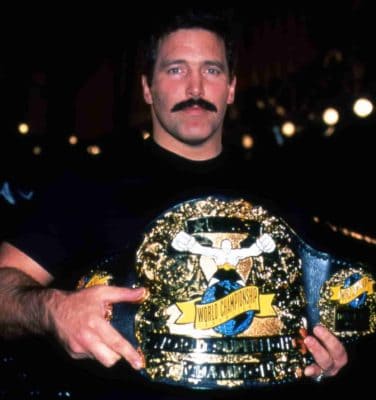
3. Don Frye

Frye has always been a fan favorite fighter and one of the most iconic figures of the sport. We can’t talk about the early days of MMA without Frye and the crazy wars he’s had while fighting for UFC and Japanese Pride FC. 

He joined the UFC from collegiate wrestling and made his MMA debut at UFC 8 tournament which he ended up winning. Later the same year, he would also win his second UFC 96 tournament. Frye then moved to Japan to take part in Pro-Wrestling matches and fight for Pride FC. 
Last we heard: Frye retired from MMA in 2011. The UFC inducted him into the Hall of Fame in 2013 for his amazing contribution to the sport. Still, he would go through some tough times and hit the rock bottom in the following years. He underwent many back surgeries and was even placed into a medically induces coma due to brain hemorrhage. Upon recovering, it appears he’s trying to get back on track and he did a long extended interview with very popular Vlad TV on Youtube to talk about his MMA career.

2. Pat Miletich

Photo Credit: Pat Miletich

Miletich is the former UFC 16 Tournament winner and Welterweight title holder. In 1997, he founded the first MMA gym called “Miletich Fighting Systems” which had a new concept for that time. Back then, MMA fighters were experts in one specific fighting style. But Miletich was one of the first to spot the importance of being a well-rounded fighter and knowing how to fight in all aspects of MMA. 

His gym gathered fighters from various fighting styles to train and learn from each other. It also offered classes in which fighters could become experts in multiple martial arts. It was one of the first real MMA gyms. This gym has trained over 90 elite MMA fighters and 14 world champions.

Last we heard: Miletich has three daughters, and has been retired from MMA since 2008. For many years, he worked as a law enforcement and military instructor. He has also developed his own defensive tactics and various combat courses. 

In 2009, he started working with “Showtime” as a broadcaster for the Legacy Fighting Alliance. He stayed with the LFA team for more than two decades. But he got fired from his position for being a part of the protesters who stormed into the United States Capitol in 2021. 

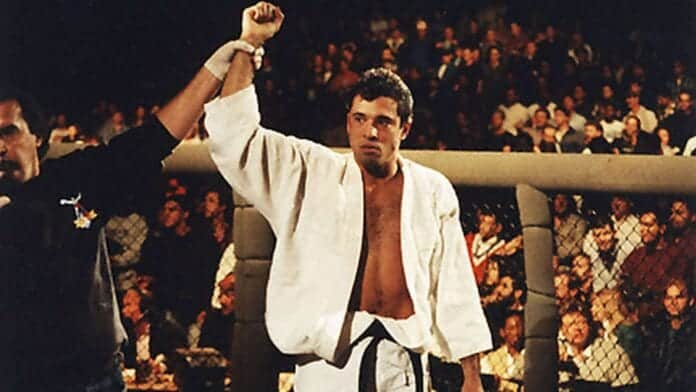
1. Royce Gracie

Royce Gracie is the first-ever UFC champion and a man who showed the world how effective BJJ is in combat sports. During the early days, he beat fighters who were much bigger than him under no rules using his BJJ skills only. Seeing him dominating fighters from other styles was a true revolution in the fighting world at the time. In his MMA career, he won UFC 1, 2, and 4 tournaments before leaving the UFC in 1994 with the perfect record of 11-0. 

Last we heard: Royce Gracie has three sons and a daughter with his former wife Marianne. As of 2020, Royce surprised us all by reporting that he has become a reserve police officer for the Pocatello Police Departmentin in Idaho. He went through all the training drills and has received the Idaho POST firearms qualification. Make sure you don’t do anything stupid in Idado because you might just get arrested by Royce Gracie!

RECOMMENDED FOR YOU:
What is Gracie Jiu-Jitsu? Fully Explained

10 Safest Martial Arts That Are Effective In Real Life

0
Photo Credit: President.az

Martial Arts can be fun to learn and they can be a great way for people to learn how to defend themselves. However, there is some risk one takes when they decide to begin learning one. There are some unsafe martial arts that certainly can be very risky while others are very safe for both kids and even senior citizens! The problem is that many do not know about some of the safest martial arts out there.

We decided to help by compiling a list of ten safe martial arts that are also quite effective in real life. Unlike non-combat martial arts such as Tai Chi, which might be safe but won’t teach you any defensive moves, these martial arts are all effective in their own right. Each one teaches both offensive and defensive moves, while some even have several tournaments you can go into. Here are ten of the safest martial arts that are effective in real life.

  1. Brazilian Jiu-jitsu
  2. Krav Maga
  3. Boxing
  4. Taekwondo
  5. Wrestling
  6. Aikido
  7. Hapkido
  8. Wingchu/Wushu
  9. Karate
  10. Judo

Let us be clear before we dive into these martial arts. There is no sport or combat martial art that will be completely safe. There are always going to be possible accidents, which are simply part of life in general. However, there is a difference between some martial arts and others when it comes to safety.

On top of this, any martial art can be safe with the right instructor who will ease you into full contact situations. That said, there are simply some martial arts that are a bit safer than others while being effective. That is what we’ll be discussing here.

10. Judo

Photo Credit: Wallace8000

Judo is not only an effective martial art, it’s also an Olympic sport. This is the martial art that former UFC champion Ronda Rousey learned and was effective in her UFC fights. The sport deals often with throws and holds rather than strikes. However, Judo also teaches submissions that can be effective in both the stand-up & ground position.

This means that you could learn how to submit a person while in hand-to-hand combat, and if by chance you were on the ground as they attack you, you’ll learn how to defend against that. Judo is incredibly safe to learn because it is well-known for taking things slowly, with precision being prime for them. Judo philosophy is that slowly going through everything will help people master each step.

This also allows for safety to be in play, as the slow nature in which you’re taught will allow you to know how to protect yourself. While you learn things on your own in this area, instructors also teach you safety precautions and maneuvers. Whether it is learning how to fall or even learning how to use your body properly so that you do not injure yourself performing a hip-toss or something similar (referred to as a breakfall). All of this keeps your safety in mind at all times.

9. Karate

Photo Credit: Claus Michelfelder

Karate is one of the best martial arts one can learn, especially as a kid. When people ask about what to teach young women or girls, Karate is often one of the top choices. The reason for this is that just a few moves can be taught to help one know how to defend themselves. Karate is a striking martial art, meaning most of the things you learn will be focused on throwing/landing a strike as well as how to defend against them.

Students will also learn several blocking techniques, which can be helpful in self-defense. Some of the more modern forms of Karate even teach joint-locks, grappling, and restraints. These are forms of painful submissions or those where you’d hold a person in a position where they cannot move.

Most Karate instructors teach you everything at a proper pace, making sure to never mix skill levels that are not equipped to be in the same class. Students are even taught how to properly stretch before training so that they avoid potential injury. Yet it is much more than that.

To prevent injuries these days, even the old school concept of using “wood” has been removed in some dojos in favor of hard plastic boards a person will break-through. Wood is still often used in ceremonies but not in classes.

When students are learning how to do proper kicks, a lot of the time, you’ll have the instructor taking the kick from his or her student. This is to prevent possible injuries to students. However, many also utilize senior students or another instructor who will wear a lot of specific padding. This will allow kicks and even punches to be thrown without hurting the person taking the move.

Even black belts with high degrees on their belt will still have people stand around in this padding. You’ll also see dummies used for stationary kicks and punches. They pretty much all look the same with a random torso and head. Yet it does not hurt to hit them.

On top of ALL of this, you’re always learning on padding. So any potential slip and/or fall won’t result in any problems, because you are not landing on concrete but, rather, a padded surface.

8. Wing Chun/Wushu

Photo Credit: Yegfitness.ca

Wing Chun has managed to grow in popularity over the last number of years for understandable reasons. It has managed to get in on the “self-defense martial art” business. Wing Chun is technically a form of the Southern Chinese martial art style known as Wushu. While there can be some small differences, the main thing is that Wing Chun is often taught in the West while Wushu is taught in Asia.

Wing Chun tends to deal with more self-defense forms while Wushu classes teach the overall martial art style. Wing Chun tends to dive more so into self-defense techniques simply due to this being more popular for Westerners. Wing Chun is well-liked by people due to being part of the “soft style” of martial arts. In the world of martial arts, there is both a hard and soft style.

Soft style means the defender will only need to exert a little force to deflect an attacker’s moves. The idea is that they will use the attacker’s own momentum against them, with the goal of getting them to move in the direction the defender will have the best advantage. Attackers will be off-balance and you’ll only need to deliver a force good enough to put a person down and nothing more.

In a Wing Chun class, this can be really useful and it can be great for even kids to know about. Since the idea is to avoid hurting the attacker unless you have to, a person will learn proper restraint (plus, injuries in class are next to impossible). Meanwhile, there will be proper defense knowledge learned to keep you safe too. Many Wing Chun practitioners relate it to being like bamboo. You bend well but don’t break.

Some stuff will involve more force, which is when more padding or padded gear will be used for students. Yet this is not as commonly needed outside advanced classes. Since you’re not trying to use too much force, the move-set is safe for even the elderly. Your body won’t be forced to do too much, which can prevent a lot of potential injuries. 

You’re quite literally learning how to do the least amount to get the best outcome, making the style incredibly easy for people to learn.

Moreover, you’ll learn how to move correctly as well as how to stand in fights. Footwork can make all the difference in a real fight and even in classes, as you’ll find out how to keep from falling over, how to use momentum in your favor, and much more. The reason this is an important thing for safety is that by knowing how not to fall and how to use proper body movement, you’ll never be in a position to get hurt.

That is why Wing Chun is so well-liked as a form of self-defense. People know they are prepared for anything and can defend themselves, without having to do much to accomplish this.

7. Hapkido

While some will find Hapkido to be an unsafe martial art to learn, we believe it to be the opposite. While what one might learn could be considered a bit dangerous, you will learn it in one of the safest environments possible. Hapkido is a Korean martial art that belongs to the “Hybrid” list, due to it involving techniques you could learn in other martial arts systems.

Many find it to be one of the best self-defense martial arts on the planet, and it’s not shocking to see why. Instructors will teach strikes, joint locks, grappling, & throwing techniques. You will even learn how to properly use traditional weapons in combat such as a knife, sword, rope, cane, short stick, mid-level staff, long staff, and even nunchucks. The weapons you learn will differ heavily from dojo to dojo, however.

Due to the weapons, they teach long-range martial arts techniques. Of course, the rest of the martial art teaches close-combat techniques. You might learn things like pressure point striking, which can be extremely helpful in self-defense to help you stop a potential attack and bring someone down quickly. Hapkido’s overall goal is to show you how to redirect force & control your opponent, emphasizing the circular motion in life.

Hapkido focuses heavily on safety while teaching all of this. They literally go so far as to tell you exact foot placement and overall footwork techniques as well as body positioning, so that you never get hurt trying to do something. Of course, they heavily focus on leverage, which is something that can be invaluable for a martial artist to learn. This can help you take down opponents far larger than yourself, as well as those much stronger than you too.

6. Aikido

Most people who study Aikido rarely complain of injuries or anything of the sort. A lot of what they teach begins with safety measures first. This is because of what this martial art teaches, throws and joint-locks. Of course, some Aikido dojos will also incorporate weapons. This truly will differ depending on where you train and who you train under.

They also teach people about proper breathing techniques, keeping you aware of how important this can be in a fight. Instructors also teach you how to face off with multiple attackers by teaching simple concepts on how you should turn and/or move among the many.

The entire idea behind Aikido was to form a martial art that would teach people how to defend themselves all while keeping their attackers free from injury. The concept was that we’re all unified with the same life energy and should focus on “the way of the harmonious spirit.” In fact, the main goal that students reach for is how to overcome one’s own anger, problems, etc.

Many instructors even teach you how to stop things, before violence ever comes up. But if you must fight, then you’ll be prepared. While Aikido can be brutal on your wrists, many instructors teach you how to toughen up your arms completely as well as your body. That way, you’ll be prepared for every next step in your training.

Instructors, like in Judo, teach you how to fall and land correctly to prevent an injury. Importantly, they will also teach you how to do the unique Aikido throws without getting hurt. This can be very important, as one can easily get hurt trying to throw someone over. Yet you learn correct body positioning, how to stand, and much more.

Due to all of this, Aikido is often looked to as a tremendous self-defense martial art and one of the safest you can learn. Heck, you’re even taught how to avoid hurting your opponent as well as yourself, how could it not be safe, right?

5. Wrestling

There have been many names for “wrestling” throughout history as well as many forms of it. Some of the hybrid forms were utilized by Greek Armed Forces for hundreds of years while others were used simply as a sport. The most common wrestling form most know about is Greco-Roman style wrestling, which dates back to the Greek and Roman forms of the sport. This is even the style of wrestling in the first Olympic Games event!

While “wrestling” might not be considered a martial art by some, it technically is in all honesty. Instructors will teach you how to use your body well, from holds and submissions to even scientific concepts like using your own leverage as well as your opponent’s. Plus, you’ll learn how to take someone down to the ground without getting hurt yourself.

Instructors will help you build your body to fit the weight class you’re in as well. This can be important for safety, as you won’t often wrestle people in your class that are a lot larger than yourself. That means you’ll have a far lower risk of injury. You’ll be strong and agile enough to do what you need to do. Of course, all of this takes place on a mat.

Do keep in mind that the mats you learn on while training will often be pretty nice too. Landing on them will help and you’ll eventually graduate to a slightly harder mat that will help you build your body. Like in Judo or Aikido, you’re taught how to fall. That ensures you’ll know how to land without getting hurt. That said, if you’re being taken down and you know you cannot stop it, knowing how to fall can make all the difference. You’ll also often wear protective headgear just to ensure more safety precautions are taken.

4. Taekwondo

Photo Credit: Javid Nikpour/Tasnim

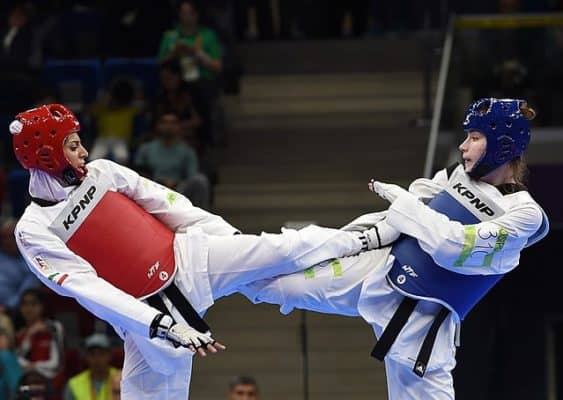
Taekwondo(TKD) is another heavily strike-based sport. There is obviously some risk when practicing the martial art but dojos make sure safety precautions are taken heavily. When you train, especially when sparring, students wear protective gear. Often you’ll see shin pads as well as headgear to protect you further. Many dojos also teach a style that does not involve knockout blows, so you can train in an even safer way.

A lot of the time, classes for kids will teach them how to do moves but they won’t spar with other kids. Which only further keeps safety paramount for the dojo. Plus, like others you might see, this martial art takes things slowly. Well before you’d even get to full contact, you’re not only taught how to do moves but also how to block or defend them too.

That extra knowledge provided enhances safety because you know how to avoid getting hit just as much as you learn how to throw a nice kick or punch. Of course, in Taekwondo, kicks are the biggest thing you’ll learn. These can be very helpful when in a real fight situation. Plus, you’ll often see these TKD kicks employed in MMA fights in the UFC, Bellator, or other MMA promotions. That is due to their highly effective nature and knockout acumen.

3. Boxing

Photo Credit: MartialArtsNomad.com

Boxing is likely one of the safest things one can learn. Safety precautions are taken HEAVILY outside of the professional side where boxing is more about points rather than knockouts. In the Olympics, boxers are forced to wear safety gear and you’ll even train in the same types of gear. Not only are you wearing gloves to keep your hands from getting broken but you’ll also wear great headgear that can keep you from getting knocked out or sustaining a terrible brain injury.There is still some risk but studies have shown that you’re just as likely to sustain a concussion playing football or hockey as you will in boxing.

Great boxing instructors teach you terrific technique, which can help a boxer know how to throw and land effective punches. People often throw strikes without knowing how to do so and can injure themselves frequently. You’d be surprised how often this happens.

That said, they also teach you how to block properly. Therefore, you’re learning about how to keep yourself safe. This can be extremely helpful in right fight situations.

2. Krav Maga

Krav Maga is an Israeli martial art that is taught primarily to Israelis via Isreal’s Armed Forces or Special Forces. It is known by many to be one of the best self-defense martial arts on the planet. This is extremely important to remember, as they quite literally teach you how to keep yourself safe in real-world situations. While there might be some possible injury in training, this is very rare to see.

Like in other martial arts, Krav Maga is taught slowly where everyone learns until they have stuff down completely. Well before full contact is involved, proper instructors have already seen that a person is capable of doing a move or moves correctly. Yes, due to the brutally efficient nature of the moves that are taught, there is always a risk for injury. Therefore, some assume that Krav Maga just isn’t safe to learn and worry that they could break something in training, but this is extremely rare.

Why? Instructors do not overly push students in Krav Maga. They are all very aware of how brutal their moves and methods can be. Thus, they want to make sure you learn at a pace you’re comfortable with and they want to make sure you can do things right. This is not only to ensure your safety but the safety of other students too.

This is the cool part about Krav Maga. You learn, safely, how to defeat another human being. Of course, there are different forms of Krav Maga teaching. There is the main, overall martial art that teaches both offense & defense. Then there are Krav Maga self-defense courses, which do not dive into some of the brutal offensive moves but will teach some along with their many defensive moves. It is merely up to you regarding which you’d prefer. Yet both are completely safe to go into.

1. Brazilian Jiu-Jitsu(BJJ)

Photo Credit: U.S. Air Force

Jiu-jitsu is literally translated as “gentle art.” Brazilian Jiu-Jitsu teaches only what BJJ is connected to, which is not striking but holds and submissions. BJJ is considered by many to be the safest martial art to learn due to this. You’re more likely to pull a muscle than break something in BJJ, which is a big deal. Of course, you learn how to stretch and prepare your body for the things you learn.

Some assume BJJ is ineffective considering they do not teach strikes. However, in real fight situations, BJJ has proven to be incredibly valuable for people. This was proven in the early days of the UFC when the amazing Royce Gracie representing Gracie Jiu-Jitsu went into the old school world of MMA that was incredibly brutal at the time. There, as a person who only trained in BJJ, he defeated all comers. Even those who trained in wrestling, taekwondo, and other well-known martial arts at the time.

A lot of BJJ is also taught on the ground while the student is on their back. Instructors will teach you how to gain correct positioning and even how to put someone in a multitude of submissions while on your back, such as the triangle choke.

In training, students often are forced to go at a snail’s pace. This is done to keep everyone safe, naturally. Your instructor will want to make sure you have mastered moves before you ever move on to something else. Even when you’ve mastered it, sparring mostly will go at 50% the pace you might normally see in a real fight. You won’t go full speed until much later on.

BJJ is also well-known for its incredibly long period to move up in belts. It can take people about a decade to move from white to black belt. You have to show true mastery of the martial art before you’re ever allowed to be among the top ranking BJJ practitioners. This shows that you know how to safely do everything from offense to defense. That is important to remember, if safety is your top concern.

Final Thoughts:

You’ll find from our list that there are several top martial arts that a person can learn safely. We know, by the looks of what you might see in movies or television, fighting of any kind can appear to be unsafe. Truly, it can be unsafe if you do not know what you’re doing. Even when you do, there is always a possible risk involved. However, injuries are rare in many martial arts for a reason.

You’re taught how to safely do things, which is often forgotten when you see things play out on screen. When you see the final result of training, it can appear as though martial artists had to have gone through some rigorous trial that was full of broken bones. Yet this is unlikely, as you can ask many martial artists if they ever broke a bone in their martial art. You’ll likely hear that they never have, which is not uncommon in the ten we listed.

This was due to great training from great instructors. Remember to always research into the dojo you plan to start training at before you go and train there at all. The right instructor is very important, especially for kids. Make sure that instructors are at the top of their martial art and even sit in on a class or two before you decide to get involved.

Many dojos allow people to sit in to get a feel of the classes before they sign up, as they want you to be prepared for what you’ll end up doing yourself. Always check to see if an instructor is certified to teach in their martial art, as several will need to go through all of that to be officially recognized as an instructor in their specific martial art.

Remember, who you’re taught by is important as they will teach you what you need to know to remain safe. Meanwhile, the protective gear you’ll be wearing will protect you the rest of the way in several martial arts too. Make sure that you buy the protective gear you need. Things like a mouthguard, cup, and padding will all be important in training. You’ll never know how important until that fateful day comes when having them pays off. Especially when it comes to a cup.

Why Are MMA Fighters Skinny And Don’t Have Big Muscles?

0
Photo Credit: Vengo Films via Wikimedia

In the minds of many fans, the most capable fighters are the ones with muscular bodies and big biceps. They often tend to associate bulky bodies with the type of strength you need for fighting, which is wrong. 

MMA fighters are skinny because their training primarily focuses on high-repetition workouts. For example, fighters do 100 pushups rather than bench press 400 lbs. High-repetition workouts do not lead to big growth in muscles, but it keeps fighters resistant to muscle fatigue. 

In reality, MMA is all about being fast, agile, and having great endurance. And MMA fighting is one of the few sports where big muscles don’t play a vital role and it’s actually counterproductive to have big muscles. As such fighters tend to be skinny to be conditioned for fighting than bulky physiques.

In this article, we will explain further why having big muscles actually hinder fighters’ athletic performance which is the reason why many fighters are skinny.

Muscle Endurance Is More Important Than Muscle Growth

MMA fighting is like a marathon which requires endurance. Your body need to be prepared for 5 rounds of fast-paced fighting by developing muscle endurance. For this reason, MMA physical training primarily focuses on high repetition workouts such as 100 pushups rather than trying to bench press 400lbs of weight set a few times. High-repetition workouts do not lead to big growth in muscles, but it improves muscle endurance, keeps body resistant to muscle fatigue. 

In other words, instead of having bulky bodies, they focus on building strong muscle endurance and keeping their body fat low at around 5-9 %. Just about every fighter prefers to have low muscle mass as it helps them to last longer in a fight.

Here is another illustration of how it works. Big muscles are great for explosive strength which works in anaerobic sports like powerlifting or football. They allow you to use as much explosive strength in a short period of time to lift a heavy object or run a 100m sprint as fast as you can. However, raw power without endurance means nothing in MMA. 

MMA is a different form of activity in which you need to perform at a high pace over an extended period of time. Instead of increasing muscle mass, fighters focus on muscle endurance training that makes them lean and shredded.  This type of skinny body allows them to perform at the best of their abilities without a sudden decrease in performance.

Imagine yourself sprinting across a field as fast as you can. You’d be tired. Now imagine sprinting across that field with a tiger chasing you…between the fear, adrenaline and work from sprinting, you’d be beyond exhausted. That’s what a martial artist deals with every time he steps in a ring.

Former UFC champion Cody Garbrant, Source

Big Muscles Burn Up Oxygen Quicker

Fighters avoid building big muscles as this speeds up the depletion of oxygen and get tired easily. Bigger the muscle, the bigger the intake of oxygen it requires.

When you exercise, your muscles consume oxygen to produce energy…

From sciencedaily.com

As a result, if a fighter adds big muscles to their frame, their heart would have to work much harder to pump in more oxygen used by big muscles. This results in a higher heart rate during the fight and lack of breath very early in a bout. 

That said, MMA fighters are careful not to build too much muscle mass while training for a fight. They focus on finding a balance between adding enough muscle mass to be strong and having top cardio. On top of that, most of them keep their body fat low which makes them look skinny. 

The best example is a fight between the former UFC champ, Tim Sylvia and Mariusz Pudzianowski. For the ones who are not familiar with him, Pudzianowski is an oversized muscular man and a former “Strongest Man” world champ. The trouble was, his big muscles were built to burn oxygen quickly but deliver huge power in a short period of time. This was the total opposite of what he needed for MMA. 

Even though he looked strong with all those muscles, he was running out of breath after a couple of exchanges. His huge muscles burned up all the oxygen in the opening minutes and he ended up being TKO’d in the second round. 

In MMA, big muscles won’t win you fights simply because they force your heart to work much harder which leads to quicker exhaustion. If having bulky bodies was beneficial in fighting, then all fighters would look like bodybuilders.

RECOMMENDED FOR YOU:
How Do UFC Fighters Cut Weight So Rapidly? Fully Explained

Big Muscles Make You Less Flexible And Slower

Big muscles make you stiff and restrict your range of body movement, which is not good for MMA. Israel Adesanya, an elite MMA fighter, is not a fan of increasing too much muscle mass as he said the following:

Yeah, sure, you want to put on size? Alright. Is your body used to being that heavy? Are you used to moving around that heavy with the work-rate you were doing with all your previous fights? Yeah, I just don’t play the game like everyone else…

source

Carrying big muscles hinders you from performing striking or grappling techniques the right way. Instead, fighters prefer being skinny to be flexible as this makes them faster and more powerful. But, how less muscle mass makes you more powerful you may ask?

You see, having big muscles doesn’t mean one can strike hard. The power of every strike comes from the rotation of your entire body, notably your legs and hips. Not having over-developed muscles makes a fighter more flexible and allows them to rotate their entire body faster, generate more power and speed in a strike. 

The same stands when it comes to ground fighting that requires grappling as well where flexibility really comes into play. It allows you to switch between the positions faster, create a space to get up or escape from a choke or joint lock. 

* RELATED QUESTIONS *

Are Skinny Fighters Better In MMA Fighting?

The data indicates that relatively skinny MMA fighters who don’t have big muscles tend to do better in MMA fighting. If we look back in history, most UFC champions have been thin and they didn’t have much body fat, regardless of the weight class. To prove our point, here is a list of some of the greatest UFC champs in history who were/are relatively skinny:

  • Jon Jones
  • Anderson Silva
  • Israel Adesanya
  • Khabib Nurmagomedov
  • Georges St. Pierre
  • Jose Aldo

Skinny fighters tend to move faster, are more flexible and have better endurance. The ones with bulky bodies, on the other side, tend to gas out early in the fight as big muscles burn more oxygen. On top of that, they are much slower simply because they have more mass to move.

With a good game plan, skinny fighters would always outlast a fighter with big muscles. They would also win most of the exchanges on the feet or ground because they are faster and more agile. 

Brothers Nick and Nate Diaz are a great instance of how skinny fighters win their fights. Even though they look like average people, their endurance is second to none. They have won most of their matches by outlasting their rivals and beating them in later rounds. 

Who Were The Best Skinny Fighters In MMA History?

In MMA history, there have been many great UFC fighters who were skinny. In fact, some of the most dominant UFC fighters have been the ones with low muscle mass and body fat. Here are some of the most famous ones:

Jon Jones 

Jones is perhaps the most gifted MMA fighter we have ever seen fight in the UFC. One of the secrets behind his success are his superior athletic abilities. He is tall, skinny, and has a very low body fat compared to most of the other fighters from his division. 

In his career, Jones went through many 5 round wars and we are yet to see him gassing out in a fight. The best instance is his first fight with Alexander Gustaffson at UFC UFC 165 in 2013 which he was losing in the early rounds. But Jones would win that fight by outlasting Gustaffson and winning the later rounds. 

Israel Adesanya

Adesanya is an ideal instance of how being skinny helps you in MMA. Don’t look any further from his bout with Paulo Costa if you want to see what’s more important in fighting. It was an epic battle between a skinny fighter and a fighter who looks like a bodybuilder. 

Coming into this bout, Adesanya looked half the size of Costa who had huge muscles on his frame. But, Costa just couldn’t keep with Adesanya’s speed, agility, and endurance. He came into the second round looking tired and beaten which resulted in him getting TKO’d.  

George St. Pierre

GSP is often seen as the best fighter of all time who has never been a big bulky fighter carrying a lot of muscles. Instead, GSP has always been lean and shredded simply because he preferred to outlast his opponents in a fight. As a result, he has never looked tired and he won many 5 round bouts, often fighting at a high pace. 

In some way, GSP has just the right amount of muscle mass that allows him to last longer while still being very powerful. Or in other words, GSP has good cardio, but at the same time, he has enough muscles to score explosive takedowns. He used this combo of endurance and relentless wrestling to win many of his matches.

Do MMA Fighters Lift Weights?

Yes, MMA fighters often lift weights but with a different purpose than bodybuilders. Their main goal is to build muscle endurance and the way they exercise differs from the way other people exercise to build big muscles. 

The weight MMA fighters lift is often less than 50% of the maximum weight they can lift to do one repetition. For instance, MMA fighters prefer to lift around 30 lbs and go for 30 reps instead of lifting 100 lbs a few times. As a result, they will keep their body fat and muscle mass low and won’t get bulky like bodybuilders.

Being thin and having strong muscle endurance means a fighter can last longer in a fight. It also makes a fighter more agile and faster than the opponents who have big muscles. 

Does Weight Lifting Help You In MMA?

The answer to this question is really based on what type of weight lifting we are talking about. For instance, being able to lift 500 lbs on the bench press is a great achievement, but this means nothing in MMA where you must focus on being agile and fast and throw over 200 strikes per match. 

Lifting weights for MMA is all about high repetitions and building muscle endurance over heavy lifting to develop big muscles. Lifting 30 lbs 100 times is far more important for MMA fighters than lifting 300 lbs a couple of times. Fighters need to exercise in a way to keep their bodies lean and shredded. 

By doing so, they can exchange strikes or grapple for 5–5 minute rounds in an MMA match and not gas out. If they focus on lifting heavy weights with few reps, then they would not last a single round because big muscles fatigue much faster.

Not All Martial Arts Work Because They Are Not Combat Arts!

0

A lot of people get into martial arts due to bullying or simply due to wanting to learn how to protect themselves should an issue arise. Yet you should be aware that self-defense training differs, as not all martial arts are created equal here. Not all martial arts deal with training that prepares someone for combat, sometimes in any form whatsoever.

Some martial arts are for exercise which is a part of non-combat art such as Tai Chi. Therefore, being a martial artist in non-combat arts will not prepare anyone for real-world fighting. Yet there are plenty of others that will involve combat training. Those can adequately prepare someone for a real-world fight that the previous type cannot. For this reason, it is incorrect to assume that all martial arts are designed to make you a competent fighter.

In this piece, we’ll discuss the idea of combat vs non-combat style, the martial arts that work well in a fight (and those martial arts that do not work), combined with the best self-defense martial arts to look into. After reading this article, you will understand much better as to why not all martial arts work in combat situation.

Understanding Combat Arts vs Non-Combat Martial Artists

Martial arts can be separated into two different categories. The first category is Combat art. Combat arts are designed to teach people how to defend themselves and fight. A popular martial art such as Karate was created to prepare people how to fight when attacked.

The second category is non-combat martial arts. There are some martial arts that are for a person’s well-being, such as the ancient Chinese martial art of Tai Chi. It’s a health-based martial art. Of course, it does simulate fighting stances but you are not learning how to fight. Therefore, it is not designed to be a martial art that you could actually use in a proper fight. Great for meditation, not for self-defense. Therefore, Tai Chi falls under non-combat martial art.

While we often loop everything under the “martial art” name these days, the big thing to remember is that for it to be a true combat oriented martial art, one needs contact. If no contact is performed, it is then can’t be labeled as “combat art.”

The Hybrid Art:

There are some hybrid versions of non-combat martial arts and combat arts. The best example of this can be seen among the Shaolin monks. Many are trained at the infamous Shaolin Monastery or Shaolin Temple in the Henan Province of China. They are known for being a peace-driven group of monks that choose to abstain from any form of combat outside training unless they have no alternative.

They will train on the health side of their martial art, even using some forms of Tai Chi. They are often known for their numerous hours of meditation. There is scientific evidence that proves they are able to move heat and energy to specific parts of their body through these impressive meditation techniques. They mix in combat art and even some religious aspects to this.

However, the Shaolin were known as protectors in China for centuries too. The same fighting style and techniques taught hundreds of years ago are still taught there today. Combined with this, they have added other techniques as time has gone on. Most of the monks even learn how to use a weapon and become experts with it as part of their training. While a lot of these can be seen as a performance, they can really do damage to someone if they want.

Therefore, you have some hybrid martial arts like this. Yet the depth at which the Shaolin go into things is relatively unique.

Martial Arts That Don’t Work In A Fight

Sumo is not very useful. The reason is not just that sumo is typically done by larger people. Rather, it is based on really just trying to get your opponent out of the specifically designed fighting area they are in. This can be a ring, square, or something else. Therefore, it’s a lot like the tournament problem where you’re training to know how to fight someone inside a rule-based, controlled environment.

Aikido can work in a certain situation, but only when you have a weapon to use. It is rare that one will carry their Aikido weapon around with them, making this martial art essentially useless most of the time for people. Shin-Kicking is another martial art that is pretty useless. It is exactly as it sounds, and thus heavily controlled.

One martial art often confused for being useful is Capoeira. This is likely thanks to Eddie from the Tekken video games who helped to really put the martial art on the map. It involves a person who dances around, often performing break-dance style moves. It was actually designed by Afro-Brazilian slaves to come off as a dance to confuse their enslavers. In reality, they were using the dance to cover up that they were practicing fighting techniques.

The problem with Capoeira is not that it cannot be effective at all, but that it does not often help in regular surprise fights. This mostly comes down to the fact that you often put yourself out of proper positioning to be effective against a person who is not employing the same fighting style. It would be pretty ineffective in regular combat. Although masters of Capoeira might be okay, this is a rarity.

Read all about the worst martial arts to learn.

Martial Arts That Do Work In A Fight

The martial arts considered most effective for fighters are Jiu-Jitsu, Brazilian Jiu-Jitsu, Karate (and its many variations), Taekwondo, Muay Thai, Sambo, & Judo. Even fighting styles that people do not always consider a martial art but certainly are can be useful too, like boxing and wrestling. These are contact martial arts that prepare you with various fighting techniques to defend against an assailant.

Self-Defense Art That Works

The most popular self-defense martial art today tends to be Krav-Maga. This is a martial art that was formed specifically for the Israeli Special Forces and ended up being used for the entire Armed Forces later on.

Krav Maga

Krav-Maga is designed to help a martial artist understand numerous ways to hurt or even kill a human being if needed. The idea is that you can be completely unarmed and manage to still have a solid chance to defend yourself against a person of any size. The best martial artists in this territory tend to be considered some of the most dangerous fighters on the planet.

Of course, it cannot be used in the world of MMA due to the numerous rules involved. This is also why you do not see a ton of Krav-Maga tournaments like you do for other martial arts. It is not meant for performance or sport, but rather, for combat needs entirely.

Muay Thai began the same way as the others referenced. It was developed at some point in the 16th century Siam kingdom as a peace-time martial art, often practiced by the soldiers of King Naresuan. It prepared them for potential issues long-term but this martial art was not used as much until the 19th century when Siam King Chulalongkorn made it a national martial art and made sure it was practiced in schools across Thailand for kids to learn.

It would become a useful physical exercise and even developed into tournaments we see today. Yet Muay Thai entirely came together for soldiers to implement in combat, when needed. Thus, it is known for being a very useful self-defense martial art.

10 Football Players Who Became MMA Fighters In Their Journey

0

MMA is a compelling sport where some of the best fighters on the planet eventually end up. Either to test their skills or potentially even show how their specific martial art is best. Regardless of the reason behind it, many people understand why martial arts join the world of MMA to literally “mix” things up. You do not, however, expect football players to make the jump as often.

In the case of the people on our list today, their paths all differ. Some are multi-sport athletes, others even played football professionally. Regardless of their run, they all ended up in MMA after playing football

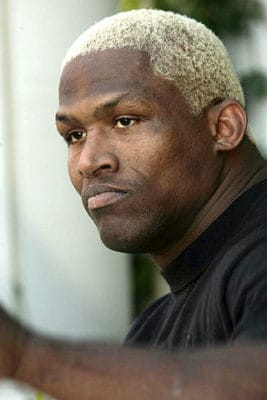
Kevin Ferguson (February 8, 1974 – June 6, 2016) aka Kimbo Slice

Kimbo is well-known for being a notable street fighter. He would eventually go on to get a huge opportunity in professional MMA corporations and even landed television and movie roles. However, before all of this Slice was a gifted linebacker from the Miami-Dade area. When growing up, he was entering a big season that could have resulted in some major football scholarships.

Sadly, Hurricane Andrew hit his hometown. Not only did it take out Kimbo’s own home but would also affect his school and the entire neighborhood. It all took place in 1992, the worst possible time for Kimbo. Scholarship offers dried up and he was left without a potential football career path. Yet he would eventually get an opportunity with the Miami Dolphins in 1997 at the age of 23.

While he did not make the team, it was for the best. As Kimbo went on to have quite a lot of success without football in his life, including a short but still notable MMA career.

Eryk Anders

When discussing Eryk Anders, you have to truly give the man some props. He played for Nick Saban at the University of Alabama and even won a BCS National Championship in 2009. He was a huge asset for the Crimson Tide during the 2008-2009 period as a starting linebacker for the team. This same season was his Senior Year.

He had 66 tackles, 14,5 of them being for losses. Along with 6 sacks and an interception. In the National Title game, Anders even caused a forced fumble and had seven tackles. While Anders did go on to the NFL, he did not really do well enough to last. He also tried his hand at the CFL and even Arena Football before eventually deciding on getting involved in MMA.

This has been a solid career choice. He won 9 fights in a row before being offered a deal by the UFC. Of course, while his UFC career has been hit and miss thus far, he has been quite impressive. From National Champion football star to the Octagon, Eryk Anders has lived a compelling life.

Brenden Shaub

Image Credit: Incredibleprogress via Wikimedia Commons

While most people recognize him today for his comedic prowess and podcast success, Brenden Shaub had a big run in both MMA and the world of football. In high school, he played both football and lacrosse. However, he did not see any college scholarships for either sport, which led him to try out for the football and lacrosse teams at Whittier College. He made both teams and was so successful that he ended up getting a football scholarship offer from the University of Colorado.

Due to NCAA rules, he had to sit out for one season due to transferring. Yet he would eventually play for the team. Although he went undrafted in the 2006 NFL Draft, he eventually landed on the Buffalo Bills practice squad. He would be released shortly into his time with the Bills but landed on his feet by getting signed to the Utah Blaze, an Arena Football League team. Brenden retired from football just a year later but decided to give MMA a try.

This turned out pretty well. He won his first 4 fights before he was signed to take part in the 2009 version of The Ultimate Fighter. While he would eventually lose to Roy Nelson in the Finale of the show, he proved himself enough to the UFC to earn a contract. Brenden would win 6 fights in the UFC before having to retire in 2014.

Since then he has been doing pretty well for himself as a podcaster.

Brian Stann

We should actually formally introduce this man. 2nd Mobile Assault Platoon & 3rd Battalion, 2nd Marines Captain Brian Stann. As you can tell, Captain Stann spent time in the United States Armed Forces. Yet before he did this, he was actually a pretty good linebacker for the Navy Midshipmen. Of course, any man who is able to do so after graduation from the Naval Academy must serve at least 4 years in the Armed Forces.

This meant that a career in football for Stann was never really the goal. He was obviously quite successful in his time with the Armed Forces and was even awarded a Silver Star for directing two casualty operations, three vehicle-recovery operations, and multiple close air support missions under enemy small arms, machine gun, and mortar fire in a 360-degree fight. We’re thinking he earned this honor!

After his time was up in the Marines, Stann went into MMA. He was signed by the WEC and even won the WEC Light Heavyweight Championship! In 2009, he was offered a contract by the UFC and had moderate success. Stann won 6 fights and had 3 Fight of the Night wins. Of course, he left the sport in 2013.

For 9 total years, he served as CEO for Hire Heroes USA, and today he is the Chief Operating Officer at FirstKey Homes.

Ovince Saint Preux

Image Credit: Bruno Massami via Wikimedia Commons

Ovince Saint Preux was a major high school athlete. He was born to Haitian immigrants in Immokalee, Florida. It was here at Immokalee High School that was part of the wrestling, track, and football team. As a wrestler, he ended up with a record of 26-1, becoming the State’s 1A Runner-Up in his weight class. In his Senior Season for the football team, he ended up with a then-school record of 18 sacks! That resulted in All-State honors.

In track, he was pretty impressive too and competed in the 110-meter hurdles, 300-meter hurdles, discus throw, and 4×400 Relay. All of this helped him earn a scholarship from the University of Tennessee. While he’d redshirt his freshman season, Saint Preux played football for the team each year from 2001 to 2004. He even earned Varsity Letters in 2002 & 2004 respectively after playing a total of seventeen college games. He played both defensive end and linebacker as a reserve.

After he graduated college, Ovince decided to train in kickboxing and submission grappling while also trying to get a professional football opportunity. His professional attempts turned out to be unsuccessful, yet his martial arts experienced seemed to be quite useful and resulted in opportunities in the world of MMA.

Saint Preux would go on to win 6 out of 7 fights for Strikeforce. Of course, once the company was purchased by then-UFC owner Zuffa, LLC, Ovince was also given a chance to compete in the UFC. He has competed in the company since 2013 and has been incredibly successful with the company.

He has won a Fight of the Night Award as well as SEVEN Performance of the Night awards! Ovince has also won more than a dozen fights in the UFC on top of this.

Dominick Reyes

Image Credit: Muhammad Nurmagomedov

Dominick Reyes has had a huge MMA career, but he was an incredibly gifted Strong Safety for the Division-1’s Stony Brook Seawolves. A 4-year starter for the Seawolves, he was able to rack up over 200 tackles. He even led the Big South League in tackles in 2010. He is even the all-time tackles leader for Stony Brook too.

He was voted to the All-Big South First Team & Second Team in his time with the Seawolves as well. While Reyes attempted to head to the pros for both the NFL & CFL, he never could land on any team. This was when he decided to truly dive into MMA. While he holds a Blue belt in Brazilian Jiu-Jitsu today, this took him years to achieve. He was even working a normal day job while also having some nice success in MMA.

He was simply not making enough in MMA to survive, so he was pulling a Clark Kent/Superman concept on people until the UFC gave him an opportunity after he went 6-0 in his early MMA career. The UFC managed to take on one heck of a fighter, as Reyes was able to win his first 6 fights, capturing Performance of the Night twice.

Today, Reyes is considered a regular top contender in the UFC Light Heavyweight Division.

Matt Mitrione

Matt Mitrione actually enjoyed some pretty good success in the world of football, even played professionally in the NFL. He was a standout in college for the Purdue Boilermakers, where he had 35 starts at defensive tackle. Sadly, he sustained a broken foot that kept him from being drafted in the 2002 NFL Draft. The New York Giants, however, took a chance on him when he healed up.

Yet injuries plagued his career. Not only did he have more foot injuries, but he had 7 surgeries to fix the issue. One of those was even done to extend his Achilles Tendon, keeping him on crutches for a full 16 months. The Giants cut him in 2004 and Matt tried playing for a few other teams before, ultimately, his career was over.

However, Mitrione always had a love for martial arts, even as a kid. His parents enrolled him in karate to help with his hyperactivity, meaning Matt was well-versed in Shotokan Karate for years. Matt even has a black belt in the martial art, which resulted in him getting an offer to fight for Jayson Werth‘s inaugural promotion. Nothing really came from this but Matt would get a big opportunity to be part of the 2009 Ultimate Fighter: Heavyweights edition.

He won his fight in the Finale of the show, resulting in a UFC contract. Since competing Mitrione had had some huge wins over some well-known fighters. He has beaten Kimbo Slice, Gabriel Gonzaga, Derrick Lewis, and Roy Nelson. He is even one of only 6 people to ever defeat the incredibly notable heavyweight fighter, Fedor Emelianenko.

Matt did have a long career in the UFC, but he has since competed in Bellator MMA.

Bob Sapp

Bob Sapp has sort of mixed his time in both MMA & Professional Wrestling for years now. Of course, Sapp has not really been the most successful MMA fighter, known mostly for his losses than his wins. Sapp was actually a Kickboxer for a lot of his early fighting career. But what he did best was playing football out of all the sports he tried.

He played for the University of Washington and was part of the Huskies team that ended the Miami Hurricane’s 58-game home winning streak. Sapp was even able to win the Morris Award in 1996, a trophy given to the best offensive/defensive lineman annually. Due to his great collegiate success, he would be drafted in the third round by the Chicago Bears in the 1998 NFL Draft.

Sadly for Sapp, he would be released by the Bears yet the Minnesota Vikings took a chance on him. However, he only played one game in two full seasons for the Vikings due to steroid abuse and the suspensions that followed. That led to the team releasing him and a chance to play for another team pretty much dead in the water. This put Sapp in poverty, which eventually led him to professional wrestling.

Sapp wrestled for a lot of places, including New Japan Pro-Wrestling and even World Championship Wrestling or WCW. While his career in WCW was short-lived, he decided to give professional kickboxing a try and did enjoy some moderate success, winning the K-1 World Grand Prix Tournament in 2005.

Sapp also felt he could have some success in MMA, along with wrestling in NJPW. Since he was already in Japan, he tried his hand at working for PRIDE FC, evening earning 2 wins in 3 fights. He’d eventually fight for K-1, Dream, Strikeforce, ONE Championship, & Rizin. Again, Sapp has rarely been a major success in MMA. But between football, pro-wrestling, & MMA, Sapp has managed to have one heck of an athletic career.

Greg Hardy

Greg Hardy has been known for his football career far more than anything related to his MMA time. He played at an elite level in the NFL and managed to rack up 40 career sacks, 238 total tackles, and 8 forced fumbles. In fact, in 2012 & 2013, he had two seasons where he had over 10 sacks. Hardy even made the Pro-Bowl in 2013 after having a career best 15 sacks that season!

However, Greg Hardy has always been his own worst enemy. He only played roughly 6 seasons in the NFL in spite of being highly productive because of several suspensions. He was arrested and eventually faced criminal charges for domestic violence, eventually having some charges dropped.

From 2014 to 2016, the man could not get out of the public eye in a negative way. This resulted in his NFL career pretty much ending and a transition to MMA with no prior martial art background. He began this in 2016 and would win some major amateur fights that eventually caught the eye of UFC President Dana White.

That resulted in Hardy appearing in Dana White’s Contender Series, and eventually the UFC. Hardy has had a moderately successful transition to MMA from football. Hopefully he can stay out of his own way this time.

Brock Lesnar

Image Credit: Refill via Wikipedia

Brock Lesnar is mostly known for his work in the WWE. He was a pretty successful collegiate wrestler who won the NCAA Heavyweight Championship as a collegiate wrestler. He would transition this success into the WWE, but only for around 3 years. Lesnar is a freak athlete, but the schedule for WWE was too difficult for him, yet he still wanted a competitive opportunity. Football seemed like the best transition for a man in his mid-20s.

In spite of never playing high school nor college football, he was given an opportunity by the Minnesota Vikings to try out for them. Lesnar was nearly successful at making the team. However, he just missed out on doing so. This seemed to be for the best, as he decided to jump into MMA right after. He did not have to wait very long for a phone call from the UFC.

Lesnar then joined the company and the rest, as they say, is history. He won the UFC Heavyweight Title and helped the company grow massively, becoming a huge blockbuster attraction. While Lesnar would depart from the UFC for another WWE run, he did go back for a fight with Mark Hunt. Of course, Brock did win the fight but it was eventually thrown out when Lesnar tested for a banned substance.

He has not competed in the UFC ever since. Yet many believe he’ll yet again return. Time will tell!

RECOMMENDED FOR YOU:
11 Most Intimidating MMA Fighters Of All Time

Herschel Walker

Photo Credit: Michael Kaplan via Wikimedia

When you hear the name Herschel Walker, you automatically think about football. It is not crazy to do, as Walker is considered by many to be one of the best running backs in history. He was an incredible college running back for the University of Georgia, helping them capture a National Championship in 1980. Walker also won the Heisman Trophy & Maxwell Award in 1982.

This led to a big opportunity at the professional ranks. Instead of going to the NFL, however, Walker decided to go to the newer USFL. Obviously he became a major success there but when the league died, Herschel jumped to the NFL where he played for the Dallas Cowboys and eventually the Minnesota Vikings & Philadelphia Eagles.

Walker was not just a gifted runner, as he could also catch the ball and become a productive Wide-Out. In spite of being one of the best running backs of his era, he’d only make 2 Pro-Bowls. Yet if we combine his USFL & NFL statistics, he put up a major 13,787 career rushing yards. This would be good enough to maintain the Top 10 best career rushing numbers, except he only put up a little over 8,000 yards in the NFL.

One would think that after a Hall of Fame football career, Walker would be done as an athlete. Yet he proved everyone wrong when he decided to try his hand at MMA. This was not as crazy as many might have thought. People did not realize that Herschel Walker has a fifth-degree black belt in Taekwondo!

He won both of his only two MMA fights but has not competed since 2011, Either way, what an impressive accomplishment for a man years out of his prime. Imagine if Walker dedicated the prime of his life to MMA over football. We might not have heard of other top heavyweight fighters at all!