Home Blog Page 33

Is Taekwondo Effective in a Street Fight? Q&A

0
Photo by Korea.net
Photo by Korea.net

Taekwondo(TKD) is a well-recognized sport in competitions across the world, including the Olympic Games and MMA. However, these competitions each have their own rules, raising the question of whether or not Taekwondo is effective in a real fight. This article will explore Taekwondo as self-defense in real-life situations, where there are no rules or points.

Taekwondo can be effective in a fight due to its kicking accuracy and power. However, the major problem with Taekwondo as self-defense is that it does not prepare you for the fight on the ground, where many fights occur.

I will explain in more detail why I think Taekwondo on its own will not prepare you for a real fight. I have also included examples of Taekwondo used in MMA and its advantages and disadvantages.

Is Taekwondo Effective for Self-Defense?

Training in Taekwondo will provide you with some knowledge of offense and defense that you can still use in a fight. However, this should not be considered an effective discipline for self-defense. Overall, Taekwondo has become more about performing elaborate kicks to score points in a competition setting, which I will explain further down.

These elaborate kicks, although powerful, will waste much-needed time and energy that could cost you greatly when faced with an attacker. Any kicks leave you at greater risk of being thrown off balance and being hit by your opponent.

Photo by Republic of Korea

Taekwondo also focusses heavily on standing fights, whereas many fights in reality are taken to the ground. When on the ground, the kick and hand strikes that are taught in Taekwondo are no longer effective and you could easily be overcome by your attacker. Therefore, you need experience in another fighting style to be fully equipped for any situation.

Is Taekwondo Kick Only? 

Despite popular belief, the art of Taekwondo includes more than just kicks. TKD includes hand strikes, blocks, and various self-defense techniques, such as pressure points, throws, joint locks, chokes, and freeing techniques (escapes).

The reason many people believe Taekwondo is a kicking sport is that most Taekwondo competitors will use kicks to gain the most points in a match. Competitors will only earn one point for striking the body, but will earn three points for kicking their opponent in the head. A spinning kick to the torso will also earn two points.

In addition to this, competitors are not allowed to punch their opponent’s head. They will lose points if they punch the face, grab, hold or push their opponent. Therefore, in order to gain the most points and to maintain those points throughout the match, most Taekwondo practitioners will focus on kicks.

What are the Disadvantages of Taekwondo? 

You Can’t Simulate a Real Fight

One disadvantage in Taekwondo is that the rules surrounding competition and practice do not allow practitioners to experience real-life threats during a fight. For example, within a controlled environment, your opponent is not allowed to grab and hold onto your leg. In a real fight, someone could catch the leg, throw you off balance and take the fight to the ground.

Taekwondo also does not focus on ground grappling techniques, making practitioners vulnerable if an attacker were to knock them to the ground. In the competition setting, competitors cannot be held down if they fall, allowing them to scramble to their feet again.

They also have 10 seconds to get up before the knockdown is considered a knockout. Therefore, the sport does not encourage ground fighting. Realistically, if you were knocked to the ground by an attacker, they would try to keep you there by kicking, punching or jumping on top of you.

Students May Become Overconfident

It is natural to think that a black belt in Taekwondo would win in a fight. However, as mentioned above, there are situations in a street fight that are not simulated in Taekwondo practice or competitions. This can give practitioners a false sense of security when faced with a real attacker. Someone who genuinely wants to hurt you will not fight within the rules of the Taekwondo match.

As I mentioned earlier, Taekwondo includes some self-defense moves, but these are only practiced in a controlled setting and are only used in competitions as demonstrations. Techniques such as the ‘Scissor Finger’ are designed to gauge at your opponent’s eyes, but practitioners will never have the opportunity to practice this to its full extent in training.

In addition to this, black belts can be awarded to children. On average, it takes approximately four years to reach the black belt level. Therefore, if children begin at an early age, they have the potential to reach their black belt before they are 10 years old. With these children learning alongside their adult peers, they may naively think that they can defend themselves effectively against a fully grown adult.

One of the youngest children to earn their Taekwondo black belt was Ethan Comer, who was promoted at six years old. Although Comer would have a better chance at defending himself against an attacker than other children, he realistically will not be effective against an adult who could use their size and strength against him.

Most Gyms are Competition-Focussed

Although there are some effective self-defense strategies in Taekwondo, most of these are not permitted in a competition setting. As I mentioned before, eye-gouging is a method that is included in the list of Taekwondo techniques, but this will lead to disqualification and serious harm to your opponent/peer.

Because of this, many gyms (or Dojangs) will focus primarily on what will earn their students the most points in competitions; kicks.

Is Taekwondo a Good Martial Art? 

Among its disadvantages, Taekwondo is still beneficial to those that choose to learn the art. As with any sport, training in Taekwondo can help to keep you fit and healthy and improves your flexibility considerably.

Taekwondo specifically will train you to strike quickly and with accuracy when kicking your opponent. These kicks can expend energy in a fight, but if the opportunity presents itself, a well-timed and well-placed kick can knock your attacker out.

However, there are still gaps in knowledge that leave you vulnerable in a fight. Even if you learn Taekwondo techniques such as hand striking, escapes, throws, chokes and joint locks, you still will not be prepared for a ground fight.

On the ground, your kicking techniques and most of the hand strikes are not possible, ruling out most of your offensive attacks. Even if the fight remains standing, kicks leave you much more vulnerable to being thrown off balance than staying on both feet and striking with your fists.

Therefore, Taekwondo is better to learn alongside another fighting style, such as Brazilian Jiu Jitsu, boxing or wrestling. By itself, the focus relies heavily on the fight remaining standing.

Is Taekwondo Really Useless? 

Taekwondo has its benefits over other martial arts, as mentioned above, but some people believe that its disadvantages render the art useless in the real world. However, learning a martial art is never entirely useless.

Having a martial arts background still gives you an advantage over an untrained attacker. You are taught how to stay calm when faced with an opponent and how to land accurate strikes.

To add to this, you will also develop self-esteem and confidence. Students are taught to respect themselves and others and learn how they should be treated. This can help in everyday life when you need to stand up for yourself to resolve conflict, such as in the workplace.

Photo by Korea.net

Martial arts are also very team-focussed, encouraging students to be humble and to support one another. The discipline that comes with learning a martial art is part of the reason why many parents enrol their children in a martial arts school.

Why is Taekwondo Not Respected? 

Some people lose respect for a martial art if they feel it has drifted away from its origins and become a ‘watered down’ version of what it once was. This has been the general view of Taekwondo as it has slowly transitioned into a sport governed by organizations such as the World Taekwondo Federation and being included in the Olympics.

The focus has slowly shifted from learning effective offense and defense to learning how to score the most points in a short space of time. Practitioners will learn to ‘tap’ their opponents as they execute perfect kicks. Meanwhile, your opponent is limited in their defense options based on the rules of the sport. They cannot grab you, hold you or attack you below the waist.

Although Taekwondo was traditionally a dangerous and effective means of protecting yourself from an attacker, the rules that govern the sport now have rendered it ineffective in the real world.

Do any MMA Fighters use Taekwondo? 

There have been a number of fighters in MMA that have trained in Taekwondo. One example is Anderson Silva, a fifth-dan black belt in Taekwondo. Silver was a UFC Middleweight Champion and still holds the record for the longest-reigning UFC champion, with a total of 2457 consecutive days. Demetrius Johnson holds second place with 2142 days.

Throughout his reign, Silva certainly used many Taekwondo techniques, including a number of impressive knockouts. However, he also holds a black prajied in Muay Thai and a third-degree black belt in Brazilian Jiu Jitsu. He used a combination of techniques from each in his fights.

Another great example of a high-level Taekwondo practitioner in MMA is Anthony Pettis. He holds a third-dan black belt in Taekwondo and was a one-time UFC Lightweight Champion. However, again, Pettis also holds a black belt in BJJ to compliment his Taekwondo techniques.

This demonstrates that successful fighters do use Taekwondo in MMA. However, it also points out that these techniques need to be combined with another discipline in order for a fighter to succeed in a fight.

Is TKD Better Than Karate?

Karate is a martial art that uses whole-body movements, with more balance between hand striking and kicks. Taekwondo, on the other hand, has become more weighted towards elaborate kicks from long-range.

Although Karate offers a broader range of techniques, it still faces the same challenges as Taekwondo. Both do not prepare the student for all fighting situations, such as ground fighting. However, one advantage Taekwondo has over Karate is the ability to attack from further away. Most Karate techniques are only effective from close range, leaving you more vulnerable to attack.

The kicking technique in Taekwondo is also faster, increasing the chances of hitting your opponent. Although many fighters in the UFC have a background in Karate, such as Georges St-Pierre, it is more likely that you will see the fighters using techniques from Taekwondo or other martial arts than from Karate.

Therefore, both Taekwondo and Karate would need to be combined with another martial art in order to be fully effective, but Taekwondo may have more relevance in a fight.

What is a Clinch in MMA? Easily Explained

0
Photo by Thaifighter911

One of the core elements of MMA fighting is the clinch. It has been successfully used by MMA fighters and is used across a range of fighting styles.

A clinch is designed to put an opponent into a hold. This gives the fighter more control of their opponent’s movements. Once in the clinch, they might want to land punches and kicks. Alternatively, being in a clinch position will enable the fighter to throw their opponent to the mat much easier.

In this article, I will explain how the clinch is used in MMA as simply as possible if you are not familiar with this technique.

What is a Clinch in MMA?

Let’s start by looking at what a clinch is. Simply put, this is when one fighter puts another into a hold. Once they have them in a hold, they can drag the opponent to the ground. Sometimes, they will use it as an opportunity to punch or kick them. The most important element, though, is to remain in control of their movements.

This has become a prominent part of MMA because of the multiple fighting styles that use it. The most obvious example of this is wrestling, both Greco-Roman and freestyle. Wrestlers use the clinch to be able to hold and manipulate the opponent, often the aim will be to pin them to the mat.

Clinch in wrestling
Photo by MartialArtsNomad.com

However, other fighting styles use a clinch. Some of the most prominent examples are;

  • Muay Thai
  • Judo 
  • Brazilian Ju-Jitsu (BJJ)
  • Boxing

These martial arts which use clinch have a stronger emphasis on offense. For example, Muay Thai emphasis throwing the opponent to the mat and trying to land punches on the way down.  

Fighters who embrace these styles have shown how effective a good clinch can be. Because of this, it has been able to achieve more mainstream appeal. As an MMA fighter, knowing how to properly execute clinch or defend against clinch is one of the fundamental techniques that every fighter learns.

Why Do MMA Fighters Clinch?

To better understand why the clinch has become an essential technique of MMA, we need to look at some of the advantages and disadvantages of using it during a match. 

Advantages

There are dozens of reasons to use a good clinch hold. These include;

  • Controlling the opponent: When applied well a clinch hold will give a fighter more control over the movements of their opponent. This can put them into a position where they will be able to land good offensive maneuvers. Controlling their movements is also a good technique for scoring points with the judges. 
  • Tire an opponent: When in a clinch hold, the opponent will need to expend a lot of energy to break it. The more tired the opponent becomes, the more likely they are to make a mistake. 
  • Evens out the fight: It’s rare for a fight to be even. One person will usually have a height advantage. A clinch hold is a good way for fighters to neutralize this threat. Some clinch techniques have been designed for a smaller person to use against a larger opponent. 
  • Can be used for a takedown: In MMA, a clinch position is often used to set up for a takedown. Taking an opponent to the ground can significantly limit the opponent’s movements on their back. Once the opponent is on the ground, the fighter can deliver strikes, without the opponent able to hit back. Alternatively, this can be used as a set-up for a submission move. 

Disadvantages

There are also some situations where fighters will avoid applying the clinch. These include:

  • Requires close contact with the opponent: One of the biggest risks of this technique is getting close enough to the opponent to apply the clinch hold. When closing the distance to apply the clinch, there is a greater risk that they will get punched or kicked against a very good striker.
  • Risk of a reversal: Another potential concern is that their opponent will be able to reverse the hold. A good grappler often prefers to be in the clinch position because it enables them to apply their submission moves more easily such as standing kimura.

Can You Punch in a Clinch?

In an MMA fight, fighters will be able to punch in a clinch. However, because this involves lifting a hand off their opponent, it’s most common for them to kick instead. These can be knees to the chest. These are designed to force the opponent to lean forwards. Once they do, they will be opening themselves to the potential of getting punched.

These rules are very different from the ones that apply in boxing, where boxers can’t apply a clinch for more than a few seconds before the referee breaks it. Punching an opponent while tangled up in a clinch position is sometimes referred to as dirty boxing. In MMA, as long as there is action occurring in the clinch, the hold can continue.

Alternatively, they might also try to kick the legs. When doing this, they will be able to knock their opponent off-balance, this can make a takedown a lot easier.

While the MMA rules have been designed to give fighters a lot of latitudes, there are a few things that will be banned during the clinch. First, they won’t be able to grab or hold the fence for the following reason:

“Fighters grab the cage when they’re attempting to jostle for position in the clinch, avoid a takedown or when they’re badly rocked and don’t know what’s going on. Grabbing the cage can result in a warning from the referee, point deductions and a reset in the center of the Octagon.”

Bleacherreport

How Do You Clinch in a Fight?

There are a few methods that you can use to apply the clinch against a striker. These are:

  1. The flying knee: The first step of this process is to block a punch with the palm of your hand. As you are doing this, grab their fist. Then, deliver a flying kick to their torso. This should force them to bow their head.  Once they do, you can grab the back of their neck and begin the clinch. 
  2. The steering wheel: In this case, you will need to grab control of their hands. Once you do, you can get hold of their biceps. This will allow you to stop them from throwing a punch. 
  3. Ducking the head: If you have fast movement, you might want to duck your head under the punch. As you do, rush forward to get under the arm of the opponent. From there, you can go on the offense, landing strikes. Or you can use the position to clinch up. 

Final Thoughts

The clinch is one of the most important elements of MMA. It has been used in various styles from wrestling to Muay Thai. Being able to get an opponent into a clinch will give the fighter an upper hand. They can control their movement, landing blows or bringing an opponent to the mat. Because of this, learning how to successfully apply and break a clinch could be the key to winning an MMA match. 

How Long Does it Take to Learn BJJ for Beginners? Q&A

0
Photo by John Lamonica

Learning a new martial art can be a daunting process and it is difficult to gauge if you are progressing at an acceptable pace. If you are considering learning Brazilian Jiu-Jitsu(BJJ), you may be wondering how long it will take you to learn the techniques. In this article you will find answers to the common questions people have about how long it takes to learn BJJ for beginners.

The Gracie Combatives program, which teaches BJJ beginners basic self-defense, takes 108 days. However, through the belt system, graduating from beginner to blue belt takes 2-3 years. However, those with prior grappling experience can achieve this much quicker as there is no minimum time frame.

I will explain these beginning stages of BJJ in more detail below. You will also find more common questions, including how often you should train and how you can speed up your progress.

How Long Does it Take to Learn BJJ for Self Defense? 

The Gracie family, the founders of BJJ, recommend that beginners start their self-defense training with the Gracie Combatives program. Although BJJ consists of over 600 different techniques, the Gracie family recognized that there are 36 core techniques that will equip you with the skills required to defend yourself against any attacker. This self-defense program was originally developed for the U.S. army.

The program can be completed at your own pace, as long as you are proficient in all 36 techniques. The recommended training schedule for this is 108 days. However, this assumes you are learning one technique every three days. If you learned one technique every day, you could complete this course in just over a month (36 days).

This course is the minimum requirement for self-defense in BJJ. However, if you are training in BJJ at your local gym, you will be trained following the BJJ belt system. According to Helio Gracie, reaching your blue belt provides you with enough knowledge to defend yourself against any untrained attacker. Graduating to blue belt usually takes longer than the basic Combatives program, which I will explain in more detail below.

Is BJJ Hard to Learn? 

BJJ is a martial art that was originally designed for anyone to learn, regardless of their weight, size or fitness level. In this regard, it is not hard to learn because there are no prerequisites and it does not rely on your own strength. However, BJJ does require patience, hard work and discipline if you want to be good.

Instructors will often teach a technique in one class, allow time to practice, and then move onto to another technique by the next class. This puts the responsibility on the student to practice these techniques between classes.

In addition to this, if you are attending three sessions per week, learning a new technique each time, it will still take years to master every Jiu-Jitsu technique. For this reason, it is expected that BJJ practitioners will undergo individual study to learn new techniques.

Therefore, despite the fact that BJJ is not physically hard to learn, the total commitment required to further develop your technique can be hard for some individuals.

LEARN MORE
Get the full report on Is BJJ Hard To Learn?

Can You Learn BJJ in a Year? 

If you are learning BJJ for self-defense only, you can become proficient in the 36 core Gracie Combatives in less than a year, as mentioned above. However, if you want to become a black belt, or ‘professor’ in BJJ, this cannot be done within a year.

Through the International Brazilian Jiu-Jitsu Federation (IBJJF), becoming a black belt will take a minimum of three years, although that is incredibly rare. There are even exceptions to this rule, which I will discuss further down, but graduating to black belt typically takes 10-15 years.

However, it is possible to receive your blue belt within a year. There is no minimum time frame required to graduate from a white belt to a blue belt. If you only want to learn how to defend yourself against an untrained attacker, earning your blue belt will achieve this.

How Many Times a Week Should I Train BJJ? 

The Gracie Combatives program recommends learning a new technique every three days to keep up with their training schedule. With this in mind, you should be training in Jiu-Jitsu 2-3 times per week, or ten sessions per month. Training three times per week will allow you to have one day of rest between each session.

For a world champion such as Marcus Almeida, a typical week of training consists of 3-4 days every week with his coach. However, some practitioners may train up to six days individually. The reason Almeida’s coach does not train with him any more than 3-4 days is that it allows his body time to recover. Training too many times during the week can cause you to burn out and be detrimental to your progress.

How Long Does it Take to Get a Blue Belt in Jiu-Jitsu? 

There is no minimum time frame to receive your blue belt. However, children practicing Jiu-Jitsu cannot receive their blue belts until they are 16 years old. On average, a person will take 2-3 years to receive their blue belt.

In the meantime, a white belt will receive ‘tips’ or ‘stripes’ on their white belt to measure their progress. In total, you will receive four stripes before graduating to your blue belt, with each stripe taking approximately 3-6 months. However, this varies significantly depending on the student’s dedication to their learning.

BJJ Ranking System

One of the quickest people to receive their BJJ black belt is Travis Stevens, who went from a white belt to black belt in 18 months under John Danaher. Stevens was promoted from his white belt to blue belt in just a number of weeks. This was made possible by Stevens’ history as a Judo Olympian as well as his dedication to BJJ training with Danaher. Judo and BJJ share many similar techniques that would have prepared Stevens for the basics of BJJ.

To receive a blue belt, students must be able to apply the techniques of BJJ from all major positions on the mat. These major positions include guard, side control, knee-on-belly, mount, rear mount and turtle. Also, as a general rule of thumb, if you are able to submit other blue belts, you are likely to be close to your blue belt promotion.

How Do I Get Good at BJJ Fast? 

There are three key things you should do to speed up your progress as a BJJ practitioner, outlined below.

Train Regularly

As I mentioned earlier, training three times every week will give you the opportunity to learn new techniques from your instructor, while giving your body the break it needs to recover. Training with an instructor is important in receiving feedback and correction. Sometimes you may think you understand a technique, but there are fine details that you have missed that may allow your opponent to escape your pin or allow them to submit you.

Attend Open-Mat Sessions

Attending open-mat sessions will give you the opportunity to practice your techniques in a live grappling situation. You can also roll with people of different experience levels. Rolling with more experienced students will allow you to learn new techniques. Rolling with people with similar experiences will give you a chance to practice your techniques in an evenly-matched situation.

It is also important to roll with people who are less experienced than you. This will give them the opportunity to learn, but will also allow you to practice explaining your techniques to others. This helps to solidify your theoretical knowledge.

Independent Study

Self-directed learning is one key aspect to progressing faster in your BJJ career. Watching instructional videos will expose you to more techniques than your instructor can teach you in a short period of time.

Breaking down BJJ matches will also help you identify techniques that are effective on the mat. If you are able to learn techniques that are used by world-class BJJ competitors, you know that they are good techniques to learn.

Can You Learn Jiu-Jitsu by Yourself? 

You cannot become fully competent in Jiu-Jitsu by yourself. You need to be able to practice your techniques with another person so that you understand how their body moves in response to your own. Without someone to practice with, you also will not be able to identify any flaws in your technique, which could be detrimental in a real fight situation.

In saying that, you can still learn the theory behind each technique through instructional videos and by practicing the basic body movements required. For example, in the Gracie Combatives program, students who are learning on their own are instructed to practice triangle choke on their legs instead of a partner’s neck.

How Many Techniques are there in BJJ? 

There are currently over 600 techniques in BJJ. It is difficult to define an exact amount because new techniques are continually being developed over time. These techniques can be divided into five major categories, including takedowns, positions of control, submissions, escapes, guard passing and guard retention.

As I mentioned earlier, 36 of these techniques are considered crucial in self-defense against an untrained attacker. The remaining techniques will help you to defend against an experienced attacker, or will prepare you for competitions. 

How Do You Remember BJJ Moves

Everyone has a different learning style. However, there are some general tips that will always help you to remember BJJ moves, outlined by black belt Andre Galvao.

Drills involve repeating the technique multiple times with a partner, using little or no resistance. This allows you to build muscle memory for how your body needs to move.

Taking notes will allow you to remember the names of the techniques as well as little tips to remember the movements. For example, the ‘hitchhiker escape’ reminds practitioners to flick their thumb up, as a hitchhiker would, to escape an armbar.

Finally, watching instructional videos will solidify what you have learned. You can also pick up on any fine details you may have missed in your class.

Key Differences Between TKO and KO in MMA – Simply Explained

0
Photo by Matthew Walsh

There are two common ways of winning an MMA match. You can either get a TKO or a KO. But what do these terms mean and what is the difference between them?  

A TKO or Technical Knockout is when a fighter is unable to competently defend themselves. Sometimes, a TKO will occur when doctors or medical staff will decide that it is no longer safe for a fighter to continue the match. On the other hand, a KO or Knockout occurs when a blow renders a fighter unconscious. 

While this can seem like an easy distinction, there are a few rules that referees need to follow before declaring a TKO. Keep reading to find out more about each of these finishes. 

What is the Difference Between KO and TKO

Let’s take a closer look at each of these options, to get a better understanding of the way that they are declared. 

What is KO in UFC/MMA?

The knockout is one of the easiest finishes to identify. One fighter will receive a blow. Then, they will temporarily lose consciousness. Even if they only lose consciousness for a few seconds, the fight is over. Unlike in boxing, there is no ten-count.

It should be noted that there is a range of blows that can cause loss of consciousness. The most common is a hit to the head. However, it’s also possible that a KO can also come from a well-timed body shot to the liver. 

After the KO has been declared, the fighter will need to go see the ringside doctor, where they will be medically accessed. Often, they will be given a medical suspension. This means that they won’t be able to compete for 30 days, to give their bodies some time to recover. Sometimes, a fighter can lose consciousness because of a chokehold. This isn’t declared a KO. It will be a submission. 

What is a TKO in UFC/MMA?

The technical knockout is more subjective. It occurs when a fighter can’t defend themselves. This will often mean that they have lost the ability to block blows. In this case, the referee will step in to put an end to the match, protecting the health of the athletes. However, the fighter won’t have lost consciousness. 

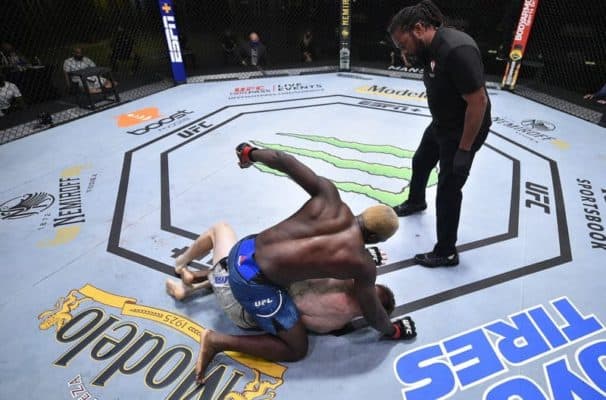
Often, a TKO will occur on the ground, with the dominant fighter able to get into a superior position. However, there are some instances of a TKO occurring while a fighter is still standing. While they might not have lost consciousness, they might no longer be able to hit back. Often, they will only be able to stay on their feet by hanging onto the cage. This is commonly referred to as being “out on their feet”. 

Another example is a position known as “The Turtle”. In this case, a fighter will be pinned on their back and unable to get up. They will put their hands over their head, to protect themselves. But the opponent will still be able to make good strikes. Though they might still be conscious, they are unable to mount a defense. In this case, the referee will call a TKO.

UFC Derek Brunson wins via TKO

While these are the most common reasons why a TKO will be declared, there are a few other instances where a TKO can be declared;

  • One fighter has received a severe injury, which makes them unable to continue fighting. 
  • Some cuts might cause so much bleeding that they reduce visibility. 
  • When the trainer or coach throws in the towel. 

Each of these is related to medical problems that have occurred during the match. Between rounds, the cutman will come into the ring and stem bleeding

If the cut occurs during the match, and the fighter starts bleeding, the referee will decide what to do. If it is a minor cut, they will allow it to continue. However, if it a serious cut, they might decide to pause the match. This allows them to consult with the ringside doctor, to see if it is safe to continue. If it is, the bout resumes. 

If it isn’t, the match will be ended. At this point, it will be called a TKO. After this, there will procedures. The most common is the fighter getting a medical suspension. In this case, they will be unable to enter another bout within 30 days. This ensures that they have enough time to recover. 

Is Tapping to Strikes a Submission or TKO?

In MMA, fighters have the opportunity to tap out during a match. This often happens when they are placed into a submission move. Once they have tapped out, the fight is immediately stopped by the referee. 

How this is treated will depend on the circumstances in which the tap out occurred. For example, imagine the fight goes to the matt and a chokehold is applied. Then, the fighter taps out. In this case, it counts as a submission, because they were put into a hold. 

On the other hand, some people will tap out after receiving strikes. In the absence of a chokehold, it will be deemed a TKO. 

Is Throwing in the Towel a TKO?

Some trainers will opt to stop a fight. The main reason they do this is that they want to prevent their fighter from taking any more damage. Most coaches will be reluctant to stop a fight, making this a rare sight. To decide whether to throw in the towel, they will consider a lot of factors;

  • The severity of the injury
  • The fighter. Some people will expect the coach to pull them out, others will want to finish the fight no matter what. 
  • How long the match has to go
  • The importance of the fight. Most coaches are very reluctant to call off a title match. 
  • The odds that they will be able to win the match
  • The personality of the training team

Once the coach throws in the towel, the match is stopped. This is a TKO. 

Other Ways of Finishing an MMA Fight

While TKO and KO are the most common finishes, they aren’t the only way to conclude a fight. Some of the other potential finishes will include;

  • Submission. This is when a fighter taps out, this often happens after they have been put into a hold. 
  • Disqualification. This occurs when one person uses an illegal move. 
  • Forfeit. This needs to happen before the fighting starts. It’s most common when one of the participants is injured. 
  • No Contest. This happens when both people violate the rules of the fight. 
  • Decision. The fight finishes and heads to the judges who then score the bout to decide who won.  

Is TKO or KO Better?

Both a TKO and a KO will result in the end of the fight. As soon as a fighter scores a TKO or a KO, they are declared the winner. Both reflect strongly on the record and will boost their ranking within the sport. 

Getting a lot of strong KOs or TKOs is needed to build a strong reputation within the MMA. This will help them advance their careers, earning their way to more title bouts. Some athletes have a prefer KO. This is the most unambiguous. They clearly bested the opponent. 

While a TKO finish can sometimes get messy, as it relies on the judgment of the referee. This has led to a lot of controversial moments, with fans at odds with the decision of the referees. 

Final Thoughts

Two of the most popular ways of finishing a match are with a KO or TKO. While these are similar, there is a key difference. The fighters’ ability to defend themselves. In a KO, they have lost consciousness. In a TKO, they are still conscious but are unable to fight back. Both forms of victory are highly prized in competition and can help a fighter build their reputation. 

What Happened to PRIDE Fighting Championships?

0

MMA fans, notably the new ones, can often hear stories about the glory days of Pride Fighting Championships(Pride FC or Pride) and how good it was back in the 2000s. People telling these stories tend to go even further by saying that Pride FC was the best MMA product ever. Even better than the UFC. But was it like that? And even if it was, how could such a big company collapse out of nowhere?

Pride FC was the most famous Japanese MMA promotion that was active from 1997 to 2007. From 2000, it was the home of the best fighters in the world, including the ones from the US, and its events were gigantic. It was a much bigger promotion than any other of that time, and being a Pride champ meant you are the best in the world.

But the Pride FC as a company collapsed quickly mainly due to their sudden loss of major TV deals with the Fuji network.

Still, this is just the tip of the iceberg and a brief explanation. Stay with us to find out more about what happened to PRIDE FC, what was unique about it, and how different it was from the UFC.

How Did PRIDE FC Go Out of Business?

Pride FC was one of those companies that went from top to bottom in a very short time span, and the exact cause of its fall is still unknown. It all started when the company lost its biggest TV deal with “Fuji TV” in 2006 which had a huge impact on their revenue. At the time, their main incomes were through various TV deals, and “Fuji” was the main one. The impact was so bad that Pride got out of business in less than a year, and it all ended with UFC buying Pride in 2007.

The main question is: why Fuji TV decided to get out of business with the most successful MMA Company?

According to many sources, this has a lot to do with the internal issues within Pride FC, people who ran it, or better to say “controlled” it. Around 2005, rumors were flying that Pride was under the control of the Japanese mafia group called “Yakuza”. This group used Pride to fix matches, manipulate the taxes, gamble, and do other illegal stuff. And like that wasn’t bad enough, many sources suggest that there was an internal war between two Yakuza groups over their interests in the promotion.

All of this had a huge impact on Pride FC as a brand and what it stood for, notably when it comes to its fans in Japan. You see, Japanese people were appalled by groups like Yakuza, or anything this group was involved in at the time. So when it became clear that they were involved in Pride, the image and TV ratings have plummeted.

It’s a shame that all the reasons behind its fall do not have anything to do with the sport and production itself. Pride events will forever be once in a lifetime spectacles.

Who owned PRIDE FC and where are they now?

The original founder of Pride FC was Nobuyuki Sakakibara who remained the owner until the very end. Before getting into MMA, he had a lot of experience in organizing combat sports events. He worked with various TV networks and was a part of the K-1 production. In 1997 and while being a member of the “KRS” promotion, he decided to start his own MMA show.

He organized the first three events under the name of “KRS-MMA”, with the help of his friends and colleagues. Following the fourth event, he formed a company “Dream Stage Entertainment Inc”, and build his own brand called “Pride Fighting Championship”.

Sakakibara remained the owner of Pride until the very end in 2007 when he sold it to the UFC’s parent company, Zuffa. But, he would stay in the fighting business and start a new promotion called “Dream” in 2008. Dream had some success in the beginning, but, it also collapsed in 2012.

Sakakibara decided to give it another go by starting another promotion, “Rizin FF” in 2015. As of 2021, Rizin events have been among the most popular in the eastern world and doing reasonably well.

Was PRIDE FC better than UFC?

Even in modern days, a lot of fans think that Pride FC was much better than the UFC. Yes, it all ended up with UFC buying out Pride in 2007, which shows us that the UFC ended up as a better business in the long run. But, during the early 2000s, it’s fair to say that Pride FC was, by far, the most popular MMA promotion. And it was bigger than the UFC if you look at the overall picture.

During the early 2000s, the UFC was going through a lot of changes. In 2000, the famous Fertitta brothers and Dana White bought the UFC for $2 million, and they focused on regulating the sport. We saw the birth of “Unified Rules of MMA” that changed the sport for the better, new pay-per-view deals, and many other changes. At the time, their goal was to build a strong base and strategy that would allow them to rise in the following years.

At the same time, Pride FC was rising at a rapid rate and was much popular than the UFC. It was the home of the best fighters in the world and the toughest competition. In fact, many UFC fighters moved over to fight in Pride during the early 2000s, out of which some were UFC legends like Don Frye, Mark Coleman (in 1999) and Royce Gracie.

Its events were gigantic like “Shockwave Dynamite” held in 2002 that holds a record for the largest live MMA audience ever (91,107 people). The magnitude of their events and TV deals they had was something the UFC could only dream about at the time.

Who were the Biggest PRIDE FC stars?

For almost a decade, Pride FC was the home of the best fighters in the world. When you look at its roster of fighters in each weight class, you can only see true legends of the sport. We would have to devote an entire article to make a fair list of the best fighters. But for now, here is a brief look at the biggest Pride FC stars:

1. Fedor Emelianenko

Fedor was the greatest champion in Pride FC history, and among the best fighters to ever fight in MMA. During his days in Pride, Fedor was able to win the heavyweight title, defend it three times, and win the 2004 Grand Prix tournament. He left the company in 2006 with a record of 14–0 and on a 22 fight winning streak.

2. Mirko CroCop

CroCop was the 2006 Pride Grand Prix champion, and for sure, the best kickboxer we have ever seen compete in MMA. He was the most feared striker of the Pride era who knocked out many great fighters utilizing the famous left high kick. Here are some of his amazing records:

  • Tied with Wanderlei Silva for most finishes (16)
  • Most first-round finishes (15)
  • Most wins though kicks (8)

3. Dan Henderson

Henderson is a true legend of Pride and the only fighter who was able to win titles in two separate weight classes. He won both the welterweight title and Grand Prix by beating Murilo Bustamante in 2005. Then, he moved up in weight to knock out Wanderlei Silva to win the middleweight crown in 2007.

4. Wanderlei Silva

Silva is a former Pride middleweight champion and 2003 Grand Prix winner. In the minds of many fans, he is the most violent fighter we have ever seen. He left nothing but carnage in each fight he stepped in, regardless of the outcome. He holds many records for:

  • Most title defenses (4)
  • Most wins in Pride history (22)
  • Tied with Mirko CroCop for most finishes (16)
  • Most knockouts in Pride history (15)

What was the Difference Between UFC and PRIDE FC? 

Both UFC and Pride FC are two companies that, apart from promoting the same sport, do not have much else in common. If we set them against one another, these two differ a lot when it comes to rules, event format, and many other things. Here is all you need to know about the differences between UFC and PRIDE:

History— Founded in 1993 in the US, the UFC is the pioneer of modern MMA in the western world. Pride FC, on the other side, emerged a few years later in 1997 in Japan. Its precursors were some other Japanese MMA promotions like “Shooto” and “Pancrase”. Yet, these two focused more on shoot style wrestling, while PRIDE was the first one to promote pure MMA matches.

Rules — The UFC played a big role in creating the “Unified Rules of MMA” which they adopted in 2000. Pride FC never adopted this set of rules since they had their own rules that were much different in many areas. Keep reading this article as we will explain all the differences in rules later in this article.

Weight classes — Nowadays, UFC has 12 weight classes in total out of which eight are for men and four are for women. But in the early 2000s, the promotion didn’t include women’s MMA, which they have started promoting from 2012. Pride also didn’t have weight classes for women during its existence. They only had five weight classes for men, out of which one was “open weight”.

Event format — Pride FC had champions in each weight class. Still, their “Grand Prix” tournaments were the most popular MMA events in the world at the time. We saw the best fighters competing multiple times in a single night, which was crazy to watch. UFC also had tournaments in the early 90s, but they abandoned that concept after just a couple of years.

Fighting Area— UFC uses the octagon-shaped steel cage. In present days, there are larger and smaller versions of the octagon. But the original one is 30 feet in diameter, 6 feet high, and has 750 square foot fighting area. Pride FC used a five-roped square ring, with each side of the ring being 23 feet long (7 m).

UFC Octagon
Photo by Lee Brimelow
Pride FC Ring

UFC vs PRIDE FC Rules— What was the Difference?

The rules between these two promotions differed a lot because the UFC adopted the Unified Rules, while Pride didn’t. The Japanese promotion had its own rules that were much different in just about every aspect. Here is all you need to know:

Rounds

The UFC nontitle bouts include 3 rounds while the title fights are 5 rounds. Each round is 5 minutes long with 1-minute rest between. In total, most UFC fights include 15 minutes of action, while the ones for the title are 25 minutes.

Pride FC matches also included 3 rounds, but, the first round was 10 minutes long while the second and third were 5 minutes. And the rest period between the rounds was 2 minutes. In total, the matches were 20 minutes long. The only exception was during the Grand Prix (GP) events. If two rounds of GP took place on the same night, then each bout consisted of two rounds with the first one being 10 minutes and the second five minutes long.

Illegal strikes

Pride FC rules included many strikes that were and still are illegal in the UFC. For instance, the notorious soccer kicks to the face, foot stomps, and knees to the grounded opponent. These strikes are all illegal according to the Unified Rules. But, some strikes that UFC allows, like elbows to the face, were illegal in Pride. 

Gloves

Both UFC and Pride used open finger gloves that are around 4–6 OZ in size. Although the size was the same, the design of the gloves was much different. The popular opinion is that Pride had a better design since the glove caused the fingers to curl back when in a neutral position. This stopped fighters from fully extending their fingers and we had a much lower rate of eye pokes as a result.

Scoring system

The UFC uses the famous “ten-point” scoring system adopted from boxing where judges score the fight round by round. They use the following criteria to decide the winner of the round (in this order):

  • Effective grappling or striking
  • Effective aggressiveness
  • Fighting area control

Pride FC had a different scoring system where judges scored the fight in its entirety and matches couldn’t end in a draw. They used the following criteria to decide the winner of the match (in this order)

  • The effort made to finish the match
  • Damage given to the opponent
  • Standing combinations or ground control
  • Takedowns and takedown defense
  • Aggressiveness
  • Weight (if there is a difference in weight between the fighters)

Drug testing

UFC fighters must adhere to State Athletic Commissions’ rules to avoid using medication that may enhance performance.

Pride FC was not regulated by Athletic Commission since it was not a U.S.-based promotion. Pride FC never tested its athletes for performance-enhancing drugs in its existence (1997–2007).

Related Questions

Who bought Pride Fighting Championship?

In 2007, the UFC’s parent company called “Zuffa LLC” bought Pride FC after 11 months of intense negotiations. The two sides closed the deal on May 25, 2007, with UFC paying less than $70 million to buy all Pride assets from Dream Stage. 

Was Pride FC Fighting fake?

Pride FC was a real MMA promotion that wasn’t fake at all. In fact, it was way more brutal than modern UFC as it included notorious strikes like soccer kicks, stomps to the face, and knees to the grounded opponent. Back in the early 2000s, it was the most popular MMA promotion and home of the most skilled MMA fighters. Many Pride FC fighters would later join the UFC and become champions.

Is Boxing Considered A Martial Art? Yes, Here’s Why

0
Photo by BagoGames
Photo by BagoGames

When you think about martial arts, what’s the first thing to pop into your head? Ninjas? Samurai swords? Bruce Lee? Well, if we were to think of all the fighting skills in the martial arts family, it’s hard not to mention boxing. Boxing is certainly a fighting sport, but can it be classified as a martial art?

Boxing is considered a martial art because it fits the definition of a martial art perfectly. It is a combat skill that can be used for self-defense, as a sport, or used by the military as a means of close-quarters combat. Boxing has systemized methods of training for the purpose of combat.

Many people debate as to whether boxing is a martial art or not, and in the modern context of what we see as a televised sport and the huge payday’s that boxers receive, may contribute to it being seen as a sport rather than a martial art. However, the roots of boxing provide undeniable confirmation of boxing being a true martial art.

Why Boxing Is Considered A Martial Art

Martial arts are techniques that have been practiced for many centuries. It is a skill that is used both in self-defense and for fighting that has ancient origins. Depictions of boxing from the Sumerian culture have been found, which date back to 3000 BC, as well as in the ancient Egyptian culture and even in ancient India.

Boxing is a martial art because it has specific moves and techniques for combat that are taught in a systematic way. The object of boxing is to incapacitate or subdue an opponent to the point where they are no longer capable of posing a combat threat.

Boxing has been practiced as a fighting skill for thousands of years. Boxing was introduced as an event in the Olympic games in ancient Greece as early as 688 BC. Boxing was seen as an important skill to master for war in ancient times as a means of hand-to-hand combat if you became disarmed or ran out of weapons to use in battle.

Boxing was seen as a means to incapacitate an opponent by beating them into submission with fists or knocking them unconscious. A correctly placed punch was even known to kill.

Boxing skills are still taught to military personnel as a method of gaining the upper hand over an opponent in hand-to-hand combat, in conjunction with skills from other fighting styles.

Is Boxing A Martial Art Or A Sport?

Many martial arts, even the eastern styles of martial arts that come to most people’s minds as true martial arts, are considered as a sport. Karate is a prime example of this; it is a martial art, and it is also a recognized sport with worldwide tournaments and competitions.

Boxing is a martial art that has become a sport. It is a martial art because of the nature of the techniques and the intent that are part of boxing. It is a sport because it is a martial art that has been used as a means of competition, and rules have been put in place to reduce the risk of serious injury.

Boxing is an incredible fighting sport that, at first glance, looks pretty violent. However, boxing requires a rare form of athleticism and concentration, which might make it one of the most mentally challenging martial arts.

Boxing is a complex martial art that requires you to perform at your best, both mentally and physically. This sport requires insane skills and technical precision, and a high degree of physical strength and fitness.

When Was Boxing Invented?

Boxing was not invented as such but rather evolved from a battlefield skill into a spectator sport through the years and as mankind became more civilized.

Boxing has a long and colorful history, starting back in ancient times dating back to 1600 BCE in the ancient middle east, Egypt, India, and Greece. During the rule of the Roman Empire, boxing became a popular spectator sport, and fighters began wrapping leather thongs around their knuckles to protect them. 

During the Roman era, metal studs were added to the leather thongs to make the fight more brutal. In the early 1500s, boxing re-emerged as a public spectacle in the form of bare-knuckle boxing in Britain. It was often called prize fighting because the winner was rewarded with a cash prize at the end of the fight. It was during this era in Britain that the term boxing was first used to describe this combative sport.

In these early days, there were few rules, but as the years progressed, rules were put in place to outlaw activities such as headbutting, scratching, and gouging. Kicking and hitting a man while he was down, holding the ropes, biting and using hard objects in the hand as weapons were also banned from the ring.

Prizefighting was eventually banned due to its brutality and the gambling activities that were spawned from the activity.

Even as recently as the early 1900s, boxing struggled to achieve legitimacy as a sport, but fight promotors and great boxing champions prevailed, and modern boxing began to be accepted. The amateur version was even introduced as a sport in British schools, and soon, amateur boxing clubs sprang up across the country.

Why People Say Boxing Is Not A Martial Art

This can be something of a controversial topic, as some martial arts experts claim that complete proficiency in a martial art implies mastery of all ranges of unarmed combat, including weapons. But this argument would discount some eastern martial arts as well. They go on to say that boxing is not considered a true martial art because it only covers one range of unarmed combat: striking at mid-range.

The main reason people consider boxing not to be a martial art is because of the commercialization of it as a sport, and it has lost the traditions and training that historically defined it as a martial art. Others simply reason that because it did not originate in the east, it is not a martial art.

However, when considering the historical component, boxing has to retain its status as a martial art, just like any other traditional martial art created to improve self-defense. When you look at the history of boxing, for example, you will find that Roman soldiers were taught boxing to improve their hand-to-hand combat. Therefore, it’s hard to argue against boxing not being a martial art in this regard if you consider how ancient boxing was taught to enhance its fighting skills.

Is Boxing The Best Striking Art?

Boxing is a complex sport that teaches a fighter how to read their opponent, anticipate strikes, how to defend against strikes, and fighting strategies and tactics. The strike, however, is the main offensive technique in the style.

Boxing is the best striking art because the strike is the core of the offensive technique in boxing. Multiple strikes are taught from many different angles and positions with pinpoint accuracy and power. The full-contact nature of the sport allows for no holding back with strikes. 

The fact that boxing is a full-contact fighting sport also allows for full power strikes, which teaches a boxing student how to punch without holding back due to no-contact rules.

Is Boxing Good For Self-Defense?

Boxing is a combat martial art that teaches both offensive and defensive fighting techniques, but how well would these skills fare if you are in a situation where you need to defend yourself? Would boxing skills count in your favor and give you an advantage for self-defense?

Boxing is a great self-defense fighting art because of the variety of techniques taught, from anticipating an attack to fending it off and striking back with offensive techniques and strikes with speed. An untrained person on the street will easily be overcome by an experienced, trained boxer.

A trained boxer will have a greater chance of achieving a one-punch knockout of their assailant. Boxing also teaches balance which will help a person who is trained as a boxer to stay on their feet in the event of an attack and how to anticipate and deflect blows from an attacker.

Boxers are also taught to strike with speed and accuracy. This speed combined with placement for maximum effect could easily catch an attacker unawares and end an attack before it gains momentum.

What Martial Arts Can Beat Boxing?

Boxers have an advantage because they are taught to fight hard and use full strength and power. Many other martial artists in other fighting disciplines are taught to hold back since there are few that allow full contact. The techniques that boxing teaches are also very effective at close quarters. So, which martial art stands the best chance against a boxer?

Boxing does not teach grappling, kicks, and takedown techniques. A boxer would be at a disadvantage at close quarters or defending against a martial art that specializes in these techniques. Thus, BJJ, Wrestling, and Sambo could possibly take down a boxer unless he gets a punch in first.

This is why there is no one fighting style that is perfect and why MMA fighters train in a variety of fighting styles. They use the appropriate techniques from different styles to their advantage against opponents who are lacking in certain fighting areas.

Conclusion

Boxing is definitely a martial art based on its history and the techniques that are taught as part of this fighting style. The fact that techniques from boxing are still taught to law enforcement officers and military personnel further cements the validity of boxing as a martial art.