
Home Blog Page 31

What is Catchweight in UFC? Simply Explained

0
Tyron Woodley vs. Kelvin Gastelum
UFC catchweight bout (Gastelum missed weight)

Many unusual terms are used in the UFC, and one that you often hear is “catch weight fight.” You have probably heard this term before and generally understood it. However, as with many UFC rules, there is still an air of mystery, making it difficult to follow your favorite UFC fights. So, in simple terms, what is catch weight in the UFC?

The UFC sets up a catchweight fight when both fighters accept the new negotiated weight, discarding the weight limits of their division. Catchweight often occurs when one or both fighters cannot lose enough weight before the weigh-ins, meaning they are heavier than the maximum permitted weight.

You may be wondering how a heavier fighter can still fight if they didn’t follow the rules, giving them a clear advantage. This advantage is sometimes not worth it for the penalties that are also enforced on the overweight fighter. I will explain this, as well as other elements to a fighter’s weight limit, below.

What is Catchweight?

Catchweight refers to any weight limit in a fight that does not adhere to the traditional limits for weight divisions in the UFC. I will outline the traditional weight classes in more detail at the end of this article. This alternative weight limit strays from the original weight limit specified in the fight contract, but is agreed upon by both fighters prior to the bout. 

The catchweight is usually set to the weight of the heavier fighter. For example, UFC 214 Bantamweight fight between Aljamain Sterling and Renan Barao became a catchweight fight with a 140lbs weight limit. Normally the Bantamweight division limits fighters to 135lbs, but Barao could not cut enough weight to reach 135lbs.

What is Catchweight Bout? (What Causes It?) 

A catchweight bout simply refers to a fight where the participants have agreed on a catchweight instead of the limits of their weight division. This is a result of one or both fighters being unable to lose enough pounds before the weigh-ins, meaning they are heavier than the maximum allowable weight.

Having extra weight gives a fighter an advantage, which I will explain in more detail further down. Therefore, fighters try to achieve a weight as close as possible to the maximum for their weight division. One of the reasons why fighters don’t make their weight is that they simply misjudged how much weight they could lose before the weigh-ins.

Another reason is that it is medically unsafe for them to do so. This was the case in the example mentioned above between Sterling and Barao. Barao was hospitalized in his attempts to lose weight before his Bantamweight bout with Sterling. It was therefore decided by the Sports Commission that he would only be allowed to fight if the fighters agreed on a catchweight of 140lbs.

However, the decision to go ahead with a catchweight bout ultimately belongs to the fighter who did make weight. If they adhered to their contract but their opponent did not make weight, they have the power to choose between fighting and cancelling the bout. If the fight is cancelled, the fighter who did the right thing will usually get paid “some money” as compensation (click here for full quote from Dana White).

If the fighter chooses to accept the new weight limit, they have the opportunity to earn their show money, but will also automatically receive a bonus. This bonus is taken from the winnings of the fighter that did not make weight, which I will explain in more detail below.

What happens if a UFC Fighter is Overweight? 

As I have mentioned, when a UFC fighter does not make weight (because they are overweight), the fight will either be cancelled, or will continue as a catchweight bout.

Given Two Hours to Qualify

Immediately following the weigh-in, the overweight fighter is still given the opportunity over the next two hours to lose more weight and qualify for the match. Fighters are allowed to weigh up to one pound heavier than the maximum weight for their division in a non-title fight, but if they are fighting for the title, weights must be precise.

Lose a Portion of their Earnings

If the fighter is still unable to make weight, the decision lies with the opponent who weighed in successfully. If this opponent agrees to fight at a catchweight, around 30% of the fighter’s earnings will go to their opponent for disadvantaging them.

Any bonuses, such as the ‘Fight of the Night’ bonus, will also automatically be given to their opponent. If the fight does not go ahead, the fighter who did not make weight will be fined a percentage of their show money.

No Recognition for Title or Ranking

When a fighter is overweight for a title fight but the fight remains on the card, the catchweight fight will no longer be for the title. This is because the new weight limit no longer reflects that weight division. Fighters who don’t make weight also do not receive points for that fight in the UFC ranking system.

Can You Fight Underweight UFC? 

Any fighter is allowed to fight under the weight limit for their division. However, this gives them a disadvantage as their opponent will likely be as heavy as possible, and therefore more powerful, for that weight division. If you are too far underweight and your weight falls into the weight division below, you also cannot fight.

For example, a fighter in the Lightweight division can weigh up to 155lbs, but their weight cannot drop below 145lbs because this is the weight limit for the Featherweight division. 

Can UFC Fighters Gain Weight After Weigh-In?

UFC fighters almost always gain weight after the weigh-in. This is because they want to be as heavy as possible for the fight.

It is common for fighters to lose as much weight as they can before a weigh-in by dehydrating themselves in the days beforehand. The theory stems from the fact that human beings are made of 60% water weight. By dehydrating the body through heat and no water intake, most water weight is lost through urination and sweat.

Therefore, after a fighter has successfully weighed in, they will regain their water weight by sipping electrolyte drinks over the next day. This alone can increase their weight by 10-15 pounds, according to Livestrong.com.

Fighters can also lose weight before a weigh-in through diet and exercise. They can then gain additional weight by eating more food, specifically carbohydrates, after the weigh-in.

How Many Days before a Fight is the Weigh-In UFC? 

It can be very confusing as to when the UFC weigh-ins occur. This is because there are actually two ‘weigh-ins’. The first weigh-in is where the fighters’ weights are recorded. This occurs on the day before the fight, in the morning. The fighters are weighed somewhere in the hotel they are staying, and this event is overseen by press and UFC staff only.

UFC Official Weigh-in

The second weigh-in, which occurs the following day, is a ceremonial event. This is open to fans and is for entertainment purposes only. The fighters will be announced, will step onto a set of fake scales and their weight that was recorded the previous day is announced. By this stage, the fighters can be up to 10-15 pounds heavier than that.

UFC Ceremonial Weigh-in

What’s the Most You Can Weigh in the UFC?

UFC fighters are divided into 12 weight divisions, including eight for men and four for women. Each division has a weight limit, which is the most a fighter can weigh to participate in that division. These weight divisions are listed below.

Weight DivisionMaximum Weight
Heavyweight (men)265lbs
Light Heavyweight (men)205lbs
Middleweight (men)185lbs
Welterweight (men)170lbs
Lightweight (men)155lbs
Featherweight (men & women)145lbs
Bantamweight (men & women)135lbs
Flyweight (men & women)125lbs
Strawweight (women)115lbs

As you can see, the heaviest division in the UFC for men is the Heavyweight. These fighters can be a maximum 265lbs at weigh-ins. The heaviest division for women is the featherweight, which has a maximum of 145lbs. Therefore the most a male fighter can weigh is 265lbs, and the most a female fighter can weigh is 145lbs, unless more weight divisions are added to the UFC.

However, this does not take into account the amount of weight each fighter gains after weigh-ins. This varies from person to person, but could be 10-15lbs depending on their size and how dehydrated they are. Ultimately, the heaviest fighter could potentially be around 280lbs during a fight.

LEARN MORE
Get the full report on Why Is There A Weight Limit For UFC Heavyweight Fighters? FAQ

8 Worst Martial Arts for Self Defense

Photo by Gusjer

Editor’s note: The views and opinions expressed below are those of the author

Over centuries, humans have created hundreds of martial arts out of which many are effective as well as ineffective ones. Unfortunately, there are plenty of fighting styles that teach bad techniques that won’t help you much in a real fight or any scenario in which you have to defend yourself. In fact, some well-known fighting styles you think are effective, actually won’t teach you how to fight.

Be sure to read this article if you are thinking about joining one of the martial arts listed below because they simply will not help you in a self-defense situation.

8. Capoeira

Capoeira is a famous Brazilian art that is not that practical for real fighting. Although it looks very fascinating, you can’t rely too much on Capoeira when it comes to self-defense and here is what’s wrong with it.

Capoeira is a mix of dancing moves and martial art techniques, notably the kicks. Training makes you very flexible, improves core strength, and teaches you how to throw all types of flashy kicks. But the goal of the art is not on throwing kicks with violent intention and to knock the opponent out. No, the focus is on light contact and dancing.

Unlike some other arts on this list, Capoeira training includes sparring. But we are talking about light contact where you should always be careful not to hurt the opponent. To be fair, some kicks you learn in training work in real-life fighting as well. But dancing and playing around throwing soft strikes is the last thing you need to do when a fight breaks out.

At one point in time, Capoeira was very popular in Brazil and people saw it as useful for self-defense. But all of its downsides got exposed with the birth and rise of a more effective art called jiu jitsu.

7. Aikido 

Aikido is among the most popular martial arts in the world thanks to famous movie figures like Steven Seagal. But, this doesn’t mean that Aikido techniques work in real life at all. In fact, Aikido as a concept is really bad and far from being effective in real fighting. But for some reason, many people think the other way around despite all the proof.

The problem with Aikido is very simple and you don’t have to be an expert to figure out what’s wrong with it. The main goal of Aikido training is to overcome oneself and grow into a better person. And the second goal is to learn how to beat the attacker without aggression or violence. Or in other words, beat the opponent without hurting them.

Even though this concept sounds honorable, it probably works only in Aikido dojos. Street fighting or any self-defense scenario is intense, violent, and you have to use force to defend or escape out of trouble. Soft techniques and light contact have never worked in real fighting, and never will.

When it comes to techniques, Aikido focuses on using the attacker’s momentum against them. It teaches you various throws, wrist and elbow locks, or even how to defend against weapons. Actually, Aikido techniques are hard and you need to spend years on the mats to master them.

Aikido schools also forbid full contact sparring since the techniques are “too dangerous”. They never spar because students could suffer a serious injury from joint locks or powerful throws. But this is not true. Don’t look any further from throws and joint locks in Judo and BJJ if you need any proof. Both of these arts include even more dangerous throws and joint locks than Aikido, and their students spar on a daily basis.

https://youtu.be/7Cbs7s8HLmc

6. Sumo

Sumo is one of those martial arts I don’t have to spend too many words explaining why it is bad for real-life fighting. You just need to look at a single sumo match or see just a picture of it to figure out all that’s bad about it. It won’t teach you how to fight or help lose weight, that’s for sure. 

You can often hear people referring to Sumo as “Sumo Wrestling”. But in reality, Sumo doesn’t have much in common with wrestling at all. The main goal is to push the opponent out of the pit area using sheer strength and some grappling skills. Sumo athletes are very strong and mobile considering their weight, but they are not fighters by any means. Yes, they look intimidating weighing over 400 lbs, but having that much weight doesn’t play a big role in a real fight. 

In MMA, we have seen a couple of Sumo wrestlers stepping into the cage and getting destroyed. The first one to get beat up was Telia Tuli who got knocked out after just 26 seconds at UFC 1 in 1993. But the best instance of how bad Sumo is for real fighting was a fight between the 600 lbs sumo fighter Emmanuel Yarborough and 170 lbs Daiju Takase. Despite such a huge difference in weight, Takase was able to finish the fight with strikes.

5. Tai Chi

Tai Chi school is not a place you should train in if you want to learn self-defense or any type of fighting skills that you can use in real life. Yes, Tai Chi training has many other physical and mental benefits. But when it comes to learning how to fight, Tai Chi is among the worst martial arts you can train in.

First of all, Tai Chi is also known as “shadowboxing”. In some way, this gives you a great insight into why it is not effective in real life. Its students train alone and they practice techniques in pre-arranged forms. This form of training is very much like “kata” in karate. Tai Chi students never spar neither they do any type of live drills against the partner who is putting on resistance. No, there’s no sparring in Tai Chi, or any type of live drills where you can simulate real fighting scenarios.

Tai Chi focuses too much on meditation and improving oneself. And the techniques it teaches are bad and impractical. For instance, Tai Chi teaches you to stand in a wide stance while holding your hands extended in front, which is bad for real fighting. Standing in this type of stance against a skilled striker would get you hurt. This is just a single example, and there are many, many others.

4. Kyusho Jitsu

This martial art focuses on applying pressure or striking sensitive body areas. It teaches you how to target the pressure points to subdue the opponent and win a fight. Students learn how to attack nerves on the neck, arms, legs, and execute various throws and joint locks. There are videos online showing Kyusho masters putting people to sleep with a single touch.

But, there has always been one big problem with this type of martial arts that claim you can KO a person with one finger, like pressing a button. They are all fake and these things do not work in street fighting for instance.

Training Kyusho Jitsu could even be dangerous because it makes you believe that these techniques work in real life. Trying some of the Kyusho Jitsu moves in a street fight could get you seriously hurt. Yes, we all have pressure points, but they are not easy to strike in the middle of the street fight. While you are giving your best to find and strike a pressure point, the opponent would destroy you with simple strikes that every single person can throw.

If putting people to sleep just by touching their neck works in real life, everybody would do it.

3. Atma Raksha Tantra (ART)

This fighting style comes from India. It falls into a group of those no-touch arts that are not effective in real life at all. One has to be crazy to join ART school thinking they will learn how to win a fight without any contact. The thing is, over the years there have been many masters who claimed they can knock out a person without even touching them. But this might be the worst one we have ever seen.

ART is not just about stopping the enemy in their tracks with a mean look or loud shout. It even doesn’t focus on Chi energy like some Chinese arts, but rather on some type of Hypnosis. ART masters claim they can use the energy to put the attacker into hypnosis, and then manipulate their minds and movement with one finger. It’s like having a magic stick from Harry Potter or driving a remote-controlled toy car.

This martial art is really weird and like all no-touch fighting styles out there, useless for any type of fighting.

2. Ba Gua Zhang

Ba Gua Zhang is a Chinese martial art that comes from the same school as “Tai Chi” called “Wudang School”. On paper, it is a fighting style that covers all the aspects as it teaches you how to strike, grapple, and deal with weapons like knives. But in reality, Ba Gua Zhang is far from being practical in real life.

The main part of training is to learn how to walk in a circle while keeping both of your hands extended in front. The focus is on breathing, keeping the mind calm, and executing soft strikes in a calm manner. Although this sounds good, it’s actually not effective at all.

For instance, keeping your hands extended in front is really bad for self-defense as it leaves you open for punches and kicks. It’s always better to focus on blocking the strikes or use head movement to dodge/slip strikes. And although it looks fluid, the footwork and movement in Ba Gua Zhang is just weird. By moving this way, you are putting yourself off balance and out of position all the time. If you look at some videos, you can even see that they often cross their legs while moving around, which is really bad.

1. Yellow bamboo

Yellow bamboo is a martial art created in Bali. It focuses on using God’s energy to beat the attacker without any contact. The key is to use the negative energy of the attacker against them to knock them out with a loud shout. Although this sounds confusing and fake, it’s what Yellow Bamboo is. They even say it works against multiple attackers as well. Videos online show masters “knocking out” a group of more than 10 attackers without a single touch.

This art is clearly all about a heavy cult following. These so-called masters will sell you various stories about how Yellow Bamboo is better than other arts and why. Although these stories are crazy, they sound really convincing which is a reason why you can see so many people practicing Yellow Bamboo. But if we move back to reality, there are no words to describe how absurd this martial art is for real fighting.

One time, a skilled BJJ fighter challenged Yellow Bamboo masters to test his grappling skills. For some reason, Yellow Bamboo masters accepted to show how their no-touch skills work against BJJ. It all ended fast with BJJ fighter taking their back and placing a rear-naked choke in less than a few seconds.

What is BJJ Open Mat? BJJ Beginner’s Guide

0
Photo by Ippon Kumite

If you are new to Brazilian Jiu-Jitsu (BJJ), you may have heard the term ‘open mat’. Beginners are encouraged to attend open mat sessions, but this can be quite daunting when you don’t know what they are and what to expect. This article will provide insight into BJJ open mats, so that you can feel confident that you know what you’re in for when you go.

BJJ open mats allow practitioners to roll with one another, allowing them to learn from experience. Open mats play an important role in applying what you have learned to a real fight. They are usually one hour long, broken into several five-minute rounds, and any belt is welcome to participate. 

I will provide more detail below about what you can expect at an open mat, as well as several benefits you can gain from attending. I have also included some unspoken rules that a beginner might not know before their first open mat session.

What is Open Mat? 

An ‘open mat’ is a BJJ training session where there is no instruction or structured lesson. A typical BJJ lesson will consist of instructional time and drills, which involve practicing a particular technique several times over.

This does not leave much time to roll freely and apply the techniques you have learned. Open mat sessions provide the opportunity for BJJ practitioners of any experience level to practice their techniques by rolling with one another freely.

What Happens at Open Mat? 

Open mat sessions usually include both No-Gi and Gi grappling and last around an hour, similar to the length of a typical BJJ lesson. They are broken into approximately five-minute rounds, depending on the preferences of the coach or owner of the gym.

Most of the time the gym’s BJJ coach will attend the open mat sessions and take charge of setting the timer for each round and initiating warmups. Other than that, BJJ practitioners will take charge of who they roll with and how they roll.

The open mat environment is very casual, allowing people to ask anyone of any skill level to roll with them, or sit out if they are tired. Some people will take the time after a roll to discuss and practice techniques that were used and give each other tips. Others may want to go as hard as they can for as long as they can to test their endurance for competition. 

The Important Benefits of Open Mat 

Extra Practice

Photo by Gabribatu

BJJ open mats are very beneficial to practitioners because they provide you with extra experience. You are able to practice whatever techniques you need to work on and are teaching yourself to use the muscle memory that has been built up during drills. Open mat sessions work on the principle that practice makes perfect.

Under Pressure

A lot of the time in a BJJ session, the coach will instruct his students to use minimal resistance on their partners while they are drilling a technique. This allows practitioners to practice the motions and finer details of the technique without being distracted by your partner’s defense.

However, it is also very important to practice these techniques under pressure, with your partner using full resistance against the technique. Practicing under these conditions prepares you for the conditions of a street fight or competition, where your opponent will not hold back. Open mats provide this opportunity.

Refines Your Skills

When you roll freely with others, you gain a better understanding of how well you are doing. You can identify weaknesses that you can work on, so that your opponent can’t escape your submission or pass your guard. On the other hand, you may notice that you are performing another technique quite well, so will know your strengths.

Photo by Matthew Walsh

You will also start to refine techniques, particularly when rolling with people who are more experienced than you. Some techniques are useful on untrained attackers or white belts, but will not be effective against an experienced attacker. Some techniques are known to make you vulnerable to a counterattack.

For example, some white belts will use their elbows to open their opponent’s closed guard. This tends to work on other white belts, and is also effective against an untrained opponent. However, an experienced BJJ practitioner would know that they have the opportunity grab your arm and lock you in a triangle choke.

Prepares You for Competitions

Rolling at an open mat is a good opportunity to prepare for a BJJ competition because the conditions are similar. Although you will not be scored on points, you will come across techniques that you haven’t learned before and will be rolling for extended periods of time. You will need to have a strong defense and be prepared for anything.

You will also get a feel for commonly used techniques and start to see patterns in behavior when you roll with people. This allows you to focus on defending these techniques and blocking common escape routes.

Although you would be divided into a particular weight class for a competition, you will still get accustomed to rolling with various body shapes. Someone who is tall with long legs is generally better at triangles, whereas a shorter person with a solid neck is harder to choke with a triangle. 

What Should You Do While at Open Mat? 

There are no set rules in an open mat, but there are usually unspoken agreements among BJJ practitioners. These are detailed below.

Be Respectful

You should always respect others when at an open mat. This means being courteous when asking someone to roll and showing understanding if they do not want to roll with you. It also means maintaining good personal hygiene so that everyone is kept safe from germs and bad odors.

Understanding that everyone is there to learn and being humble is another way of showing your respect. BJJ coaches will discourage students from discussing their partner’s weaknesses and mistakes in a way that is degrading or embarrassing.

Establish Your Expectations

Most practitioners will be on the same page when it comes to rolling. However, some people may want to try techniques that are not common and potentially dangerous, such as heel-hooks. If you have a partner who is willing to practice with you, this is fine. However, you should mention your intentions to give your partner the opportunity to withdraw if they do not want to practice those techniques.

Another common issue occurs when someone subconsciously holds back their strength for fear of hurting the other person. This is particularly common for men rolling with women. Everyone is different and has different expectations from a roll. Therefore it is important to establish whether you are happy for your partner to use their full strength and skills, or whether you would prefer less resistance to practice a technique.

Understand the Hierarchy

Most of the time, higher belts will treat everyone as an equal, considering that everyone at the open mat is there to learn. However, one unspoken rule is that lower belts should reset their position if they and a pair of higher belts bump into each other when rolling. This demonstrates respect to those that have more experience than you, and also allows the rounds to continue as seamlessly as possible.

Are BJJ Open Mats Free?

Most BJJ gyms have a recurring payment system that allows access to all training sessions and equipment at the gym. For example, a BJJ gym may charge anywhere from $150 to $200 per month, but you can attend as many BJJ lessons as you like. The open mat sessions should be included in this price.

However, some gyms will allow BJJ practitioners from other gyms to join the open mat session. Because these people are not regularly attending the gym, they may be offered a cheaper fee or may be allowed to participate for free. This can benefit the gym by attracting a wider range of skill levels to the open mat sessions.

Should White Belts Attend Open Mat? 

White belts are definitely encouraged to attend open mat sessions to gain more experience and progress faster through their first belt. However, every gym is different, so you will need to check the policies of your local gym before you try.

Some gyms may require you to reach a particular skill level before rolling at an open mat. This ensures that every practitioner at the open mat will have some form of offense and defense, making the rolls more technical than fighting an untrained individual. Other gyms will allow people to join in, regardless of their skill level.

Final Thoughts

Overall, BJJ open mats are very important in consolidating your knowledge of BJJ. They are usually open to all skill levels, including white belts, and are included in your regular BJJ gym membership fee. Therefore, every BJJ practitioner should attend open mat sessions as part of their regular training routine.

10 Best Martial Arts For Women – Most Effective in Real Life

0

In this day and age, there is a rising trend of women joining martial arts classes for various benefits. Whether it’s for fitness and weight loss, or learning self-defense, women are more than present in the martial art world. If you are one of many women looking to join the classes, be sure to read this article.

The list we have put together below consists of only the best martial arts specific to women. I have done deep research to find only the best martial arts that give you the best chance in self-defense situations. The list we compiled includes arts that focus on leverage and techniques, which means that you don’t have to be strong or physically big to master them as a woman.

Now, let’s go through each art below, and hopefully, I can help you in finding one that suits you the best.

10. Jeet Kun do

Jeet Kun Do (JKD) is a combat system founded by the famous actor and martial artist, Bruce Lee. Back in the 1960s, Lee was the first one to mix techniques from various grappling, striking, and weapon-based arts into one style of fighting. He took only the best and most effective techniques that all work in real life from:

  • Judo
  • Boxing
  • Wrestling
  • Jujutsu
  • Wing Chun

JKD might be perfect for women since its techniques are simple, direct, and very good for various self-defense scenarios. Although it is a versatile style, you won’t have a hard time picking up the basics, or learn how to carry out the moves the right way. And it even doesn’t matter how old or athletic you are, all women can benefit from Jeet Kun Do training.

“The idea of intercepting is key to JKD, whether it be the interception of your opponent’s technique or his intent. The basic guiding principles are: Simplicity, Directness and Freedom (the form of no form).”

Source

The entire art revolves around intercepting the attacks with fast counters. The emphasis is on speed, timing and economy of motion so that you can deliver fast and powerful strikes. You will learn proper stances, footwork, blocks, punches, kicks, and how to fight in all ranges. In some schools students also learn how to target sensitive points like eyes, throat, solar plexus, or groin area.

9. Sambo 

Sambo is a Russian combat system that is among the most underrated martial arts. Sambo as a concept is great for women who want to learn self-defense because it is an all-around system. But before you join the classes, bear in mind that there are two styles of Sambo:

  • Sport sambo— focuses just on grappling and ground fighting without any striking. It is a mix of Judo, and wrestling techniques into one style. Students learn various throws, takedowns, and submissions. Once the fight hits the ground, the emphasis is on finishing the fight with joint locks, notably leg locks while chokeholds are not allowed.
  • Combat Sambo– is a military version that includes both grappling and striking. To some extent, it is very much like modern MMA where fighters can mix striking and grappling together.

Women who want to learn self-defense won’t make a mistake by choosing Sambo. The only downside is that Sambo is still a new thing in the western world and you might have a hard time finding a good school to train in.

8. Taekwondo

Taekwondo is a Korean martial art that falls into a group of modern martial arts. It is famous for putting a lot of emphasis on kicks, since the founders believed that kicks are the longest and most powerful weapon. And kicks also bring you the most points in the competition. But most schools will also teach you the basics of punching and blocks.

There are many reasons why women should train in Taekwondo. First, training will make you flexible and improve core strength in a very short time span. This helps you carry out the techniques better, and is crucial for the overall health as well. And second, it teaches you how to execute fast and powerful kicks from all ranges. Even if you are facing a stronger opponent, a single well-placed kick to the liver, groin or head can easily win you a fight.

I have to bring up that some traditional schools of Taekwondo teach various other self-defense tactics. You might learn how to use elbows and knees, the basics of grappling, or even dirty tactics.

7. Karate

Karate is, perhaps, the most popular martial art that is well spread all around the world. It is great for women because it focuses on movement, quick attacks, and fast and precise striking. You don’t have to be too strong or athletic to master karate. Here are the three most popular karate forms:

  • Shotokan
  • Goju-Ryu
  • Kyokushin

Don’t let this confuse you. All three styles teach solid self-defense skills that might help you get out of trouble. Each form focuses on mixing punches and kicks, and some might teach you how to throw elbows as well. But in my view, Shotokan is an ideal option for women, and here is why.

Shotokan focuses on constant movement and blitz attacks. You will learn how to move in and out fast to do damage without being hit back. The power of the strikes is not that important as the focus is on speed and precision. This is ideal for women because they can use speed to overwhelm the attacker with a high output of precise strikes, and mobility to stay at a safe range. 

6. Boxing

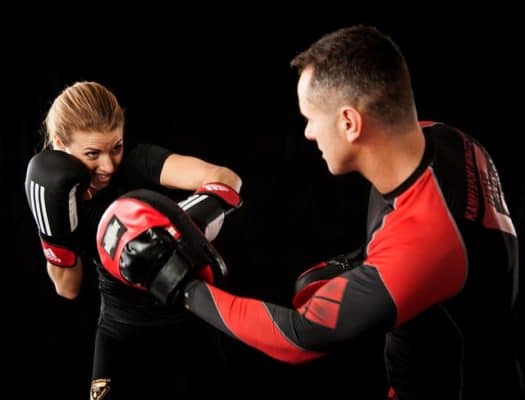
Boxing is one of the oldest martial arts and a very popular choice among ladies. Although it is a very popular sport, boxing will teach you all about real fighting and self-defense. Not a single martial art teaches better footwork, head movement, and how to throw punches better than boxing does. These skills play a key role in any type of fighting scenario you may face.

One of the reasons why boxing is popular among women is the fact that it’s not that hard to master. Boxing is not that versatile as its fighters use only their hands to strike. It won’t take much time for you to learn a proper stance and how to throw basic combos. Of course, boxing becomes a small science as you go further into the pro-competition. But for self-defense, it is not that challenging to master.

Boxing is a bit limited as it teaches you how to strike with hands only. Some people think it won’t help a woman against a male attacker, for instance, as most ladies don’t have big punching power. Still, a mix of proper boxing technique, speed, and a bit of power is often enough to do damage and back off the attacker. A broken nose or jaw can quickly change the course of the fight, and destroy the confidence of the attacker. 

And let’s not forget some key boxing tools like head movement and footwork. Once a person starts throwing strikes at you, you will know how to slip/dodge them, change angles, and fight back with strikes or buy some time to run away. Having good head movement is crucial in a street fight where people tend to swing wild punches without proper technique, which you can all avoid with a few boxing skills. 

5. Judo 

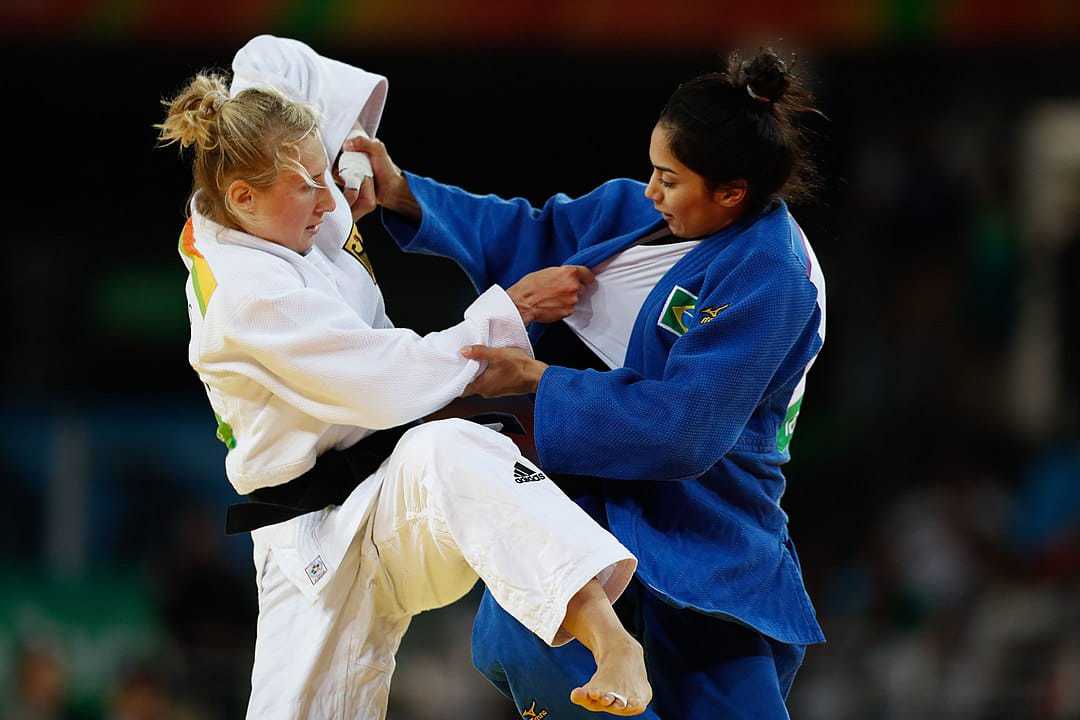
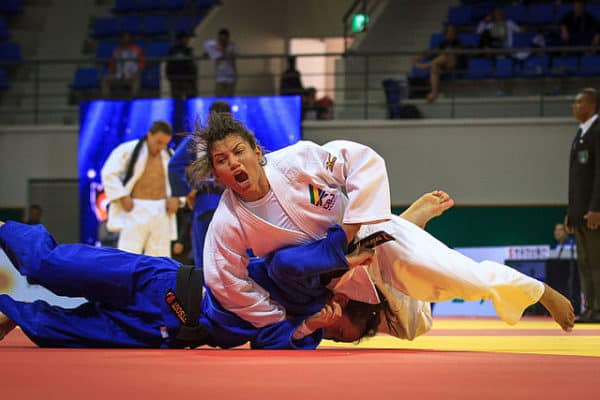
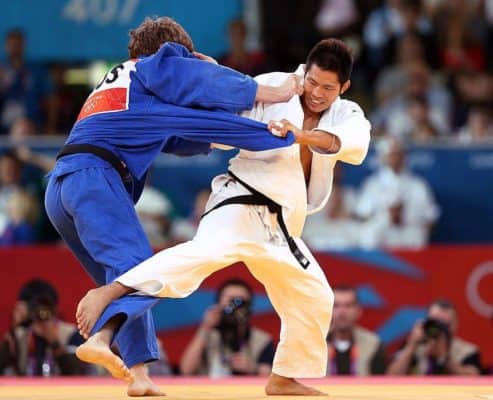
Judo is one of the best grappling arts and a great option for all women who want to learn self-defense. It focuses entirely on grappling and doesn’t include any striking at all. The goal in Judo is to secure a strong grip, use the opponent’s weight against them to throw them off balance, and take them down. Once the fight hits the ground, judokas will subdue the opponent using various pins, joint locks like leg or wrist locks.

Every woman should have at least basic judo skills as it really pays off in a self-defense scenario. This is because street fighting is not a pro match where we have two skilled athletes fighting under the rules. No, most street fights are chaotic brawls at close range that include a lot of grabbing and pulling. And these types of hand-to-hand combat action are where judo shines.

Once the fight breaks out, Judo teaches you not to panic, get a hold of the attacker and secure a strong grip. This stops the attacker from swinging hard strikes at you and allows you to execute various trips and throws. It really doesn’t matter if the opponent is a man or another woman since most average people don’t know how to defend against Judo moves. It is ideal for situations where you don’t have much space to maneuver like in a bar.  

4. Muay Thai 

At first, Muay Thai might not sound like a good martial art for women, as it looks brutal on TV. But in modern days, Muay Thai classes are adapted to the modern lifestyle, and very safe to train in. If you are a woman, there’s no better place to learn how to strike and lose weight than the Muay Thai gym.

Muay Thai is, perhaps, the best striking art that teaches you all about how to use all limbs as weapons to fight at all ranges. You will learn how to throw boxing combos, hard kicks, and fight in the clinch using elbows and knees. The focus is on fighting at distance using kicks, and at close range in the clinch.

It is good for women because it trains them to throw each strike with a lot of power and violent intention. It is notably effective in the clinch which is good because most street fights are close-range brawls. If a person gets in your face for instance or grabs you on the shoulder, Thai boxing trains you to use this to unload with the barrage of elbows and knees. Even if the opponent is a bigger man, elbows, knees and kicks can inflict a lot of pain.  

On top of that, Muay Thai training is cardio-intense and burns up to 1000 calories per hour. If you stick with the classes, expect to get in top shape in a very short period of time.

3. MMA

MMA (mixed martial arts) is the most versatile fighting style on this list. It is great for women because it trains you to use your entire body as a weapon to fight at all places. MMA teaches you how to fight in the standup using strikes, grapple, or fight on the ground. This is the reason why MMA is often seen as a sport closest to street fighting, which makes it close to ideal for self-defense.

As its name suggests, MMA is a mix of techniques from various grappling and striking arts put into one style of fighting. The best thing about it is that includes only the battle-proven techniques that work in real life as well. You won’t spend second learning any fake moves or techniques in MMA.

No single martial art prepares you against different styles of fighting. However MMA students spend time cross-training between the following four martial arts to prepare for different types of fighting styles:

  • Muay Thai (striking, standup)
  • Boxing (striking, standup)
  • Wrestling (grappling)
  • BJJ (grappling, ground fighting)

Although it won’t teach you how to deal with weapons or dirty tactics, MMA is still among the best arts for self-defense. It will make you an all-around fighter and confident wherever the fight takes place. Whether it’s a fight on the feet, on the ground, in a small room, or parking lot, MMA teaches you how to defend against any type of attack.

2. Krav Maga

Founded by the Israeli military, Krav Maga is very good for women as it focuses entirely on self-defense. Krav Maga trains you to fight in various environments, against one or more opponents, and with or without weapons. The main goal of training is to prepare a person for any combat scenario they may face in real life, including warzones.

The main goal is to attack in a blitz, do as much damage as possible, and run away from danger. Students learn various punches, kicks, as well as how to apply or defend against dirty tactics and weapons. There are no rules in street fighting and dirty tactics like groin strikes could save your life.

Krav Maga also touches on how to keep your mind calm and always be aware of the environment you are in. You will train your mind to spot the danger, analyze the situation and make rational decisions. If you are in a bar, for instance, and there is a bottle next to you, Krav Maga teaches you to grab it and blast the attacker with it.

This is what makes Krav Maga better than most other arts on this list. It won’t teach you how to fight in the ring or octagon, against one person, and under the rules. No, it is designed for real life and that’s what makes it perfect for any woman out there. The only downside is the fact that Krav Maga training is really intense, and not for anyone. But you should, at least, try it.

1. Jiu Jitsu (BJJ)

Photo by Richard Presley

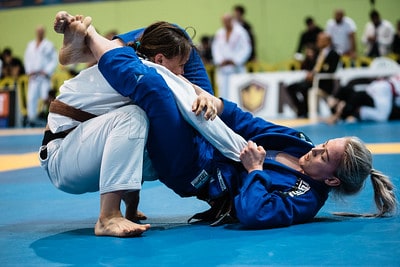
BJJ is the most ideal martial art for women, and it’s really hard to argue against that. It is one of the arts with the lowest injury rate, most effective for self-defense. It is the only art that is so effective that even a small person can learn to defeat a stronger and bigger opponent.

BJJ is an art that focuses entirely on grappling and ground fighting. It doesn’t include any striking which is the reason why the rate of injuries is really low. Strikes and the force of impact are the cause of most injuries in training. BJJ is not 100% safe by any means, but rolling on the ground is much safer than trading punches. And this is one of the reasons why so many women are joining BJJ classes.

BJJ has its origins in Judo and will teach you how to secure a strong grip, and execute a throw to take the opponent down. The main goal is to do this as fast as possible since the emphasis of the art is on ground fighting and using various positions, escapes, joint locks, and chokes to beat the opponent.

This is ideal for women because you don’t have to be strong or athletic to take the opponent down or submit them. No, the focus is on leverage and technique. Even if the opponent is bigger, they will have a hard time defending because sheer power won’t help them much against BJJ moves. 

BJJ skills keep you safe even if the attacker manages to take you down, which often happens when a man attacks a woman. You will know how to fight off your back using various joints locks, escapes and sweeps. But still, bigger and stronger attackers would most likely have a hard time keeping you on the bottom or defending against your submissions as most people do not know how to fight on the ground.

If you want to learn more about why BJJ is the best martial art for women, click here to find out 10 Most Compelling Reasons Why Women Should Learn BJJ.

Related Questions

What is the best martial art for a petite woman?

Petite women have more than one option when it comes to self-defense training. In fact, some of the very best fighting systems like Krav Maga and BJJ are ideal options for petite women.

Krav Maga is often seen as the best fighting system for self-defense that is still used by the Israeli military. It is great for women of all sizes as it teaches you how to fight according to your strengths and weaknesses. Krav Maga teaches you how to always use your strengths in a fight, which in the case of petite women are speed and mobility.

BJJ might be even better as it is the only fighting system that allows a smaller person to beat a bigger attacker. The main focus of BJJ is on leverage and techniques that a person can’t defend against relying just on their strength. Despite being small, you can still win a fight with chokes, joint locks, or throws. Even if the attacker takes you down, BJJ teaches you how to fight off your back, and its techniques work against people of all sizes, genders, or ages.

What Is The Gracie Diet? Basic Overview

0

There are many diets out there, all claiming to be the best at keeping your weight down. If you’ve heard of the Gracie Diet, you probably know that it’s not like a normal diet. To the Gracie family, dieting seems to be a way of life. Members of the Gracie family are healthy and full of life and seem to have the same fascination with watermelon juice. If your curiosity has led you here, this article outlines the basic principles of the Gracie Diet in a way that is easy to understand.

The Gracie Diet involves mixing foods from six categories in a way that reduces fermentation and maintains a balanced pH. Pork is prohibited, alcohol and tobacco are discouraged and meals are consumed 4.5 hours apart for digestion. Benefits include better short and long-term health and weight loss.

There is so much more to the Gracie Diet than can be explained above. Below you will find a detailed summary of what this diet involves, including how it works with Jiu-Jitsu training.

Gracie Diet Explained

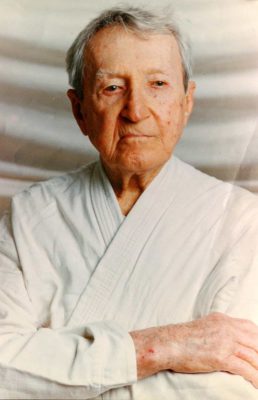
Carlos Gracie Sr.

The Gracie Diet was developed by Carlos Gracie Sr., one of the co-founders of Brazilian Jiu-Jitsu. It primarily outlines which foods can be eaten together by categorizing them into six different groups. These categories are outlined below. The diet also outlines how often you should eat, including some periods of fasting, which I will explain further down.

Gracie Food Categories

  • Group A: Vegetables, greens, fats, oily foods, meats and seafood.
  • Group B: Starches and Flour. For example, Oats, Pearl barley, Corn flour, Potato, Rice, Rye, Soybean, Wheat, Macaroni and Lentils.
  • Group C: Sweet fruits/foods, fresh and creamy cheeses.
  • Group D: Acidic fruits.
  • Group E: Raw bananas.
  • Group F: Milk.

This range of foods does not include pork, which is prohibited in the Gracie Diet. The diet also discourages the consumption of alcohol and tobacco. The foods that are able to be consumed focus on balancing pH levels, making the overall meal as neutral as possible. This means that some groups of foods cannot be eaten with others. These rules are detailed below.

  • Group A: Combine together and with foods from Group B.
  • Group B: Do not combine together. Combine with groups A, C or F. 
  • Group C: Combine together and with foods from Group B.
  • Group D: Do not combine together or with any other group.
  • Group E: Combine with Group F (milk) and selected foods from Group C. Do not combine with groups A, B and some of Group C.
  • Group F: Combine with Group B and selected foods from Group C. Do not combine with Group A and some of Group C. 

The Purpose of Gracie Diet 

The Gracie Diet is designed to improve your quality of life by maintaining a healthy body over a lifetime. The combination of foods mentioned above promotes easy and effective digestion, reducing acidity and fermentation in the digestive tract. It also minimizes the amount of toxins that enter our bodies through poor eating or unknowingly consuming chemicals from the production process.

The Gracie Diet was used to supplement medicine with healthy eating. It was designed to keep the body strong and healthy at all times so that the Gracie family could defend their family’s honor in a fight at any given time. This diet was refined over 65 years and tested on Carlos’ own children and grandchildren, with great results. Carlos’ descendants thrive today and have maintained their family legacy of some of the best fighters in the world.

Gracie Diet Benefits

The benefits of the Gracie Diet relate to your long-term health. Growing up, Rorion Gracie was told that following the Gracie diet would pay off after he turned 50 years old. Once he surpassed this age, he noticed that he was free from most of the health concerns of others his age and that his energy levels allowed him to do the physical activities he used to do in his 20’s.

Rorion followed the Gracie diet from a young age, showing its benefits in preventing many diseases. The theory behind this is that the digestive imbalances and consumption of trace toxins in our food build up over many years, contributing to common ‘age-related’ diseases. By minimizing these toxins and bad reactions, their effects don’t accumulate as we age and we are healthier in the long term.

In addition to this, the Gracie Diet has also been known to reverse poor health. One example that is shared in the Gracie Diet book involves a head physician, who had been suffering from a bad ulcer, being convinced by Carlos Gracie to try the diet. He was scheduled for surgery and allowed Carlos to take charge of his diet in the meantime. Within two weeks, the ulcer had completely healed.

The Gracie Diet can also help with weight loss. The consumption of healthy foods naturally reduces the ratio of body fats. However, in order to actively lose weight on the Gracie Diet, calorie counting and being active is recommended to burn more energy than you consume.

How to Follow Gracie Diet 

Preparing Your Food

Preparation of your food makes a big difference in how many toxins enter your body through your diet. The Gracie Diet recommends washing your hands before every meal, thoroughly washing all fruits and vegetables before they are consumed and peeling any fruits that may contain pesticides in their skin.

When to Eat

If you follow the Gracie Diet, you should aim to eat three meals every day. These meals should be spaced out by at least 4.5 hours to allow the stomach to fully empty before the next meal. The theory behind this is that the digestive tract needs time to rest between meals and constantly introducing foods increases the chance of poor chemical reactions.

The Gracie diet also promotes fasting for one day every month. This is mostly recommended for people over 40 years old, but can be performed by anyone to help cleanse the body.

 In regard to portion sizes, it is recommended that you eat until you are approximately 80% full. This allows you to enjoy your food without over-filling yourself. Sometimes it takes a while for our bodies to register that they are full and satisfied.

What to Drink

Between meals, you should only drink plain water or coconut water as these are not counted as a food group. However, during mealtimes, you can drink anything that adheres to the Gracie food combinations. Below are drinks that can be consumed during mealtimes and which category they fall under.

  • Vegetable Juice: Group A
  • Sweet Fruit Juice: Group C
  • Tea: Group C
  • Milk : Group F
  • Banana Smoothie: Groups E and F
  • Acidic Fruit Juice: Group D
  • Water and coconut water (can be consumed anytime)

Keep in mind that acidic fruits cannot be consumed with any other food. They cannot even be consumed with another acidic fruit. Therefore, eating an acidic fruit or having acidic fruit juice (such as orange juice) will be the only thing you can eat for that meal. You would also need a lot of the same fruit to feel full.

All other drinks can be consumed with a decent meal. For example, vegetable juice can be consumed with meats, fats and starches. Therefore, vegetable juice might be a good option for larger meals where you can consume carbohydrates, fats and protein.

However, the safest drinking option is water and coconut water, as I mentioned above. These do not restrict what you can eat with them and therefore you have more options for your meals.

What Should I Eat Before Jiu-Jitsu Training? 

The Gracie Diet was designed to “ensure that all family members were ready to uphold the Gracie name in an unarmed fight with anyone, anywhere, and at any time.” (The Gracie Diet, p. vi). For this reason, if you follow the Gracie Diet, your body will be prepared for Jiu-Jitsu training at any time. It should have an abundance of nutrients and energy available to get you through the lesson.

With that said, the timing of your meals is something that you should consider. Healthline (link to website) recommends waiting 1-2 hours before exercising after a main meal. This is because most people experience stomach upset if they exercise on a full stomach.

The Gracie Diet recommends spacing your meals out by 4.5 hours. Therefore, if you eat two hours before a one-hour training session, you can eat your next meal 1.5hours after the session. This is a good amount of time to cool down, have a shower and get changed before your meal.

This spacing will allow you to have enough energy, while also reducing your chances of having an upset stomach during training. The type of meal you have is entirely up to you, provided you stick to the Gracie recommendations for food combinations.

What Should I Drink Before BJJ?

It is important to have enough energy for BJJ training. However, unless you are eating a meal, the Gracie Diet only allows water or coconut water between meals. If you follow the recommendations above and eat 1-2 hours before training, you will be limited to these two options.

Of the two, coconut water is the better choice for before and after exercise. Not only does coconut water hydrate you, but it also contains a number of essential nutrients. According to Healthline (link to website), you will receive the following nutrients in every cup of coconut water.

  • 9g of carbohydrates
  • 3g of fibre
  • 2g of protein
  • 10% of your recommended daily intake (RDI) for Vitamin C
  • 15% of your RDI for magnesium
  • 17% of your RDI for manganese
  • 17% of your RDI for potassium
  • 11% of your RDI for sodium
  • 6% of your RDI for calcium

How Do I Recover From Jiu Jitsu

Recovering from Jiu-Jitsu requires you to stretch, stay hydrated and replenish your energy stores. On the Gracie Diet, this involves drinking water or coconut water immediately after the training session. Coconut water will provide more nutrients to replenish your body, so is a good option after your session. 

However, if you are following the recommended guidelines above, you will be ready for another main meal within 1.5 hours of finishing the Jiu-Jitsu session. This means that your energy and nutrient stores will be replaced soon anyway, so drinking plain water is also fine.

Judo vs. Sambo – The Fundamental Differences

0
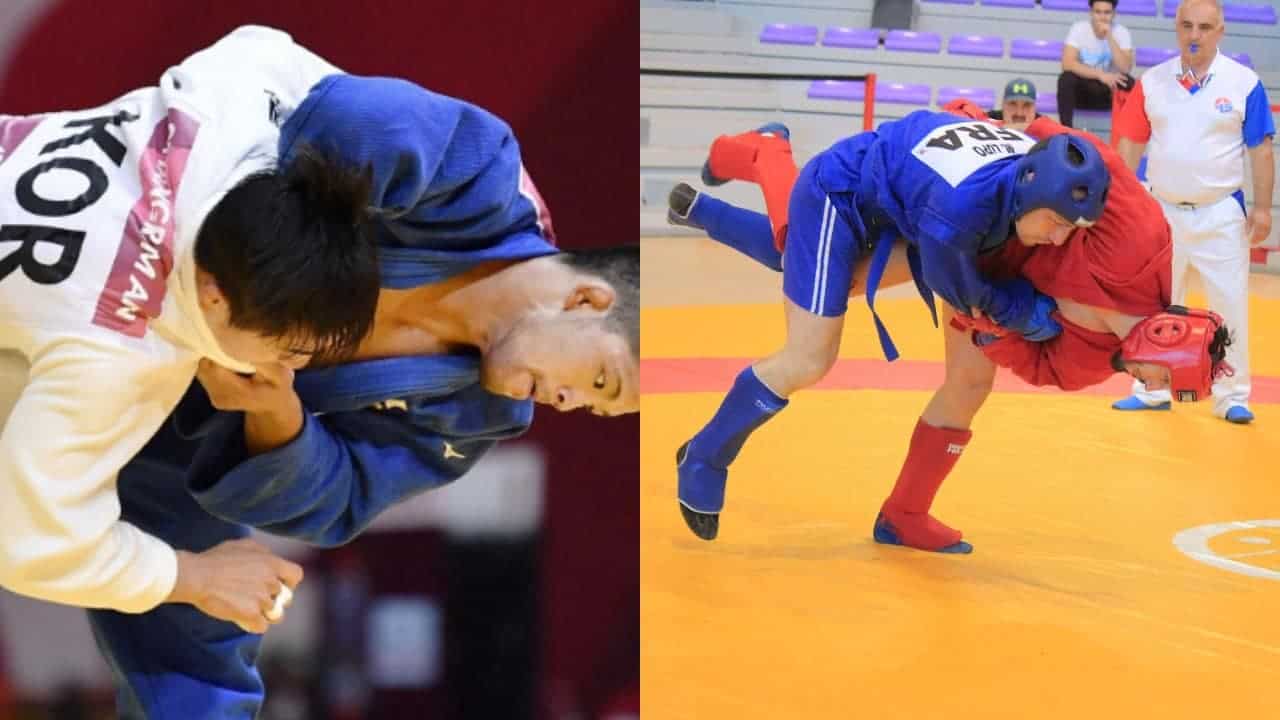
Photo by CFS SAMBO FRANCE

There are many combat-style sports and martial arts that resemble each other and seem to have similar techniques. Sambo and Judo are two styles that often seem similar to each other, but when you take a close look at each fighting style, there are some significant key differences between the two.

The crucial difference between Judo and Sambo is that Judo was designed to be practiced for self-defense, mental and physical benefits, and as a sport for everyone. Conversely, Sambo was designed exclusively for the Russian military to prepare for brutal hand-to-hand combat situations.

When you take a cursory look at Sambo and Judo, they seem to have many similarities, especially with the grappling-type techniques. While this observation is true, and they certainly do have some similarities, there are fundamental differences between Sambo and Judo that distinguish each from the other.

What Are The Fundamentals Of Judo?

Photo by Korea.net

Japan has been the birthplace of many martial arts, and this includes Judo. It is considered to be a modern martial art because it is a relatively young fighting style, developed in 1882. This is considered young because many other martial arts can trace their roots back for many centuries in their country of origin.

The creator of Judo was a Japanese educator and athlete by the name of Jigoro Kano, and he based his development of Judo on Japanese Jiu-jitsu(Also known as Jujutsu). 

The fundamentals of Judo include the following aspects of martial art.

  • The takedown. One of the main objectives in Judo is to throw or takedown an opponent onto the mat or the ground.
  • Subdue an opponent. Subduing an opponent by immobilizing them with a prescribed pin technique.
  • Force a submission. A submission can be forced in Judo by executing a choke or a joint lock which results in the opponent submitting.
  • Strikes. Judo does include training for strikes with both the feet and the hands, but only in the form of pre-arranged kata. They are not allowed during Judo competitions or during free practice sessions. Strikes are not taught as a means of attack or to subdue the opponent but are used to teach a student how to deal with a strike.
  • Weapons. Judo includes training with weapons, but the weapons are used to teach Judoka or practitioners how to defend against a weapon. They are never taught as a means for attack.

Judo rules do not allow the attacking of any joint of the body other than the elbow. It is illegal to touch the face of an opponent when you are training or engaged in a Judo match.

Recent changes to Judo have made leg takedowns and leg attacks illegal moves in the sport; however, if you train traditional or old school Judo, you will still be taught these techniques.

What Are The Fundamentals Of Sambo?

Photo by President.az

If Judo is considered a modern fighting style because of its recent origins, Sambo is an even younger fighting style. Sambo is a combat-fighting style that originates from Russia and was developed in the 1920s.

Sambo was originally developed for the Soviet military as a means of unarmed combat and had its foundation in many different martial arts, including Judo, Jui-Jitsu, boxing, Greco-roman wrestling, and other martial arts.

The intention around the development was not as a sport but as a form of unarmed combat for soldiers. The military form of Sambo is referred to as Combat Sambo, and the sport version of the fighting style is referred to as Sport Sambo.

Sport Sambo’s techniques and moves are akin to judo and wrestling without striking techniques. In contrast, Combat Sambo involves many more forms of attacks and strikes, including head strikes, which are more appropriate for a soldier in a life-and-death situation than a sport.

The fundamentals of Combat Sambo include the following techniques and philosophies.

  • Win at all costs. Combat Sambo’s philosophy is to win at all costs because if you lose, it could cost you your life.
  • Strikes. Combat Sambo actively uses strikes, including using the head as a weapon, elbows, and hands.
  • A wider range of grappling techniques. A wider range of grappling techniques are used in Combat Sambo, including takedowns by the legs.
  • Weapons as a form of attack. Combat Sambo includes teaching how to use various weapons as a tool to attack the opponent.

Sport Sambo bears a closer resemblance to Judo and includes the following.

  • Grappling. Sport Sambo includes many grappling techniques that were incorporated into the style from wrestling.
  • Takedowns. Takedowns are taught using a combination of techniques from Wrestling and Judo.
  • Leglocks. Leglocks are used both as a form of takedown and to generate a submission.
  • Submission holds. Submission holds, and joint locks are taught targeting joins of the arms and the legs.
  • Strikes. Strikes are not allowed in Sport Sambo.

Sport Sambo more closely resembles Judo because it is basically Combat Sambo that has been toned down to be a sporting activity rather than a life and death fight.

The Key Difference Between Judo And Sambo

Even though Sambo and Judo have a lot of similarities, there are some key differences between the two combat styles, mostly because of Sambo’s adoption of techniques from other fighting styles.

The main differences between Sambo and Judo that differentiate the two fighting styles are as follows.

  • Judo allows for chokeholds, but this is an illegal move in Sambo.
  • Modern Judo does not allow for leg takedowns or leg attacks. These moves are sanctioned in Sambo.
  • Judo teaches the philosophy of peace and has a spiritual and morality component that is taught as part of the fighting art. This is not the case in Sambo; it is strictly a fighting sport.
  • Sambo was created for the military, while Judo was created as a sport.
  • Up until 2020, Sambo did not have a belt grading system. Judo has had a belt grading system since its inception.
  • Judo is an Olympic sport but Sambo is not yet accepted as an official Olympic sport.

Is Judo Or Sambo More Effective In Self Defense?

Judo is a fighting style that is oriented around defense, while Sambo promotes attack. Even though there are differences between the moves and philosophies of these two fighting styles, they are both very effective styles for self-defense.

Sambo would be the more effective fighting style for self-defense over Judo because it incorporates a wider range of grappling and takedown techniques that are not taught when learning Judo. This is not to say that Judo is ineffective for self-defense, just that Sambo is a more robust system that better prepares you in self-defense situations.

If you are competent in Judo, it will most certainly be to your advantage when you need to defend yourself. Most attackers would be unfamiliar with Judo and would be surprised by the Judo techniques that are used against them.

Judo teaches you to put your opponent down, and once your attacker is down, you can make your escape to safety.

Sambo has many more moves and techniques that are taught as part of the style, including takedowns using your legs and targeting the legs of your attacker. This would give you a greater number of options when called upon to use your skills for self-defense.

Both Judo and Sambo are effective as self-defense fighting skills, and the techniques learned in both fighting styles will serve you well if you need to use them to defend yourself.

Which One Should I Choose Judo Or Sambo?

The decision regarding which fighting style you should choose to learn will depend on several factors. The first being personal preference.

If you like the history and the whole being aspect of Judo which includes training body, mind, and spirit, then Judo would be the more appropriate style to chose.

If you are only interested in learning self-defense skills, then Sambo would be the better of the styles to choose to learn.

Another influencing factor may be availability. There are many more training facilities offering lessons in Judo than there are offering training in Sambo.

If Sambo is not offered in your location, start off with Judo. The skills you learn in Judo are useful and have relevance should the opportunity to learn Sambo should present itself for you in the future.

Conclusion

Even though Sambo and Judo have many points of similarity, the key differences in the philosophy and techniques between the two styles make them unique and separate from each other.

Both styles are great to learn from a self-defense point of view, but if you are looking to get into MMA, Sambo would be the better style to focus your attention on.