Home Blog Page 18

Taekwondo Belt Ranking System – EASILY Explained For Beginners

Taekwondo(TKD) is one of the most popular martial arts that is well spread all around the world. Like most other traditional martial arts, Taekwondo training also includes a belt ranking system and strict promotional criteria. But how many color belt ranks are there in Taekwondo?

The number of colored belt ranks varies between the two main styles of Taekwondo, WT and ITF. In ITF, the color belt ranks start from the 10th geup (white belt), all the way down to the 1st dan (black belt). WT belts start from the 12th geup (white belt) to the 1st dan (black belt).

This is just a brief explanation of the Taekwondo belt ranking system. Be sure to read this article to learn more about the color belt ranks, and how this system works.

History of Taekwondo belt ranking system

TKD emerged in the 1950s in South Korea, however, the concept of belt ranking used in TKD has been around for much, much longer. The thing is, Hong Choi and members of other kwans (dojos) that created TKD didn’t invent the color belt ranking system. No, they have actually adopted color belts from Judo, and like most other arts, modified it to suit their system.

The story of the Taekwondo color belt ranking system began in the 20th century in Japan. At the time, Kano Jigoro, a martial art genius who created Judo, was working on developing a unique grading system. His main idea was to create specific ranks that will separate students and competitors by the level of proficiency. The idea of colored belts came after he played the famous Japanese strategic board game called “go” which is similar to chess. The initial colored belt ranking concept had just four belts and many more would follow in the future:

  • White
  • Blue
  • Brown
  • Black

The system Kano Jigoro had created was so practical that many other martial arts like Karate, BJJ, and TKD have all adopted this concept. Of course, each of these arts has modified the system according to its needs, but the core of the concept remained the same.

Taekwondo Belt Ranking System Explained 

There are two main belt ranking systems in Taekwondo: WT and ITF, and you are going to learn all about both in this article. The most important thing to remember is that the ranking system in both styles is separated into two groups:

  • Junior group (color belts “geups”)includes between 10 (ITF) and 12 (WT) color belts and each rank is called “geup”. The beginners always start by wearing a white belt, and they have to go through eight more color belt ranks before reaching the final, black belt rank.
  • Senior group (black belts “Dan”)is made up of nine different black belt ranks and each rank is called “dan”, which is a Korean word for a “degree”. Students start the “dan” rank when they complete all the ranks in the junior group.

TKD Senior (Dan) belt levels are the same in WT and ITF styles of Taekwondo but junior belt ranking systems are different. Here is a list of all the junior(geups) color ranks. 

International Taekwondo Federation (ITF) junior belt ranks:

World Taekwondo (WT) belt ranks: 

LEARN MORE
Check out our article on Karate Belt Ranking System – EASILY Explained For Beginners

How Do You Progress in Taekwondo?

To achieve a higher rank, all TKD students need to pass a specified belt test, and the promotional testing is organized every two, three or four months depending on the school. Tests usually include a panel of judges and coaches in front of which students need to perform. Each student must demonstrate a high level of technical and tactical proficiency required for the rank they want to achieve. Tests are usually not hard to pass in the lower ranks, but get tougher with each higher rank. In most schools, students are required to perform:

  • Patterns/forms (Poomsae) which include different blocks, punching and kicking combos. Each student is performing alone and they must execute all of the techniques in perfect motion and without mistakes.  
  • Sparring against other students to demonstrate a practical application of the techniques in a real fight
  • Breaking boards to display power and control
  • Perform physical exercises to demonstrate the required fitness level
  • Theoretical test where students need to answer questions about terminology, different concepts, and the history of Taekwondo.
  • In senior (dan) ranks, students need to pass a written test before they can move to the practical test.

In some schools, students also need to show consistency and loyalty to get promoted to the next belt. They must show up to the dojo at least 3 times a week, and even attend special training classes to prepare for a test. They must also show loyalty to the school by attending promotional events, and following all the rules and regulations.

How much time it takes to move from one rank to the next truly depends on the level you are at. Students in the lower ranks tend to progress much faster because tests are not that complex. They usually need to show an improved level of fitness and perform between 8 and 9 offensive and defensive forms. But, tests get more difficult and progress slows down when they reach intermediate and advanced ranks.

Next, bear in mind that the criteria and time that you need to move from one rank to the next one depends on the school. Promotional tests in some schools are not that difficult and you can climb through the ranks much faster. However, reaching a black belt in a short time span comes at a certain price as you won’t be as proficient as students who train in traditional dojos where promotional criteria are strict.

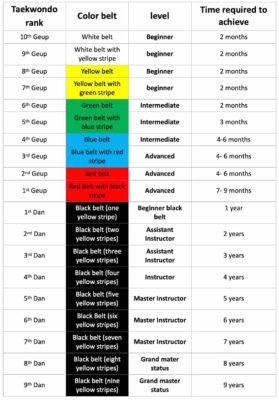
How Long Does it Take to Get Each Belt in Taekwondo?

Here is a detailed look at how long it takes to get each color belt in taekwondo. However, the following guidelines are for those who are committed to training at least 3 times a week.
How Long Does It Take to Get a Black Belt in Taekwondo?

On average, it takes between 3 and 5 years for a student with average talent and fitness level to reach a black belt rank (1st Dan) in Taekwondo. As in other sports, the exact time depends on many factors like your talent, fitness level, dedication, and passion. But bear in mind that is almost impossible to achieve a black belt rank in less than 3 years due to the strict promotion criteria.

However, there are schools where promotional criteria are not at the highest levels. In fact, it might be very low and these schools allow their students to progress through the ranks fast, and reach a black belt in less than 3 years. In fact, some schools go even further by guaranteeing that you are going to reach a black belt rank in 2 years for example. You should avoid this type of low-quality martial arts school.

Owning a black belt is great but it’s useless in this case simply because you won’t be skilled enough to be a TKD black belt. Or in other words, a legitimate blue belt who trains in a traditional dojo with the highest standards of promotion might be far more skilled than someone who got their black belt in 2 years. Also, students who got their black belts in a short time usually do not perform well in the competition. Therefore, if you want to be good at TKD, it’s in your best interest to avoid any school that offers you a fast track program to black belt .

LEARN MORE
Get the full report on Is Taekwondo Worth Learning? Here’s What You Need to Know

What is the Highest Degree of TKD Black Belt You Can Earn?

The highest degree/rank in Taekwondo is the 9th Dan Black Belt that is also known as “Grand Master” rank. This is also the highest rank that is awarded to the living people as the “10th dan black belt” is usually awarded posthumously. The only exception made was when Kim Ki-Wang received a 10th dan rank while lying in the hospital bed shortly before he died of cancer in 1993.

In WT, there have been 6 “10th Dan” black belts and 45 “9th Dan” black belts, while ITF has 39 “9th Dan” black belts and not a single person owns and 10th dan. The people with the highest 10th dan rank in WT are:

  • Choi Joon 
  • Lee Moo-yong 
  • Kim Ki-whang
  • Lee Jong-soo (aka: Chong Lee)
  • Sell Edward B
  • Pan Sim-woon

TKD Belts vs Karate Belts – Difference and Comparison

The belt ranking systems in Taekwondo (ITF) and most styles of karate are very similar because the concept is the same. Both of these arts have adopted a color belt rank from Judo created by Kano Jigoro. And, both TKD and karate include two separate belt ranks for junior and senior students with the number of ranks being the same.

For example, TKD includes 10 different color belt ranks called “geup’ for junior students, and additional 10 “Dan” ranks for senior students. Karate on the other hand also has 10 junior ranks called “Kyu”, and the same number of Dan ranks, 10. The main differences are the belt colors and the time you need to spend training to move from one belt to the next one. Here is a detailed comparison:

LEARN MORE
Check out our article on Karate vs. Taekwondo: Key Differences And Similarities

Related Questions

What MMA fighters are TKD black belts?

Throughout MMA history, there have been many Taekwondo black belts who enjoyed a lot of success competing at the highest levels of modern MMA. The following is a list of some of the most famous ones:

  • Rose Namajunas — is the UFC strawweight champion and one of the most famous UFC fighters. She started training Taekwondo at the age of 5 and had reached a black belt rank just four years later. Inside the octagon, she shines with various TKD kicks like axe and front kicks.
  • Yair Rodriguez — is a UFC fighter who is probably the best example of TKD in modern MMA. He is one of those awkward fighters who does not hesitate to throw flashy jumping and spinning kicks.
  • Anderson Silva — is one of the greatest UFC fighters of all time who has a strong background in TKD where he is a 5th Dan black belt. This makes him one of the highest-ranking TKD practitioners in MMA.
  • Valentina Shevchenko — is the UFC champion and a master in many martial arts, including Taekwondo where she owns a 2nd Dan black belt rank.
  • Anthony Pettis — is the former UFC lightweight champion who has been training in Taekwondo since the age of 5. By the age of 18, Pettis was already a 3rd Dan black belt.

Who is the father of Taekwondo?

South Korean Army general Choi Hong-hi is widely regarded as the father of Taekwondo. Choi played a big role in the development of TKD back in the 1940s and 1950s, but bear in mind that he didn’t create TKD alone. He was the founder of the first “International Taekwondo Federation” and its first president. Although Choi didn’t develop TKD alone, he is directly responsible for regulating TKD and making it popular all across the world.

LEARN MORE
Check out our article on Bruce Lee – Why He Is Considered The Father Of MMA
Is BJJ Effective In a Street Fight? (FAQ for Beginners)

0

Brazilian Jiu-Jitsu(BJJ) has unequivocally proven by UFC fighters that it’s a very effective martial art inside the UFC octagon. As such many people seek to learn this effective Brazilian art to enhance their self-defense skills outside the octagon, in case they find themselves in an unexpected street fight situation. But is BJJ effective in a street fight?

Brazilian Jiu-Jitsu is effective in a street fight because it allows you to control an attacker without needing to throw strikes, which can be chaotic and dangerous both to the striker and the recipient.

BJJ is no doubt an effective martial art that works in a street fight. But just like any other martial arts, there are things that make it very effective and not so effective in a street fight. Let me explain further why BJJ is effective and has its limitations if you are new to BJJ.

What is Brazilian Jiu-Jitsu(BJJ)?

Brazilian Jiu-Jitsu is a grappling-centered martial art which descends from Japanese Jiu-Jitsu. It came about in the early twentieth century with Japanese Judokas travelled to Brazil and taught a variety of techniques which had been removed from sport Judo. 

Since the inception of BJJ, its effectiveness has been demonstrated countless times in mixed martial arts(MMA) and many military and law enforcement organizations practice it all over the world.

BJJ is one of the fastest-growing martial arts in the world, as a result of its use by mixed martial artists, its appearance in films such as John Wick and because of its celebration by popular podcasters such as Joe Rogan and Jocko Willink.

LEARN MORE
BJJ vs Japanese Jiu-Jitsu – Key Differences and Similarities

How is BJJ Different From Other Martial Arts?

When we hear the phrase “martial arts”, we often tend to think of stunning spin kicks and breaking boards, commonly seen in Taekwondo and Karate. While these attacks can be devastating when trained over a long period of time, they are arguably too chaotic to be truly practical in a street fight. BJJ is a grappling martial art, which largely involves grabbing an opponent to take them down, then submitting or restraining them there.

BJJ enables a smaller person to defend themselves against a bigger opponent by utilizing techniques that do not require much strength. As a whole BJJ was designed for smaller people to defend themselves by focusing on techniques than relying on brute forces to defeat their opponents.

Brazilian Jiu-Jitsu is designed to be highly practical and is simplistic enough that despite having a steep learning curve can be taught to virtually anyone who invests the time and patience in.

Why Is BJJ Effective In A Street Fight?

Neutralize opponent’s strikings:

BJJ is effective because it allows a practitioner to take their opponent to the ground and control them with various pins and submission holds, such as chokeholds, leg and foot locks and armbars. It encourages a user to get in close to their attacker, as this reduces the distance needed for punches or kicks to gain momentum. 

A very few people know how to fight on the ground, Jiu-Jitsu provides the tools to make an assailant feel like they are drowning under pressure. 

BJJ can allow a much smaller combatant to restrain, or overcome a larger adversary:

The fact that BJJ techniques can make a BJJ student competent enough to handle larger, stronger opponents can make the art useful for smaller people at risk of physical assault including smaller women by focusing on techniques than strength to defeat their assailants.

Allows you to safely subdue an opponent:

Being able to control someone without striking them also reduces the risk of “one-punch” deaths, which sadly happen quite often in today’s society. If you can hold an attacker down, sap them of their energy until further help arrives, you may be less likely to face legal repercussions of harm caused by strikes, as you will have shown restraint while protecting yourself.

The following video shows a former UFC fighter Matt Serra easily handling an aggressive drunk person by utilizing a BJJ full mount move until police arrive.

BJJ teaches you how to fight on the ground:

BJJ practitioners are also very versed in fighting off of their back, meaning that if they are taken or knocked down, they are more likely to have the skills to hold an opponent, sweep them or generally just prevent them from inflicting more damage. Fights often end up on the ground, so this is a great advantage. BJJ can also be used to get an attacker off of you, so that you can stand up while protecting yourself to make an escape from the situation.

On a side note, it has to be noted that sparring or “rolling” is a very common BJJ training method, which is a way to put into practice some of the techniques in a live, semi-realistic manner. While it almost never involves striking, it is a great way of developing the muscle memory and understanding of balance and coordination.

What Are the Disadvantages of Brazilian Jiu-Jitsu?

Can’t handle multiple attackers:

While being able to go to the ground with one opponent may allow you to control them and greatly reduce the damage they can do, if they have accomplices, you may very quickly find yourself on the receiving end of kicks or stomps to the head and body. 

When facing multiple attackers, it is almost always best to try and flee the scene. In this instance, few martial arts will be as effective as a good 400-meter sprint.

BJJ does not teach striking:

A very few BJJ instructors teach striking, or a significant way to defend from strikes, barring ducking and shooting for a single or double leg takedown. There are some instances when a good knowledge of striking will be useful, again, when attempting to stave off multiple attackers.

Who Benefits the Most from BJJ?

As to the question of who benefits from learning BJJ the most, this largely depends on the reasons someone chooses to learn the art. It offers various health benefits such as core strength, cardiovascular exercise and conditioning, alongside its self-defense uses.

From a self-defense aspect, it can be argued that as smaller BJJ students can overcome larger, stronger opponents, smaller people tend to gain the most.

Does Brazilian Jiu-Jitsu Use Any Strikes?

As a general rule, no, there is no striking in BJJ. While it isn’t unheard of for BJJ practitioners to be taught striking, particularly in mixed martial arts gyms, or in gyms with those practicing Combat Jiu-Jitsu (effectively BJJ with open hand strikes), the vast majority of BJJ instructors will put emphasis solely on ground fighting. Striking someone during a sparring session is incredibly frowned upon and it is entirely illegal in competitions.

Is BJJ Hard to Learn?

BJJ is considered fairly difficult to learn – for most people, rolling around grappling with someone may not feel particularly natural to start off and they will need to overcome the barriers presented to themselves by their ego.

BJJ requires a significant time investment to see results. When starting off, it may take training 2-3 times a week for about six months before a student is competent enough to defend themselves.

LEARN MORE
Still curious? Click here to find out Is BJJ Hard To Learn? A Guide For Beginners

Which is More Effective Gracie Jiu-Jitsu or BJJ?

As a general rule, Gracie Jiu-Jitsu focuses more on self defense than Brazilian Jiu-Jitsu. BJJ, on the other hand, is designed more for the sport of grappling. Therefore, Gracie Jiu-Jitsu is arguably more effective when it comes to self-defense.

When you learn Gracie Jiu-Jitsu, instructors will teach you passed down knowledge from the Gracie “lineage”.  Helio Gracie was one of the progenitors of the art, having being taught various techniques by the Japanese Jiu-Jitsu/Judo artist, Maeda. 

For self-defense purposes, it is worth studying “the Gracie combatives” – an instructional DVD which teaches 36 “essential” lessons which were originally developed for the US Army but can be used for street defense.

LEARN MORE
Get the full report on What’s the Difference Between Gracie Jiu-Jitsu and BJJ?

Related Questions

BJJ vs Krav Maga: Which is Better for Self-Defense?

Krav Maga is the art used by the Israeli military forces and was originally designed by boxer, martial artist and sportsman, Imi Lichtenfeld for oppressed Jews to protect themselves from physical attacks in Eastern Europe during the 1930s. In some ways, it is similar to Bruce Lee’s Jeet Kune Do, a system which was primarily about using what works for each individual, on their own terms.

Krav Maga borrows techniques from many different martial arts, including Wing Chun, Muay Thai and on occasion, even BJJ.  

Like Jeet Kune Do, some would argue that Krav is more of a “mentality” or a “system” than a martial art on its own. The teaching of this system can wildly vary in quality, due to a certain amount of commercialization of the art. It tends to favor “extreme” attacks – eye gouges, throat shots and palm-heel strikes, which can be deadly but they are difficult to train in a sparring scenario, as this would be too dangerous for a training partner on the receiving end of these attacks. This makes some of the training more conceptual than practical and relying on these techniques when the fight or flight reaction kicks in may not be a good idea.

If you are able to learn Krav Maga effectively, then it can be very good for handling multiple assailants and making a getaway. However it should be noted that unlike BJJ which can be used to restrain someone in a controlled manner, Krav Maga’s attacks may land you in a lot of legal trouble as they are designed for warfare.  

BJJ vs Wrestling: Which is Better for Self-Defense?

Wrestling is a fairly-broad umbrella term for various forms of sport grappling found all over the world.  Almost all cultures have their own grappling arts, but perhaps the most widely practiced versions are Greco-Roman, freestyle and catch wrestling. Like BJJ, most wrestling forms can be used to close the distance and restrain an opponent, but there are a number of key differences.  

Firstly, sport wrestling is much more concerned with pinning and holding an opponent down than submitting them with joint locks or chokeholds. This means that there is an arsenal of weapons which the wrestler tends to lose out on.

Secondly, BJJ coaches tend to focus a lot more on what happens after the fight has gone to the ground, than the standing grappling, or takedown game. This can sometimes be a hindrance as you may still be in danger of being on the receiving end of strikes. Wrestlers are generally more effective at taking their opponent to the ground. On the flip side of this, wrestlers don’t spend a great deal of time learning how to fight off of their backs, or utilize the various useful guard positions which BJJ practitioners do.

It should be noted that the focus on conditioning which wrestlers have can be fantastic for having the endurance and toughness required to survive the most dangerous of scenarios.

BJJ vs Judo: Which is Better for Self-Defense?

While both arts judo and BJJ are grappling focused, Judo is much more centered on standing and throwing an opponent, while BJJ tends to focus on newaza (or ground fighting). 

Both Judo and BJJ have their pros and cons – much like wrestlers, judokas will find it much easier to take their assailants to the ground than those practicing BJJ. Using throws, judokas can essentially strike their opponent with the ground itself in order to stun, or injure their combatant. This can allow them to follow up and restrain their opponent, or simply make a get-away. However, again, like wrestling judo doesn’t offer the martial artist the skills to protect themselves while they are on their back.

Judokas are generally much more prone to injury, however. In live sparring, BJJ students will “tap out” or submit when they are at risk of having a bone broken, ligaments torn, or falling unconscious but live sparring for judokas involves throwing opponents. Throwing people can put a significant amount of stress on hips, knees and back, which can add up over time.  For the average person, it may make more sense to train BJJ, which might have its own risks is less likely to cause as much long-term stress on the body.

LEARN MORE
Check out our extensive BJJ vs Judo – Key Differences and Core Similarities

Which Martial Art Is Most Effective for Self-Defense?

It is difficult to say what the most effective martial art for self-defense is, but there are a number of skills and attributes that anyone should aim to improve. Sharpening your sense of awareness to detect when situations could be dangerous, how to de-escalate these situations or make a getaway is a great thing to do. Additionally, as mentioned previously, being a good runner can get you away from attackers, if it is required.

When it comes to attacking, or defending, knowing how to grapple is obviously very useful, so Brazilian Jiu-Jitsu can be a great art, however understanding footwork, timing and how to defend yourself from strikes can be vital. For this reason, studying boxing can be a great idea. Boxing provides a good understanding of how to guard your head, how to use parries, blocks, slips and rolls to deflect or avoid being punched and can help you close the distance on an attacker should you need to. Studying both arts can be a great idea, as you should have an advantage over an untrained attacker, either on the feet, or on the ground.

What Is the Least Effective Martial Art?

It is also difficult to say what the least effective art for self-defense is. An argument could be made that some traditional martial arts, designed for different times may no longer be relevant. Aikido techniques are often found to be impractical by today’s standard, while Kendo, Iado or the various European Medieval Martial Arts may no longer have much use, given that carrying a sword or other weapon of antiquity on our person may be at the very least frowned upon.  

Tai Chi, or Qi Gong may also be great tools for sharpening the mind, meditating or relaxing but applying them to a street combat scenario may not be the best idea.

It should be noted that not every martial art has to be entirely designed for self-defense. Some are great for sport, while some are fun, interesting or relaxing.

What Is Kyokushin Karate?  – An Introductory Guide for Beginners

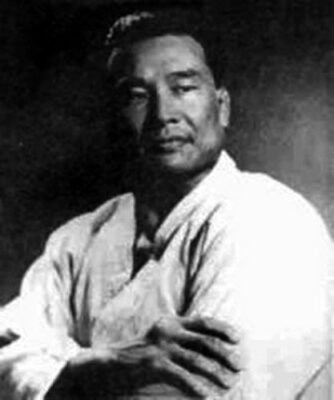
MASUTATSU OYAMA
THE FOUNDER OF KYOKUSHINKAI KARATE

Karate is a very popular martial art that also has many styles and forms out of which Kyokushin stands for one of the most effective. 

Kyokushin is the first full-contact bare-knuckle karate that was designed to make it realistic, created by Masutatsu Oyama in the 1960s in Japan. It focuses on close-range fighting where karatekas utilize kicks to the head, body, and legs as well as punches to the upper body area below the neck.

It is widely regarded as a brutal karate system where students and competitors perform bare-knuckle fighting without wearing any protective gear. Keep reading this article to learn more about Kyokushin karate. We will explain its history and what makes it one of the physically hardest martial arts.

What is Kyokushin Karate?

Kyokushin is a full-contact style of karate developed in the 1960s in Japan. The name translates to “ultimate truth” and its origins come from two main karate styles Goju-Ryu and Shotokan.

The history of Kyokushin begins in the 1950s when a famous karateka Mas Oyama decided to design a new style of karate. While most other styles emphasize light contact and focus on the point fighting rules, Oyama had a different concept in mind. His main goal was to create the first full-contact karate system that would be more realistic and effective than other styles.

Mas Oyama
Photo by Osufelipekl

The final result of his work was a style that focuses on:

  • Kicks (low kicks, body kicks, head kicks)
  • Punches to the upper body area below the neck
  • Knee strikes
  • Hard methods of training and a lot of full-contact sparring
  • Striking without wearing gloves or shin pads
  • Aggression, power, speed, and damage

In 1953, Oyama decided to open up his own dojo in Tokyo. He used his dojo to train new instructors and promote his new version of karate. In the following years, his dojo would gain a reputation for being one of the hardest schools in Japan. Students used to spar really hard and injure themselves constantly as a result. The concept and training methods were physically more demanding and brutal than in any other karate style at the time, and Kyokushin quickly rose to prominence.

The biggest moment came in 1964 when Oyama decided to found the “Kyokushin Kaikan”, an official organization. This also marks the birth of Kyokushin as an official style of karate, and from then on, Oyama would focus on expanding it in all parts of the world. By the end of the 1960s, Kyokushin was already a well-established style of karate, and in 1969, the world witnessed the first “All-Japan Full Contact” tournament.

What Are the Advantages and Disadvantages of Kyokushin Karate?

Training in Kyokushin karate has many advantages both when it comes to overall health and teaching a person how to fight in real life. But on the other side, there are more than a few disadvantages you should be aware of if you are thinking about enrolling in this style of karate. Here is a brief look into the pros and cons of Kyokushin karate.

Advantages of Kyokushin training:

  • A lot of sparring
  • Training without the safety gear (in most schools)
  • Self-defense skills

Hard sparring

Sparring is often seen as one of the best training methods for teaching a person how to apply martial art techniques in real combat. Knowing this, Mas Oyama put a lot of focus on this aspect of training while designing Kyokushin. In fact, he went even further by allowing students to spar without the gloves or shin pads.

Sparring is a part of training where two students exchange strikes while trying to simulate a real fight. You can’t expect to learn how to stay calm in a fight, judge distance, develop timing, and hit the target without many rounds of sparring. This is why Kyokushin students spend a lot of time doing all types of live drills and full contact sparring sessions. In fact, there are dojos where students spar every single day.

Training bear knuckle and without wearing shin pads

You can look at this as both advantage and disadvantage when it comes to Kyokushin training. Although hitting the heavy bag, pads and even sparring without the gloves sounds brutal (and it is), this method of training has many benefits.

For instance, boxers or Kickboxers are not trained to punch or block a strike without hand wraps and gloves. That’s why they often break their hands in a real fight because you can’t punch the same way and use the same force with and without the gloves. 

Kyokushin students know how to punch and how much force to use to not hurt their legs and hands. Their pain tolerance is also much higher simply because their bodies and minds are conditioned to absorb bare-knuckle shots. This gives them a big advantage in a real fight on the streets.

But it’s worth pointing up that, in modern times, more and more schools are starting to accept gloves and shin pads. 

Solid self-defense skills

All the skills and techniques you learn in Kyokushin are practical and may help you get out of trouble. But bear in mind that the system is not as technically advanced as some other striking arts like Muay Thai. Still, sparring all the time without wearing safety gear and learning how to mix kicks and punches to strike at a distance or close range will improve your self-defense abilities a lot. Above all, it will train your mind not to panic, and you will develop solid striking skills and automatic reactions.

Disadvantages of Kyokushin training:

  • Serious injuries
  • The lack of punches to the head and kicks below the waist
  • Katas

Serious injuries

Kyokushin training is cardio intense and it is very hard on your body. Training hard each day and sparring without the safety gear while throwing full power shots is an ideal recipe for serious injuries. If you are thinking about joining the classes you have to accept the fact that you are going to wake up every single day in a lot of pain. Serious injuries like rib, leg, wrist, knuckle, and finger fractures are quite common, along with concussions.

The lack of punches 

Kyokushin doesn’t teach you how to throw punches to the head as you can punch only the body area below the neck.

Pre-arranged forms (katas)

Like all other karate styles, Kyokushin also includes katas where students spend a lot of time doing pre-arranged moves alone. Although doing katas has some benefits, it doesn’t have much to do with preparing for real fighting.

LEARN MORE
Get the full report on Which Martial Art Has The Most Injuries?

Is Kyokushin Karate Effective for Self-Defense in Street Fights?

Kyokushin karate is very practical for self-defense as it teaches you a lot about the physical and mental aspects of real combat. In the end, Mas Oyama designed Kyokushin to be more effective in real-life combat than any other style of karate. Each technique you learn works in real life and may help you defend yourself and escape from trouble.

In training, students spend a lot of time sparring without wearing any gear. First, hard sparring trains your mind to stay calm, and it allows you to develop automatic reactions, feeling for distance, and timing. These are the crucial skills when it comes to any type of fight.

Next, all those hard bare-knuckle blows would make you both physically and mentally strong, and improve pain tolerance. Last but not least, you will develop solid footwork, kicks, and punches and learn many techniques that are highly effective, notably at close range.

The biggest downside of Kyokushin is the lack of punches to the head. You won’t learn how to properly block or evade punches, and attack using your hands, which is the main reason why it is not among the best martial arts for self-defense, but it is worth learning. 

Kyokushin Karate competitions

Is Kyokushin good for MMA?

Although Kyokushin is a full-contact martial art that has many benefits, it is quite limited when it comes to MMA fighting. If you are looking to develop a strong base and switch over to MMA after a couple of years of training, then there are better options like Muay Thai, or boxing.

Kyokushin is an effective martial art and some of its elements transition well to MMA. This is notably true when it comes to kicking techniques, footwork, angles, and fighters’ ability to sustain punishment. But on the other side, the cons are much bigger than the pros, and here is why.

Kyokushin is limited in the technical aspect of MMA because it doesn’t allow punches to the head. In training, you won’t learn much about how to block punches, dodge/slip, and counter.

Since they don’t have to deal with punches, Kyokushin fighters in MMA all have a bad habit of keeping their hands low and leaving their chin exposed. Due to the lack of guard, they often get struck on their feet in MMA. Not to mention the lack of grappling and ground fighting.

To sum it up, Kyokushin represents a solid base for MMA, but it is far from being the best or ideal.

RECOMMENDED FOR YOU
Is Taekwondo Effective for MMA Fighting? Full Analysis

What is the Difference between Kyokushin vs Shotokan?


Kyokushin karateShotokan Karate
History and originsTime and place: 1964, Tokyo, Japan
Founder: Mas Oyama
Origins: Shotokan and Goju-Ryu
Time and place: 1928, Okinawan Islands, Japan
Founder: Gichin Funakoshi and Yoshitaka Funakoshi
Origins: Shorei-Ryu and Shorin-Ryu
Techniques– Kicking above and below the waist.
– Punching the upper body area, below the neck.
– Knee strikes.
– Blocks.
– Different types of stances.
– Punches to the body and head.
– Kicks to the body and head.
– Knee strikes.
– Elbow Strikes.
– Various types of trips and throws.
Protective gear*Kyokushin karatekas do not wear gloves or shin pads.– Headgear
– Padded gloves
– Shin Pads
– Mouthguard
– Groin cup
Concept and emphasisKyokushin is the first full contact style of karate where the emphasis is on pressure, power, and causing damage or knocking the opponent out with each kick or punch.

Traditional form of Shotokan karate focuses a lot on the self-defense aspect.
However, modern practice puts too much emphasis on competition, fighting under point fighting rules, and light contact.

What is the difference between Kyokushin vs Muay Thai?


Kyokushin karateMuay Thai
HistoryTime and place: 1964, Tokyo, Japan
Founder: Mas Oyama
Origins: Shotokan and Goju-Ryu
Time and place: 19th century, Thailand
Founder: /
Origins: military combat system called “Muay Boran”. 
Techniques– Punching the upper body area below the neck
– Kicking both above and below the waist including the head
– Knee strikes
– Blocks
– Kicking above and below the waist
– Punches to the body and head
– Knee strikes
– Elbows to the body and head
– Trips, throws, and sweeps
– Fighting in the clinch
Concept and emphasisKyokushin is a full contact karate style that embraces a hard method of training. It focuses primarily on hard kicking and fighting at close range without any gear.Muay Thai is a combat sport that focuses on striking using all limbs as weapons. The emphasis is on hard kicks, and fighting in the clinch utilizing brutal elbow and knee strikes. 
Protective Gear*Kyokushin karatekas do not wear gloves or shin pads.– Full padded boxing gloves
– Groin cup
– Mouthguard
– Shin pads (only in training)

What is the difference between Kyokushin vs Taekwondo?


Kyokushin KarateTaekwondo
HistoryTime and place: 1964, Tokyo, Japan
Founder: Mas Oyama
Origins: Shotokan and Goju-Ryu
Time and place: 1950s, South Korea
Founder: Choi Hong Hi
Origins: various Chinese martial arts, karate and Taekkyon. 
Techniques– Kicks (low and high)
– Punching the torso area below the neck
– Knee strikes
– blocks
– Dozens of different kicks
– Punching to the upper body are below the neck
– Knee strikes (traditional form)
– Elbow strikes (traditional form)
– Trips and throws (traditional form)
Concept and emphasisAs a full contact karate style, Kyokushin emphasizes hard kicks and direct punches to the chest, and fighting at close range. Kyokushin karateka compete and train without any gear, not even gloves. Taekwondo puts a lot of emphasis on all types of kicks while punches are seen as a secondary weapons. Although a traditional form is more versatile, the modern practice focuses too much on competition and point fighting. 
Protective gear*Kyokushin karatekas do not wear gloves or shin pads.– Headgear
– Gloves
– Hand wraps
– Chest protector Foot protector
– headgear
LEARN MORE
Still curious? Click here to learn about Karate vs. Taekwondo: Key Differences And Similarities

Related Questions

Do many schools teach Kyokushin Karate?

Yes, Kyokushin is one of the most popular styles of karate. Kyokushin schools(dojos) are spread all across the world and just about every town has at least one school. Yet, bear in mind that the methods of training, progress, intensity, safety and many other aspects vary between the schools and even countries.

For example, some schools allow students to wear gloves and shin pads in sparring, while the other don’t. Or the promotional criteria might be strict in one school, and weak in the other. 

Is Kyokushin Karate hard to learn?

Yes, Kyokushin karate training is very hard both physically and mentally. Most schools embrace a hard method of training where students spar on a daily basis. Like that is not hard on your body enough, students do not wear any protective gear, so minor and severe injuries are quite common. They also do a lot of grueling cardio and strength workouts to condition their bodies to sustain all of this punishment. When it comes to injuries, the only good thing is the fact that there are no punches to the head.

Further, Kyokushin includes a belt ranking system and the progress is quite slow. On average, students need around 4–5 years to reach a black belt rank, but the exact time you will need depends on many factors.

RECOMMENDED FOR YOU
Is BJJ Hard To Learn? A Guide For Beginners

What are the different styles of karate?

Karate is a martial art that has dozens of different styles and forms which many people outside of the karate world find a bit confusing. However, the crucial thing to remember is that there are four main styles of karate. The following four styles are seen as the original styles developed in the Okinawan Islands:

  • Shotokan Karate
  • Wado-Ryu
  • Goju-Ryu
  • Shito-Ryu

Other Karate styles that are derived from these four main styles are:

  • Kyokushin
  • Uechi-Ryu
  • Enshin
  • Shoring-Ryu
  • Shito-Ryu

Is Jeet Kune Do Same As Kung Fu? – A Simple Comparison

0
Yip Man(left) and Bruce Lee(right) practicing Kung Fu

The martial arts world can be confusing with all the varieties of styles and combat techniques out there! Some martial arts are hybrids of different styles while others are traditional, with centuries of history. Jeet Kune Do(JKD) and Kung Fu are two popular martial arts styles but are there any similarities in the styles?

Jeet Kune Do is not the same as Kung Fu. There may be some similarities in some of the techniques, but this would be due to Jeet Kune Do including techniques from a variety of martial arts. The two styles have a different focus, intent, and philosophies that set them apart.

Jeet Kune Do and Kung Fu have some similarities in certain techniques, but the technique is not the sum of a martial art. Philosophy, intent, and a holistic approach to personal development are aspects of the fighting styles that must also be factored into their comparison. Jeet Kune Do and Kung Fu are still popular today, but which one would be the best combat art for you?

What Is the Key Difference Between Jeet Kune Do and Kung Fu?

Kung Fu and Jeet Kune Do, or JKD, are both martial arts, but some fundamental differences exist, including the definition and concept behind the styles.

Jeet Kune Do began as a philosophy and a collection of ideas by famed martial artist Bruce Lee. The philosophy was that traditional martial arts were restrictive in the rules applied to the styles and limited by being exclusive.

Jeet Kune Do was born out of this philosophy, and the intent was to create an effective, no rules, self-defense form of martial art that would be useful in the real world rather than in competition.

Bruce Lee took the good points from a number of fighting styles, including Wing Chun, a form of Kung Fu, and adapted and incorporated these techniques into his own style.

Kung Fu is an umbrella martial arts term that incorporates a number of Chinese fighting styles. Kung Fu styles were generally developed by monks as a form of exercise, spiritual enlightenment, and self-defense.

Kung Fu incorporates spirituality into the fighting style and encompasses the concept of only doing enough to disable your opponent rather than destroy them. Kung Fu styles also have rules and discipline in the way techniques are executed.

Jeet Kune Do is an adaptive style that allows you to adapt techniques to your stature and physique while maintaining the effectiveness of the moves. JKD does not include any religious or spiritual development, but the focus is rather on an efficient and effective self-defense style that can adapt to the threat of an attacker.

Is Jeet Kune Do Better Than Kung Fu?

Whether JKD is better than Kung Fu will depend on your reason for studying martial arts. If you are interested in a martial art style that trains the body, mind, and spirit, Kung Fu would be more rewarding for you. On the other hand, if your focus is to learn self-defense techniques, Jeet Kune Do would be the preferred style.

Jeet Kune Do and Kung Fu were both developed for self-defense purposes, but the attitude behind the techniques is different. Kung Fu will teach you techniques that will help you in self-defense and will be effective, but it limits you to only Kung Fu techniques.

Jeet Kune Do teaches you to take useful fighting techniques from any martial art, adapt them for your own purposes, and incorporate them into your fighting style.

Due to the philosophy of JKD, this would be the better martial art to learn for effectiveness and great self-defense-focused techniques.

What Is Bruce Lee’s Style Of Kung Fu?

Bruce Lee’s introduction to martial arts was through the Kung Fu style Wing Chun, which he learned as a young man in Hong Kong.

Since Wing Chun was Bruce Lee’s main fighting style, it stands to reason that Jeet Kune Do was heavily influenced by this style. However, the moves are not strictly Wing Chun but rather adapted from this style to be more efficient and in keeping with the philosophy of JKD.

Jeet Kune Do vs Wing Chun – Which Is Better?

Wing Chun is a flowing, smooth style specializing in close quarters inside fighting techniques. The liquid or flowing nature of the style often creates unnecessary movement and waste of energy.

Wing Chun is a closed form of martial arts which does not incorporate new techniques from other combat styles and teaches its techniques within a set of rules and guidelines for the correct form of the techniques.

Jeet Kune Do is better than Wing Chun from the perspective that it is an adaptive style that takes effective techniques from a variety of fighting styles and tweaks them for effectiveness in real-world scenarios for self-defense.

The focus in Jeet Kune Do is less on form and more on the effectiveness of the techniques for real-world street-fight application.

LEARN MORE
Check out our extensive Is Jeet Kune Do Effective? Here’s a Closer Look

Is Jeet Kune Do Better Than Karate?

Karate is an effective fighting style, but it is confined by rules and boundaries that limit the style to the defined moves and techniques used as part of the style while JKD is an adaptive style of fighting. Neither is better than the other because they are two different styles with two different philosophies.

What Kind of Martial Art Is Jeet Kune Do?

Jeet Kune Do has its foundation in Wing Chun, but it only incorporates techniques from this style that Bruce Lee considered suitable for defense in a street fight scenario. While the foundational techniques are from Wing Chun, many other martial art techniques are included in JKD.

The philosophy of JKD is to incorporate the useful components of other martial arts and adapt them to your needs.

Consequently, Jeet Kune Do includes techniques from Judo, Karate, Wrestling, Boxing, various Chinese Kung Fu styles, and even European fencing techniques. 

Jeet Kune Do is not a static martial art, and as such, it is constantly changing and adapting to include useful techniques from a wide variety of combat styles.

Students of JKD are encouraged to evaluate other styles and incorporate the good self-defense components into the style without the rules and complications of tradition to make the techniques useful in real-world situations.

RECOMMENDED FOR YOU:
Is Krav Maga A Martial Art? – Most Asked Questions

Why Did Bruce Lee Create Jeet Kune Do?

Bruce Lee created Jeet Kune Do because he found traditional martial arts limited in the strict traditions and rules imposed on students. 

Most other martial arts are closed styles and do not allow the incorporation of techniques from other fighting styles into the traditional art.

Bruce Lee saw this as a shortcoming for most traditional martial arts, particularly from the perspective of comprehensive techniques for self-defense.

JKD does not follow any of the rules imposed by the traditional arts or rules imposed by martial arts focused on competition.

Is Jeet Kune Do Allowed In UFC?

Jeet Kune Do does not focus on competition as an aspect of the art and consequently does not adhere to the rules imposed on fighters in a ring.

Techniques from Jeet Kune Do are allowed in UFC as long as they fit within the rule structure imposed by the governing body. 

The philosophy of JKD does not fit within the regulatory framework of UFC and therefore is not allowed in UFC.

RECOMMENDED FOR YOU:
Why Are There No Kung Fu Fighters in MMA? Key Reasons Explained

Did Jeet Kune Do Inspire MMA?

The philosophy of JKD to include techniques from multiple disciplines coincides with the philosophy around mixed martial arts.

Clouse, R. (Director). (1973). Enter the Dragon [Film]. Warner Brothers Pictures.

This concept of techniques from multiple combat fighting styles being used by a fighter in a single fight was part of the inspiration for MMA.

Consequently, Bruce Lee was seen as a visionary for this concept and is often considered to be the father of MMA.

LEARN MORE
Check out our article on How Would Bruce Lee Do In MMA Fighting? (BEST Explained)

Does Jeet Kune Do Have a Belt Ranking System?

Official Jeet Kune Do training does not offer a belt grading system for students. The reasoning behind this is that the style is for self-defense rather than competition.

Belts are awarded in other martial arts disciplines so that students of similar skill levels are paired for competitions.

Since JKD is not designed for competition, a belt grading system is not relevant to learning the martial art. Some dojos offering JKD training have instituted a belt grading system to become similar to other mainstream martial arts, but this is not the philosophy of the original form.

RECOMMENDED FOR YOU:
Karate Belt Ranking System – EASILY Explained For Beginners

What’s Bruce Lee’s Fighting Style?

Bruce Lee started his martial art training with Wing Chun, a form of Chinese Kung Fu. The foundations of this style formed the basis of his fighting technique. 

Bruce Lee trained in a number of different martial arts and found that one single art did not allow him full expression, which led to the development of his own fighting style, Jeet Kune Do or JKD.

Final Thoughts

Jeet Kune Do is not the same as Kung Fu, although it incorporates some techniques and moves that resemble some Kung Fu techniques.

Jeet Kune Do is not only a fighting style but a philosophy that allows for the adaptation of techniques from other styles into a fighting style focused on effective self-defense.

How Does Scoring Work In UFC? –  Here’s a Simple Explanation

0
ChinaImages/Depositphotos.com

UFC judges and the way they score fights have always been one of the hottest topics in MMA circles. Their job might look simple and you may think that can do a better job than UFC judges. But in reality, scoring UFC fights is actually a really, really tough job. Let’s start with the fundamental question: how is the UFC fight scored?

There are three judges in the UFC who score each round of the fight individually using a 10-point scale. The fighter who wins each round gets 10 points, and the other fighter gets 9, 8, or even 7 points that judges will rarely give.

To determine the winner of the round, they use the following three criteria (in this order):

  1. Effective striking/grappling
  2. Effective Aggression
  3. Ring/Cage control

Sounds simple, right? Well, why do we have so many controversial decisions then? Keep reading this article to find out more about how UFC scores work, different types of decisions, and much more.

How Do UFC Judges Score Fights?

Each UFC event involves 3 judges who sit at different places besides the cage, and their main job is to score the fight round by round using a 10-point must system adopted from boxing. After each round is over, they would pick the winner of the round, write the scores/points on the cards, and hand it to the official responsible for collecting scorecards. Once the fight is over, the officials would sum up all the scores from all judges and determine the winner. What criteria do UFC judges use to pick the winner?

Here are the three main criteria UFC judges are using in this order:

  1. Effective striking/grappling— is the first criteria judges are looking at when deciding the winner. They would look at who won more striking and grappling exchanges, and who did more damage in a round. Bear in mind that immediate damage is more important than cumulative damage. Or in other words, they would rather give the round to a fighter who scored a knockdown with a single power shot and nearly finished the fight, than to the fighter who did cumulative damage throughout the entire round.
  2. Effective aggression— judges use this criterion only in case both fighters were equal in the first criteria. In that case, the winner of the round would be a fighter who was more successful in attempting to finish the fight. But, chasing the opponent around the cage while absorbing damage and missing with your own strikes is not considered “effective”. 
  3. Fighting area control— is the last criteria that come into play only in case fighters are equal in the first and second criteria. This one is simple, the winner of the round is a fighter who controlled the center of the cage/ring, forcing their opponent to the outside position. 

Though these three criteria look simple and easy to use, it is not. Keep reading this article as we are going to explain the flaws of the scoring system in more detail.

RECOMMENDED FOR YOU:
How Do MMA Judges Score Fights And Why So Controversial Explained

How Do UFC Scorecards Work?

The UFC judges use a 10-point must system taken from boxing scoring system to score the fight round by round. The winner of the round gets 10 points while the loser gets 9, 8, or even 7 depending on how dominant the winner was.

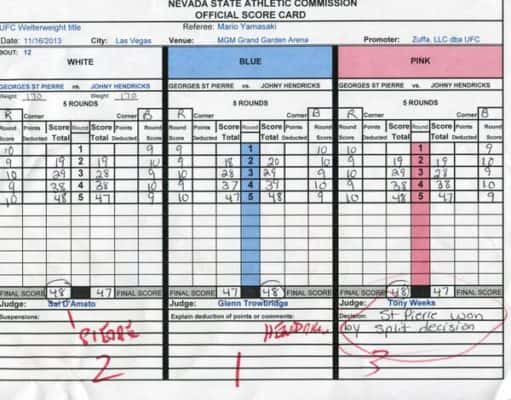
UFC Scorecard
  • 10–9 is the most common outcome of the round in MMA. This score indicates that one fighter landed more strikes, did more damage, or had won more grappling exchanges.
  • 10–8 is scored when one fighter had dominated the entire round. They might win the round 10–8 by dominating the opponent on the feet with strikes, doing huge damage and knocking the opponent down. Or by securing a strong top position early in the round and keeping the opponent on the bottom throughout the rest of the round while threatening with submissions and ground and pound. 
  • 10–7 is an outcome you won’t see that often in MMA. In fact, it happened only one time in the history of UFC when Forrest Petz faced Sammy Morgan at “UFC Fight Night 6”. This fight was one of the most one-sided bouts in UFC history. Petz won a 30-23 unanimous decision and one judge scored one of the rounds 10-7 for Petz. In theory, a fighter who had absolute control in the round and was close to finishing the fight on multiple occasions should be awarded 10-7.

After each round ends, the judges would take the official scorecards, write down the points, and give the paper to the official responsible for collecting the scorecards. Judges are not allowed to keep the scorecards or make changes after they submit the scorecards to the official. If a match ends in a decision, the official would sum up the scorecards from all three judges, and determine the winner of the match. Depending on how each judge scored the fight, here are the possible decision outcomes:

  • Unanimous Decision
  • Split Decision
  • Majority Decision
  • Draw
  • Majority Draw
  • Split Draw

UFC Decisions Explained

Here is a detailed explanation of all types of UFC decisions:

Unanimous Decisionwhen all three judges agree on which fighter won the match. Example: Chimaev vs Burns (29-28 Chimaev; 29-28 Chimaev; 29-28 Chimaev)
Split Decisionwhen 2 judges see fighter A as a winner, while the third judge has it for fighter B. Example: Volkanovski vs Holloway (48–47 Volkanovski; 48–47 Volkanoviski; 48–47 Holloway)
Majority Decisionwhen two judges agree on which fighter won the match, while the third judge saw the fight as a draw. Example: Hughes vs Nunes (28–28 Draw; 29–27 Hughes; 29–27 Hughes)
Split Draw when one judge scores the match for one fighter, the second judge scores for the other fighter, while the third judge scores the match as a draw. Example: Jourdain vs Culibao (30–27 Jourdain; 29–28 Culibao; 28–28 Draw)
Majority Draw when two judges agree that neither fighter won the match, while the third judge scores it for one of the fighters. Example: Woodley vs Thompson (48–47 Woodley; 47–47 Draw; 47–47 Draw)
Unanimous Drawwhen all three judges agree that neither fighter won the fight. Example: Gutierrez vs Durden (28–28 Draw; 28–28 Draw; 28–28 Draw)

Why Do MMA Referees Deduct A Point?

UFC fighters can lose 1 or 2 points in a match for committing fouls. In most cases, a fighter who lands an illegal blow or commits a foul during grappling would receive a verbal warning from the referee. But bear in mind that they can get away with a warning only in case the foul didn’t result in a serious injury. The most common fouls in modern MMA are eye pokes, groin strikes, grabbing the fence, or hitting the grounded opponent with a knee to the head.

If they repeat the foul, the referee will, in most cases, stop the action, and deduct a point. Once that round is over, the judges would determine the winner first, and then take one point away from the fighter who broke the rules. For example, if a fighter who committed fouls won the round 10–9, the final score would be 9–9 due to point deduction.

On paper, referees have the right to take 2 points in a round, but that rarely happens. At UFC on ESPN 5, for example, Darko Stosic got two points taken away for landing repeated kicks to the groin.

Why Are UFC Judges’ Scores so Unreliable and Inconsistent?

UFC judges and their decisions have always been one of the hottest topics in the world of MMA. But before you put the blame on the judges, bear in mind that the MMA scoring system adopted from boxing and criteria are not perfect by any means too. Let’s take a look at how the judges and the scoring system together contribute to controversial and unreliable decisions:

  • No room for error — most boxing matches include 12 rounds of action which allows the judges to get away with mistakes. If they made a bad call in one round, they have 11 left to get right and minimize the damage. In MMA, matches have just 3–5 rounds meaning that one bad call can destroy fighters’ chances of winning. There is not much room for bad calls or any errors if you are an MMA judge. Each mistake they make has a much bigger impact on the final result than in boxing, but yet, judges from both sports use the same scoring system.
  • MMA is more versatile and tougher to judge — boxing is much easier to score using a 10-point system. A boxer who lands more punches, do more damage, or scores more knockdowns wins the round. But in MMA, fighters strike with kicks, punches, elbows, and knees. They fight in the standup, clinch, and on the ground where they can also strike as well as attack with chokes and joint locks. Despite the “strict” criteria, it is much harder for an MMA judge to determine which fighter won the round, especially when the fight is chaotic and all over the place.
  • Subjective opinions — the three main criteria judges rely upon are not ideal by any means. There is a clear lack of standard, and a lot of room left for the judges to make subjective calls. For instance, a lot of judges value takedowns, hard blows, or submission attempts differently. One judge might think that a takedown is more important than five punches to the head, while the other one might have it vice versa. This is a perfect recipe for controversial calls.
  • More fights ending in a decision — last but not least, it’s worth pointing up that more fights are ending in a decision. UFC holds around 40 events per year with each event includes around 12–13 fights, and almost half of those end in a decision. This combined with the flaws within the scoring system and judges’ subjective opinions contributes to the increase of bad calls.

How Much Do UFC/MMA Judges Make?

UFC judges are appointed by the Athletic Commissions and they do not have a monthly salary like regular employees.  Instead, UFC judges are paid per event, and the exact amount depends on how reliable they are and consistent, and how big the event is. On average, they earn between $300 and $550 per event, while the most famous judges earn up to $900 per event, or even a couple of thousands when they judges highest PPV events. Although this doesn’t sound like a lot of money (and it isn’t), they are also allowed to judge other MMA events.

What Moves Are Illegal in UFC?

Here is a list of all the moves that are illegal in the UFC. Breaking the following rules and committing fouls may result in a point deduction, disqualification, or no contest:

Illegal strikes– fighters are not allowed to strikes the throat, spine, groin area, back of the head (rabbit punches), kidneys, or spine. Strikes like stomps and soccer kicks are also illegal, as well as hitting the opponent with the “12 to 6” elbow.

Grounded opponent rules — MMA fighters are allowed to fight on the ground. But, they are not allowed to blast the grounded opponent with a knee or kick to the head. They can throw kicks and knees to the body, but not to the head.

Dirty tactics — fighters are not allowed to poke or gouge eyes, use their fingers to pull the cheek (fish hooking), bite or head butt the opponent, or do any type of dirty moves.

RECOMMENDED FOR YOU:
What is Banned/Illegal in the UFC?

Different Types of Stoppages in MMA Explained

Knockout (KO)

Knockout (KO) is awarded when a fighter lands a legal strike to the head or body and their opponent falls down to the canvas either unconscious, heavily concussed, or in severe pain and are not able to continue. It’s worth pointing up that in MMA, fighters can also score knockouts while fighting on the ground too.

Technical knockout (TKO)

A technical knockout (TKO) win is awarded when the referee decides to stop the fight and prevent a fighter from absorbing unncessary damage. In most cases, they do this because the fighter is no longer capable of intelligently defending. Although still conscious, a hurt fighter might be heavily concussed and not capable of making rational decisions and this would trigger the referee to stop the fight to protect the fighter.

Corner stoppage

Fighters’ corner is allowed to stop the fight by throwing in the towel. The coaches can do this in the middle of the action when they decide that it is too dangerous for their fighter to continue. They can also stop the fight during the rest period between the rounds. Fighters also can decide to quit during a fight.

Medical stoppage

Each MMA event includes a ringside physician sitting beside the cage. If a fighter suffers a deep cut that causes severe bleeding or any other serious injury, the referee might decide to pause the fight and bring in the doctor to check whether the fighter is safe to continue or not. If a doctor determines that the injury is too severe and that it is dangerous for a fighter to continue, they would tell the referee to stop the fight. In that case, the outcome would be “Doctor’s Stoppage”, or “Medical Stoppage”.

LEARN MORE
Get the full report on Key Differences Between TKO and KO in MMA – Simply Explained

Related Questions

What is the difference between the MMA judge and the MMA referee?

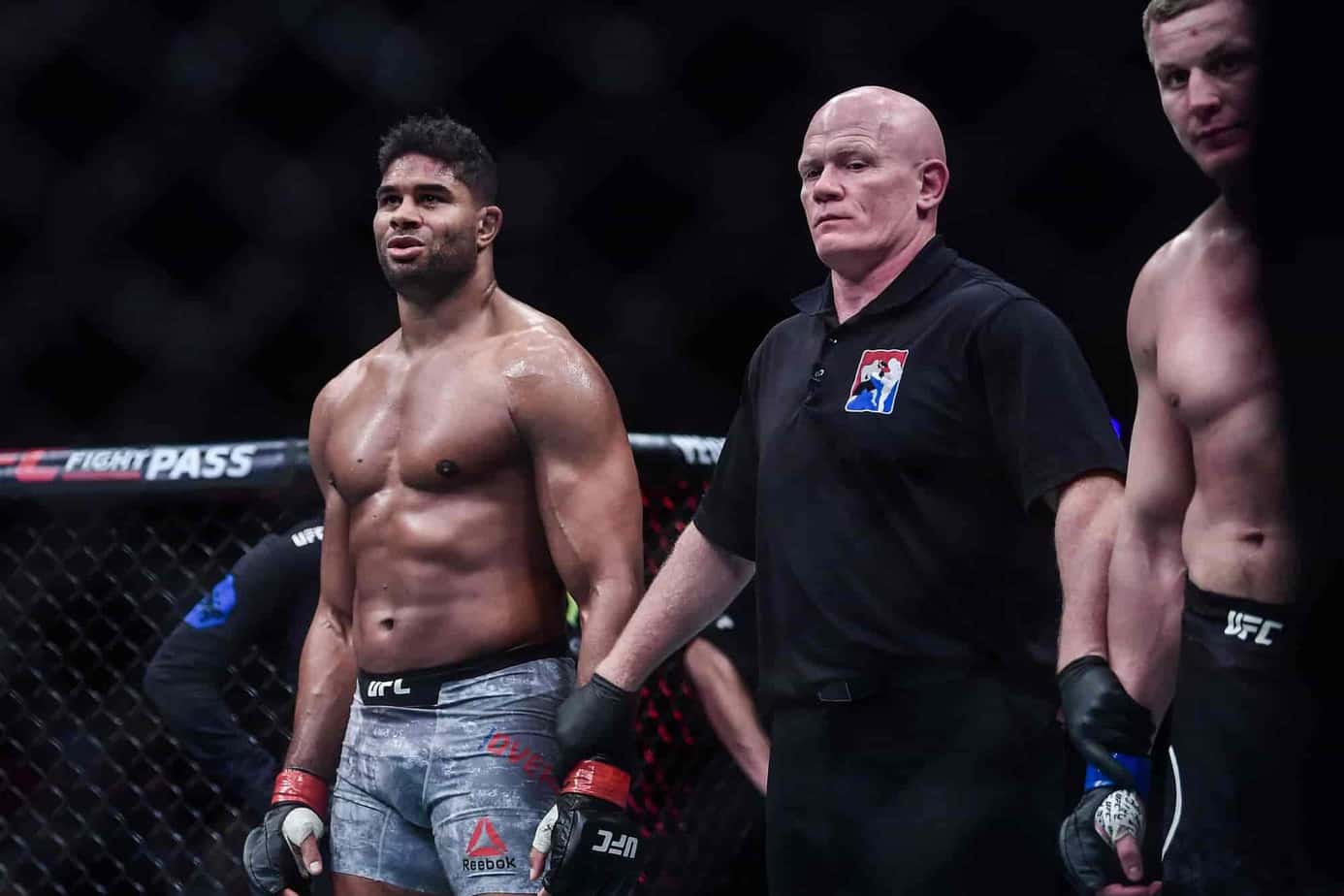
MMA referees are a third person inside the cage whose main job is to keep fighters safe, and enforce rules. They are operating inside the octagon and have the right to stop the fight at any given moment during the fight.

MMA judges, on the other side, sit beside the cage/ring and are responsible for scoring the fight round by round using a 10-point must system. They never have to enter the cage. But they have to cooperate with the referees during the fight, notably when it comes to point deductions.

Why would a fighter’s corner, instead of the referee, stop a fight?

The answer is very simple, sometimes, fighters are too tough for their own good. Most MMA fighters, notably the ones who compete in the UFC, are mentally very tough and have strong mental resistance. If you combine that with the adrenaline, aggression, and their inability to feel pain in the heat of the moment, you get a fighter who always want to continue fighting regardless of their physical condition.

Despite this is irrational, dangerous, and bad for their careers, most of them would rather get knocked out cold before quitting in the fight. That’s why the rules allow their coaches, who are in most cases their closest friends, to throw in the towel and stop the fight.

Is Taekwondo Worth Learning? Here’s What You Need to Know

0

Taekwondo(TKD) is a very popular martial art and combat sport that has been around since the 1940s. But due to the rapid rise of modern MMA and other styles like BJJ and Muay Thai in the last couple of decades, it seems like the arts like TKD are slowly fading into obscurity. But is this true? Is Taekwondo still worth learning?

Taekwondo(TKD) will always be worth learning because training improves your fighting abilities, as well as fitness and overall health. As a whole, if you commit yourself to TKD classes consistently, expect to become flexible, stronger, more agile, less aggressive, and overall, a better person.

The benefits of Taekwondo training are clear. But as you are going to see in this article, there is a reason why this Korean art is not as popular as it once was. Keep reading this article as we are going to explore all the pros and cons of TKD, and find out whether it is worth learning.

Is Taekwondo Worth Learning?

Yes, regardless if you are male or female, TKD training is beneficial for everyone. Here is a brief look into a list of reasons why Taekwondo is, and always will be worth learning:

Teaches solid self-defense skills

Taekwondo is a martial art created with self-defense in mind and early forms and methods of teaching used to be very practical for real-life fighting. The concept and emphasis have changed over time, but you can still develop solid fighting skills that can help you get out of trouble on the streets. 

One thing to consider is the fact that TKD is not an advanced self-defense system, and that it is quite limited in many areas. If you want to learn it just for self-defense, then there are far better options out there like Muay Thai, Krav Maga or MMA. That being said, the TKD skills you learn are more than enough for you to defend against a person who is not trained in martial arts.

Improves discipline and focus

TKD as a concept is versatile and includes a lot of techniques that are very hard to master. On top of that, it includes a belt ranking system and the promotional criteria are very strict in most schools. You must spend many years training hard to become proficient.

To achieve a black belt, you must set your goals, stay focused, be patient, and work hard. You won’t achieve anything without a high level of discipline and focus. This is one of the first lessons all students learn when they step into the Taekwondo dojo. 

Improves strength and cardio

Taekwondo puts a lot of emphasis on endurance. Classes are cardio intense, and students also do a lot of bodyweight strength exercises. Each session is a mix of aerobic and anaerobic workouts that will activate every single muscle in your body. Unlike in the fitness gym, these workouts allow you to improve both strength and endurance at the same time.

Throwing hundreds of kicks per class and doing all sorts of other drills with little rest will keep your heart rate high for as long as the class lasts. Over time, this method of training will make your lungs and heart much stronger, and improve overall cardiovascular health.

Increases flexibility

The main weapons in Taekwondo are kicks that all require a high level of flexibility. If you join the classes, expect to spend a lot of time stretching before and after each class, even at home to speed up the process. Over time, this will improve your range of motion, balance, and prevent many injuries.

Makes you happier and more confident

First of all, you will train in a group of 10–15 people and constantly interact with other students. This will improve your social and communication skills, and is an opportunity for you to meet some new friends. Next, training hard and going through all of those grueling workouts causes your brain to produce various happy chemicals like serotonin and dopamine. So instead of feeling angry or anxious, you will actually feel happy and relaxed after a workout.

In the end, as you are getting physically stronger, better at performing at techniques, and progressing through the ranks, the rise in confidence would naturally follow. You will have that feeling of accomplishing things that will give you wings to achieve anything you want in life.

RECOMMENDED FOR YOU:
Is Taekwondo a Sport? FAQ about Taekwondo

Why Does TKD Get A Bad Reputation?

Despite being a very popular martial art well spread all around the world and even a part of the Olympic games, there are still people who think that TKD is not worth learning. Here is a shortlist of reasons/myths why they think so:

  • Because it is ineffective– this is not true. Though there are other arts that are more practical in real life, TKD will boost your fighting abilities to some extent. The skills you develop would be more than enough for you to deal with the attacker with average skills on the streets.
  • Because it is dangerous– it is true, you can get hurt in training. But the risk is the same as in all other martial arts, and even sports like football for instance. It would be foolish to expect to not get hurt in a sport where you have to exchange punches and kicks on a daily basis.
  • It will make me or my child more aggressive— this is just another myth. TKD classes are great for kids because they will learn all about respect and how to avoid conflicts. They will train in a positive and friendly atmosphere where any type of bullying is not tolerated at all. And for last, physical exercise produces chemicals like serotonin which will make them feel happy and relaxed after a workout.

What Are the Disadvantages of Learning Taekwondo?

Although Taekwondo has many benefits, there are also more than a few cons you should be aware of before signing up.

Emphasis on competition

Back in the late 1950s, Taekwondo was founded as a martial art for self-defense and real combat. Early forms used to be more brutal and oriented towards the self-defense aspect until the competition became too popular.

TKD Competition

Over time, the entire emphasis of the art has moved towards the competition, so much that modern practices focus more on this aspect. Instead of teaching you how to fight, most schools will train you how to compete under strict rules. Some schools still use traditional methods of teaching, but you might have a hard time finding one. 

Difficult to apply in real life

First, TKD is pretty one-dimensional as it puts too much emphasis on leg strikes with limited punching. Second, training for competition is more important than self-defense in most schools. As a result, students rarely do any self-defense drills and even when they have time to do it, they get stuck doing forms, breaking boards and bricks which won’t teach them much about fighting. 

Yes, kicks are an effective weapon in a fight. However, you need space and time to throw kicks, which you won’t have in most street-fighting scenarios. In fact, most street fights take place at close range where you need to know how to punch, block strikes, use elbows and knees and even grapple and fight on the ground.

As a black belt, you will be capable of neutralizing a person who is not trained in martial arts. But you would look lost against the attacker who knows how to box, grapple, or is physically much bigger than you are. On top of that, you won’t learn how to deal with weapons or against multiple attackers. 

Not as popular among adults

Over time, TKD schools have become a very popular option among kids who want to learn martial arts. This means that you won’t see many young people in their early 20s joining the classes. Most adults choose to train in other, similar arts such as Muay Thai, Kickboxing, or Boxing, which are also more effective. So if you are an adult wanting to train in Taekwondo, you might have a hard time fitting in or finding a group to train with. Most of the adults in classes are actually black belts who have been into Taekwondo since childhood days.

Physical Injuries

TKD is a full-contact martial art that involves a lot of hard sparring where students often get hurt and sustain serious injuries. Next, the emphasis is on leg strikes, which are more powerful than punches and can cause more serious injuries like broken ribs, leg fractures, and concussions. Despite the fact that all students wear protective gear and are careful not to hurt each other, the injury rate is high. It’s not about whether you are going to get hurt in Taekwondo or not, it’s about when and how badly.

LEARN MORE
Get the full report on Which Martial Art Has The Most Injuries? FAQs

Disadvantages of TKD In a Street Fight

Training in taekwondo will provide you with solid knowledge and skills that you may apply in a real fight. But bear in mind that TKD is not the best option if your primary focus is on learning self-defense techniques. Here is a detailed look at why modern practice is not that practical in real life.

Taekwondo schools moved away from self-defense 

Modern schools focus too much on competition, winning matches, and tournaments. Students spend most of the time learning how to score points in a match, avoid fouls, and overall, obey the rules. They rarely do any simulations related to self-defense or drills where they can learn more about the physical and mental aspects of street fighting, as well as about the dangers that come with it.

Still, there are arts like boxing and Muay Thai that also teach you how to fight under the rules. But why these systems are more effective than Taekwondo then? Well, to understand this, you must take a deeper look into the rules of TKD.

The rules make Taekwondo ineffective

The following are the rules of the TKD competition that clearly limit your abilities in a real fight.

  • Rules favor kickscontestants get twice as many points for landing a kick than for landing a punch. As a result, they spend the majority of their training time learning how to throw kicks while neglecting other aspects of the art. 
  • No punches to the headin competition, there are no punches to the head. Contestants can only land punches to the upper body area below the neck.
  • Point scoring format — the main goal in a TKD match is to score more points than your opponent to win a match. Each kick or punch brings you a certain amount of points and the key is to have more when the time expires.
  • No fluid action — the action resets after every point. Once a contestant lands a clean strike, the referee would stop the action, and give the fighter a point before continuing the match.
  • No aggressioncontestants do not have to throw kicks or punches with full force to win points because the focus is on technique and precision.

If you combine these rules with the fact that the concept of training in most schools is oriented towards competition, you get why TKD is not that practical in real life. In fact, the entire concept of Taekwondo competition is the total opposite of what you will face on the streets.

One-dimensional approach

On paper, TKD is a versatile system that teaches you how to use all limbs as weapons to strike with punches and kicks, elbows and knees, and even grapple. In reality, however, the emphasis is on leg strikes, while punches are seen as a secondary weapon. Yes, kicks are effective in real fighting and cause the most damage, but fighting mostly with kicks will severely limit your ability to defend yourself against different types of strikes.

Lack of defense (guard and blocks)

Since there are no punches to the head in competition, students rarely learn any blocks or other drills on how to avoid punches to the head. Compared with Muay Thai fighters or boxers, they have terrible head movement, no guard whatsoever, and have a tendency to keep their hands low beside their bodies. If you look at MMA fighters who have a strong base in TKD, they all have this bad habit of keeping their chin up in the air and hands low. 

Forms (katas) and breaking boards

TKD training includes a lot of pre-arranged forms where students practice techniques alone. Though this method has some benefits when it comes to muscle memory and putting your mind into some type of meditative state, it won’t improve your fighting abilities. The same stands for breaking boards and bricks that visually look amazing and even intimidating, but these things do not have much in common with real fighting.

Taekwondo vs Karate  – What’s the Difference?

Though they may look similar at first sight, Taekwondo and Karate differ a lot in just about every aspect. Here is a detailed look into all the differences:


TaekwondoKarate
HistoryTaekwondo emerged in the late 1940s in South Korea. Its origins come from various arts such as Taekkyon and Chinese martial arts.Karate comes from the South Okinawan Islands in Japan and its origins go all the way back to the Ryukyu Kingdom in the 19th century. 
DerivationTaekwondo translates to “the way of the foot and fist”The word karate means “empty hands”.
Styles and FormsInternational Taekwondo Federation (ITF) World Taekwondo Federation (WTF) American Taekwondo Association (ATF)Goju-Ryu Wado-Ryu Shotokan Shito-Ryu Kyokushin
Emphasis and conceptTaekwondo puts a lot of emphasis on kicking as its founders believed that kicks are longer and more powerful weapons than punches. Most karate styles focus on mixing kicks and punches with quick footwork. But it is fair to say that most dojos actually favor punches over kicks. 

Final Thoughts

Taekwondo is an excellent choice for anyone looking for good health, a challenging workout, and/or a basic foundation in self-defense.

TKD is open for all races, genders, and people of all ages. However, bear in mind that training can be hard on your body and cardio intense. As such, people at the age of 50 or 60 might have a hard time dealing with the intensity of classes, and stay away from injuries. As a result, you won’t see many older adults joining the classes, and in some way, the same stands for the mid-aged adults as well.

Most people who are in their early 20s are far more likely to enroll in Muay Thai, BJJ, or MMA classes. The first reason is the fact that these systems are far more practical in a street fight than Taekwondo is. Second, not all people at this stage in life are into wearing a gi uniform, doing katas, breaking boards, and learning about history and tradition. Modern boxing or Muay Thai gyms are adapted to the modern lifestyle, and with that, suit better this age group.

That being said TKD classes are actually most popular among children as their first introduction to the world of combat sports. Training is safe, playful, and has tons of physical and mental benefits that support their growth.